
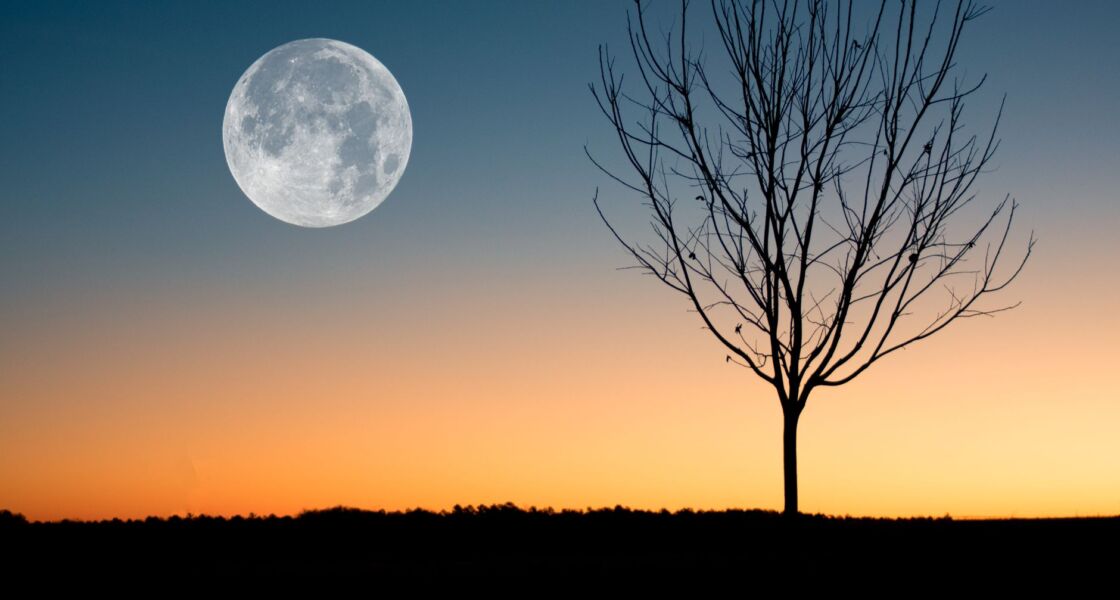
You have probably seen it. A huge, golden Moon sitting just above the rooftops, so big it looks close enough to touch. An hour later it has shrunk to a small coin high in the sky. Here is the surprise: the Moon did not change size at all. Your brain did.
This is the Moon illusion, and people have been puzzled by it for thousands of years. The strangest part? Scientists still cannot fully explain it.
The Moon Never Actually Grows
When the Moon hangs low near the horizon, it can look enormous. But the Moon is the same width down low as it is high overhead. NASA says it plainly: the Moon’s seeming bigness is “an actual illusion, rather than an effect of our atmosphere.” In other words, it is all in your head.
If anything, the low Moon is a touch farther away, not closer. When the Moon is on the horizon, you are seeing it across the whole width of the Earth, which adds a little distance compared with the Moon straight above you. So the “giant” Moon is, if anything, slightly smaller in the sky, not bigger.
The Moon’s orange or yellow color near the horizon is a separate thing. That warm glow comes from sunlight filtering through more of our air. But the color change and the size trick are two different stories. The illusion is not caused by the air bending or scattering light at all. NASA is clear that it is not an effect of the atmosphere, which rules out the idea that our sky somehow magnifies the low Moon like a lens.
Prove It With Your Thumb
You do not need a telescope to test this. You just need one thumb.
The next time the Moon looks giant near the horizon, hold your arm straight out and cover the Moon with the tip of your thumb. Your thumb will blot it out. Hours later, when the Moon is high and looks small, try again. Your thumb covers it just the same. The Moon has not changed size one bit.
A camera settles the argument too. Take a photo of the Moon when it is low, then another when it is high. Line them up, and NASA says “you’ll find that the Moon is the same width, side to side, in both photos.” Your eyes were fooled. The camera was not.
So Why Does Our Brain Fall for It?
Here is where it gets wonderfully strange. The illusion is real and easy to see, but the reason behind it is still being debated.
The leading ideas start with the stuff on the ground. When the Moon is low, you see it next to trees, hills, rooftops and distant mountains. High in the sky, the Moon floats alone in a big empty dome with nothing to compare it to.
Those foreground objects seem to matter a lot. As NASA puts it, trees, mountains and buildings may “help to trick your brain into thinking the Moon is both closer and bigger than it is.” Your brain is used to judging size by comparing one thing to another. Give it a row of tiny faraway trees, and the Moon behind them suddenly looks huge.
There is a second twist. Scientists think the horizon also messes with how far away your brain believes the Moon to be. The Royal Observatory in Greenwich offers one version of this: during moonrise, the Moon looks bigger than it is because our brain does not understand that the sky is a dome, and it wrongly projects things near the horizon as larger than they really are.
From there the ideas split. The historically most popular explanation says your mind simply reads a more distant object as larger. A newer idea suggests that same sense of distance may even change how your eye focuses on the Moon. Either way, the clues on the ground seem to feed the illusion.
No single explanation has won the argument. The size trick may come from several of these things working together at once.
The Supermoon Is a Different Story
You may have heard of a “supermoon,” and it is easy to mix it up with the illusion. But a supermoon is a real size change, not a trick of the eye.
The Moon’s path around Earth is not a perfect circle. It is an ellipse, a slightly squashed loop. Each month the Moon swings to its closest point to Earth, called perigee, and its farthest point, called apogee. When a full Moon lines up with that closest point, we get a supermoon.
How much bigger is a supermoon, really? NASA says the Moon can look “up to 14 percent bigger at perigee than apogee.” The Royal Observatory in Greenwich adds that it can appear up to 30 percent brighter than a far-away full Moon. That is a true change, caused by real distance, not by your brain.
Here is the fun part. When a supermoon rises low over the horizon, the real size change and the illusion stack together. You are seeing the biggest version of the Moon your eyes will ever serve up, half fact and half beautiful trick.
Look for Yourself
So the next full Moon that looks impossibly big over the trees is not closer, and it is not larger. It is your own clever brain, fooled by a row of distant rooftops and a few thousand years of practice.