
Here is the strange truth behind a “shooting star”: it is not a star at all. It is usually a speck of comet dust, often no bigger than a grain of sand, burning up high in the sky.
And on certain nights every year, those specks arrive by the dozen. We call that a meteor shower, and the reason it happens on a schedule is one of the tidiest clockwork tricks in the sky.
What a Meteor Shower Actually Is
A meteor shower happens when Earth plows through a trail of dusty debris left behind by a comet, or in a few cases an asteroid. NASA describes it simply: showers occur as “the Earth passes through the trail of dusty debris left by a comet.”
Comets are icy, dirty snowballs that loop around the Sun. Each time a comet swings close, the Sun warms it and it sheds bits of rock and dust along its path. Over thousands of years, that path fills with a long, thin river of grit.
Earth travels the same loop around the Sun every year. When our orbit crosses one of those grit-filled rivers, we drive straight into it, and the sky lights up. The American Meteor Society puts it plainly: a meteor shower happens when Earth “passes through a stream of debris left behind by a comet or, in some cases, an asteroid.”
Because Earth reaches the same crossing point at the same time each year, the big showers show up like clockwork. The Perseids come in August. The Leonids come in November. The Geminids come in mid-December.
Meteoroid, Meteor, Meteorite: Three Words, One Journey
These three words sound alike, and they describe the same little rock at three different moments. NASA lays out the order.
A meteoroid is the rock while it is still out in space. They range in size from dust grains to small asteroids.
A meteor is what you see when that rock hits the atmosphere and burns up. The streak of light is the meteor, and “shooting star” is just the old nickname for it. No real star is involved.
A meteorite is the rare leftover: a rock that survives the fiery plunge and actually reaches the ground. Most never make it. NASA estimates that about 48.5 tons of this space material falls toward Earth each day, and almost all of it vaporizes in the air before it lands.
Why They Seem to Rain From One Spot
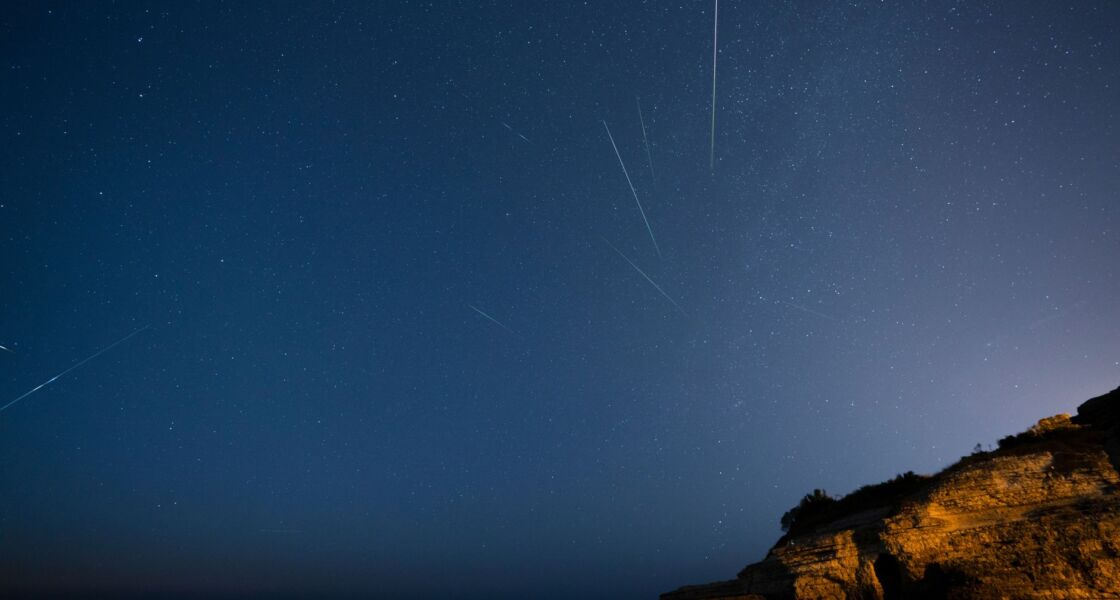
Watch a shower for a while and you notice something odd. If you trace the streaks backward, they all seem to shoot out from a single point in the sky. That point has a name: the radiant.
The meteors are not really fanning out from one place. They are all flying along nearly parallel paths, the way a straight stretch of railroad tracks runs side by side. But when parallel lines stretch off into the distance, our eyes make them appear to meet at a point. The American Meteor Society uses exactly that comparison: the trails “appear to converge, much like railway tracks meeting in the distance.”
That vanishing point is why the showers get their odd names. A shower is named for the constellation its radiant sits in. The Perseids appear to stream out of the constellation Perseus. The Leonids pour out of Leo. The Geminids spill out of Gemini.
One handy thing to know: you do not need to stare at the radiant. Meteors can flash across any part of the sky. The radiant is just the spot they all point back to.
Not Every Shower Comes From a Comet
Most showers trace back to a comet, but there is a famous oddball. The Geminids, the strong shower that peaks every year in mid-December, come from an asteroid, not a comet.
Their parent is a small asteroid called 3200 Phaethon, only about 3 miles (5 kilometers) across. It behaves so strangely, shedding material like a comet would, that NASA calls it a possible “rock comet.” Scientists are still working out exactly how an asteroid manages to leave a dust trail at all.
The Geminids are known for bright, fast meteors with a touch of yellow. They streak in at about 22 miles (35 kilometers) per second. Under a truly dark sky at the peak, NASA says you can expect to see around 40 to 50 meteors an hour.
How to Watch One (No Telescope Needed)
Here is the best part. A meteor shower is one of the few sky events where fancy gear only gets in the way.
The American Meteor Society says meteor showers “are best observed with the unaided eye.” A telescope or binoculars would zoom in on a tiny patch of sky, and meteors can appear anywhere, so you want to take in as much of the sky as you can.
The biggest thing that helps is darkness. Get away from streetlights and city glow if you can, or at least turn your back to the nearest lamp. Then give your eyes a while to adjust to the dark, and you will start to catch the fainter streaks as well as the bright ones.
After that, the method is almost too simple: lie back, look up at a wide piece of open sky away from trees and buildings, and wait. The hour or two before dawn is often the richest, because that is when your side of Earth is turning to face the oncoming debris head-on.
So the next clear night one of the big showers comes around, you already have everything you need. It is just you, a dark sky, and a river of ancient comet dust that Earth happens to be driving through.