
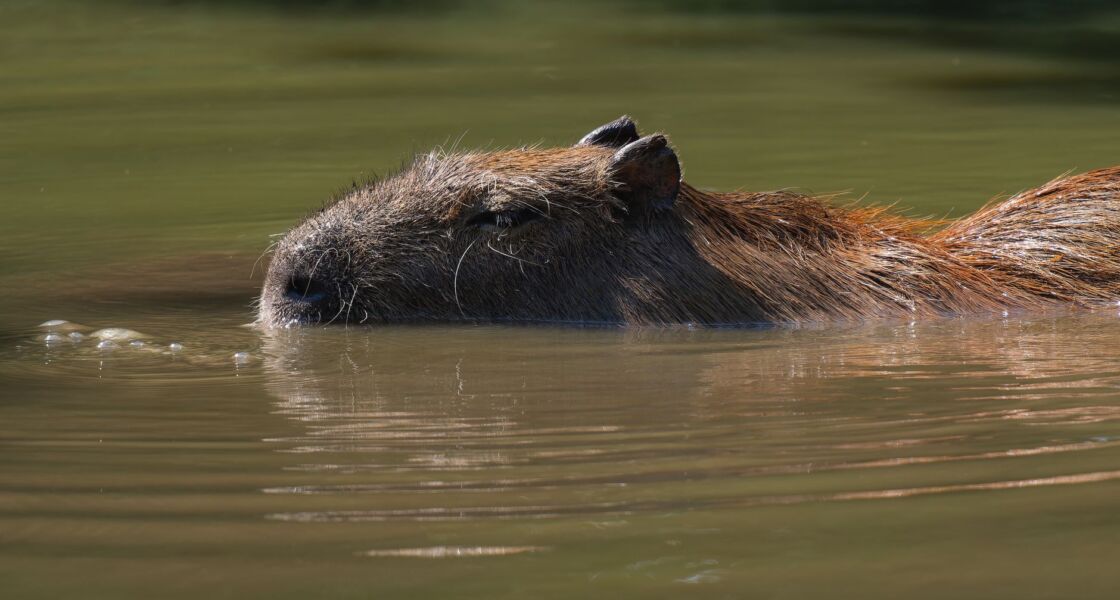
Meet the largest rodent on Earth. It can stretch about 4 feet long, can weigh more than 100 pounds, and can sit in the water with just its eyes, ears and nose sticking out. This is the capybara.
The Biggest Rodent on Earth
When you hear “rodent,” you probably picture a mouse. The capybara breaks that picture. An adult can reach about 4 feet (1.2 m) long and stand about 2 feet (0.6 m) tall at the shoulder. Most weigh somewhere between 77 and 143 pounds, and the USGS notes they can reach up to about 150.
It is still a rodent, though. Capybaras are close relatives of guinea pigs and rock cavies. They look a bit like a guinea pig that kept growing and never stopped.
They live across much of South America, from the northern part of the continent down through the central part. They are found in every South American country except Chile, and they are mostly missing from the mountains in the west. Their home is lowland country with plenty of water: rivers, lakes, swamps, marshes and seasonally flooded grasslands.
Built for Life in the Water
Capybaras are strong swimmers, and their bodies show it. Their toes are partly webbed for paddling. Their long, coarse fur is brittle, which helps it dry out quickly once they climb back onto land.
Now look at the face. The eyes, ears and nose all sit high on the head. That means a capybara can stay almost completely underwater while its senses stay above the surface, like a tiny periscope. It can keep watch for trouble while the rest of it cools off.
The water does more than cool them down. Researchers who tracked capybaras with GPS in Brazil describe water as a key resource that the animals use for staying cool, for mating and for escaping predators.
A Salad Bar With Two Helpings
Capybaras are grazers. They eat grasses and water plants, and the USGS says they pick plants with the highest protein they can find. Like all rodents, they have front teeth that never stop growing. Chewing tough plants wears those teeth down.
Grass is hard to digest, and capybaras have a clever workaround. In the morning, they eat some of their own droppings. At that time of day, the droppings are rich in protein because of the tiny microbes that digested the previous day’s meals. Eating them gives the food a second pass through the body, so the capybara gets more out of the same grass.
It is not pretty. But it works.
Life in the Herd
Capybaras are social. A herd can be as small as a pair, or a group of 15 or more, and National Geographic reports groups of up to 40. When floods or droughts come, the herd moves on. The USGS says a herd spends most of its time in a small patch of about 1 hectare (roughly 2.5 acres), because it needs water for drinking, dry land for resting and grassland for feeding, all close together.
Being a big, tasty animal brings some risks. Jaguars and pumas hunt capybaras on land, and caimans, a kind of crocodile relative, hunt them in the water. The young have even more to worry about. Snakes such as the boa constrictor, foxes, small wild cats and birds of prey all go after them.
So when are capybaras active? It depends. National Geographic says it can be day or night, and often dawn and dusk, shaped by the seasons and by where the predators are. Researchers in Brazil report that capybaras in the Pantanal wetland feed mainly during the day, while those in landscapes changed by people feed mostly at night.
Babies on the Move
A female carries her young for about 150 days, which is roughly five months. She usually has one litter a year, and a typical litter is around five babies, though it can range from one to eight. Capybaras do not build a nest. A mother simply finds cover to give birth.
The young grow quickly. At about a year and a half, when they weigh around 66 to 88 pounds (30 to 40 kg), they are old enough to breed.
In the wild, a capybara lives up to about 7 years, according to National Geographic, and the USGS reports they can live to around 12.
Capybaras in the United States
You will not meet a wild capybara on a US hike, but a few have turned up. National Geographic notes a small invasive population has been seen in Florida. The USGS says capybaras are kept as pets in the US, and that the Florida animals are thought to be escapees from a private home. Sightings have also been recorded in a few other states.
National Geographic lists the capybara as Least Concern on the IUCN Red List, with a stable population overall. Still, in some places, hunting for their skin has wiped out local groups.
All in all, it is a calm animal that likes water, grass and company. Not a bad plan for a day.