
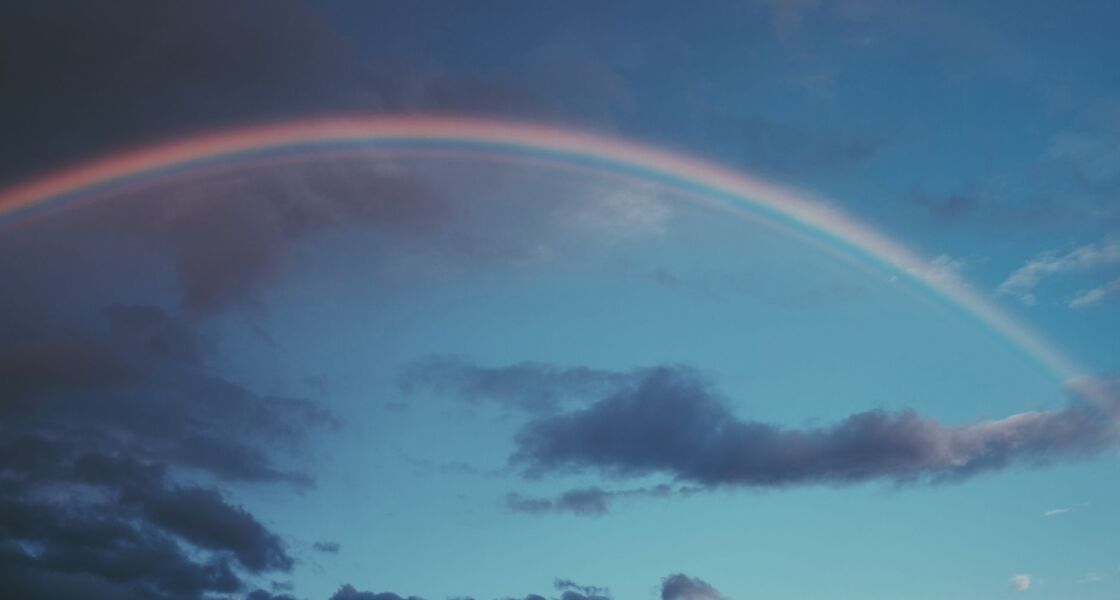
A rainbow needs two simple things at the same time: sunlight behind you and rain in front of you. Get those lined up, and the sky hangs a giant ribbon of color across the air.
But a rainbow is not really in the sky at all. It is a trick of light bending inside millions of tiny raindrops, each one a tiny glass marble splitting the Sun into its colors.
Sunlight Is Secretly Every Color
The light that pours out of the Sun looks white, but it is actually every color of the rainbow mixed together. More than 350 years ago, Isaac Newton proved this by shining sunlight through a glass prism and spreading it into a band of red, orange, yellow, green, blue, indigo and violet.
A raindrop can do the same thing a prism does. When sunlight meets a round drop of water, the drop pulls the white light apart into all its hidden colors. Line up enough drops and that split-apart light becomes a rainbow you can see from miles away.
The Three Things a Raindrop Does
Inside a single raindrop, sunlight goes through three steps in a blink. The first is bending. Light travels a little slower in water than in air, because water is denser, so the light bends as it crosses from air into the drop. Scientists call that bending refraction.
The second step is a bounce. The curved back of the raindrop acts like a tiny mirror, and the light reflects off it, turning back toward the way it came. The third step is another bend as the light speeds up and exits the drop into the air.
Here is the clever part. Not every color bends by the same amount. Violet light, which travels in the shortest waves, bends the most. Red light, with the longest waves, bends the least. So the colors fan out and leave the drop spread into a little spectrum. That spreading has its own name: dispersion.
Why a Rainbow Is an Arc
The spread-out light does not leave a raindrop in every direction. It comes back strongest at one special angle, about 42 degrees away from the point directly opposite the Sun. That fixed angle is the whole secret behind a rainbow’s shape.
Picture it this way. Every raindrop that sits at that 42-degree angle from your shadow’s head can send color to your eye. Those drops trace out the curve of a circle, and the band of color follows them. From the ground you usually see only the top half of that circle, so a rainbow looks like an arch.
It also explains why you have to stand with the Sun at your back and the rain ahead. And why the Sun has to be fairly low, less than about 42 degrees above the horizon, which is why rainbows show up most often in the morning or late afternoon rather than at high noon.
Red on Top, Violet on the Bottom
Because each color leaves the drop at its own slightly different angle, the colors stack up in order across the bow. In a normal rainbow, red sits along the top edge and violet runs along the bottom, with orange, yellow, green and blue filling the space between.
Red lands on top because red light bends the least and comes to your eye from the drops slightly higher in the sky. Violet, which bends the most, reaches you from drops a little lower down. The whole order follows from how much each color bent inside the water.
Why You Can Never Reach the End
Chase a rainbow and it keeps its distance, no matter how fast you run. That is because a rainbow is not an object sitting in one place. It is a pattern of light, and it depends entirely on where you are standing.
A rainbow has no fixed spot in the world, so it has no real end to reach. Move, and the whole rainbow moves with you, because a new set of raindrops lines up at that magic angle from your new position. Two people standing side by side are technically seeing two slightly different rainbows, each made from its own drops. The pot of gold, sadly, stays exactly as far away as ever.
Double Rainbows and the Flipped Twin
Sometimes a second, dimmer rainbow glows above the main one. A double rainbow happens when sunlight bounces around twice inside the raindrops instead of just once.
That extra bounce changes two things. First, it flips the colors. In the secondary rainbow, the order is reversed, with red on the bottom and violet on the top, a mirror image of the main bow. Second, the second rainbow sits higher, coming back at an angle of about 50 degrees instead of the 42 degrees of the primary.
The second bow is always fainter than the main one: a quieter, mirror-image twin that comes from light bouncing twice inside each drop instead of just once. The primary bounces once; the secondary bounces twice. The twin is real, just softer against the sky.
The Rainbow Belongs to You
So a rainbow is a team-up between the Sun, the rain and the exact place you happen to be standing. Three quick steps inside countless raindrops, bend, bounce and bend again, sort white sunlight into a ribbon of color aimed straight at your eye.
The next time one appears, remember that no one else sees quite the same one you do. That rainbow is yours alone, built just for the spot where you stand.