
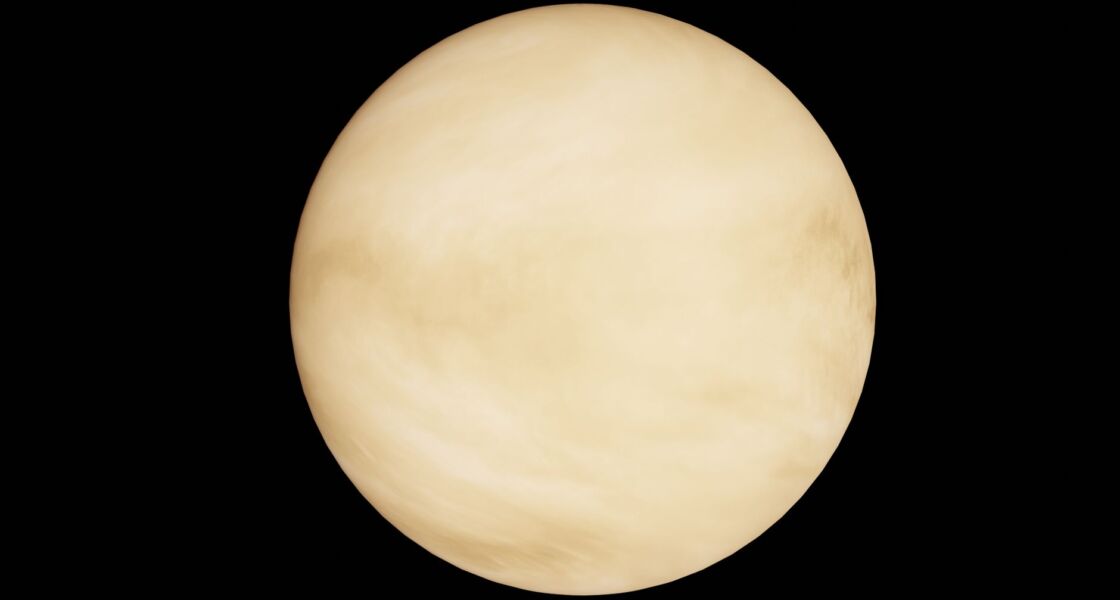
On Venus, a single day lasts longer than a whole year. The planet takes about 243 Earth days to spin around once, but only about 225 Earth days to loop all the way around the Sun.
Read that again. One turn takes longer than one trip around the Sun. Venus finishes its yearly lap before it finishes a single spin.
A Day Longer Than a Year
Here on Earth, the rules feel obvious. A day is one spin of the planet. A year is one full trip around the Sun. And the year is much, much longer, taking 365 of our days.
Venus flips that idea on its head. According to NASA, the planet rotates so slowly that one full turn, measured against the distant stars, takes about 243 Earth days. Its orbit around the Sun takes only about 225 Earth days.
So if you lived on Venus and counted birthdays by the orbit, you would reach a new year before the planet had even spun around once. On Earth we fit 365 spins into a year. Venus cannot fit even one.
It helps to picture two races. In the first, Venus tries to spin around a single time. In the second, it tries to circle the entire Sun. The lap around the Sun, the longer journey by far, crosses the finish line first.
Why So Slow, and Why Backward?
Venus is almost a twin of Earth in size, so you might expect it to spin at a similar speed. It does not. It turns at a crawl. A point on its surface moves slower than a person walking.
It also turns the “wrong” way. Most planets, including Earth, spin in one shared direction. Venus spins backward, the opposite way, which scientists call retrograde. Picture a merry-go-round that everyone agrees turns to the left, and then one single horse quietly turning to the right.
Scientists are still studying why. Venus is wrapped in a thick, heavy atmosphere, and the pull of the Sun and the heave of that air over billions of years are part of the puzzle.
The slow spin is hard to feel in numbers alone, so try this. On Earth, the Sun climbs the sky in a matter of hours and the day is done before you sleep. On Venus, a single turn against the stars stretches across about eight Earth months. A whole summer vacation could pass, twice over, inside one Venus spin.
The Sun Rises in the West
That backward spin changes the one thing every world seems to have in common: the sunrise. On Earth, and on almost every other planet, the Sun comes up in the east. On Venus it would come up in the west and go down in the east, because the planet turns the opposite way, NASA explains.
Imagine standing on the Venus surface, waiting for dawn, and facing the wrong side of the sky out of pure habit. The glow would build behind you. Every compass rule you learned about where the Sun appears would be turned around.
You would not actually see a clear, blue sky, though. Venus is wrapped in dense clouds, and its air is mostly carbon dioxide with clouds made of sulfuric acid, NASA says. The Sun would be a smeared brightness behind a thick, unbroken haze rather than a sharp disk you could point to.
The Day You Could Actually Watch
There is a twist worth knowing. The 243-day spin is measured against the far-off stars. But a day you would actually notice, from one sunrise to the next, is a different thing, because the planet is also traveling around the Sun while it slowly turns.
When you combine the slow backward spin with that orbit, the Sun returns to the same spot in the Venus sky about every 117 Earth days, NASA says. So on Venus the Sun can rise, cross the sky, and set about twice during a single Venus year, even though the planet has not finished one true spin.
Either way you measure it, the headline holds up. The planet’s actual rotation, one honest turn against the stars, takes longer than its year.
The Hottest Place in the Solar System
And this is no gentle, pleasant place to watch those slow sunrises. Venus is the hottest planet in our solar system. NASA puts surface temperatures at about 872 degrees Fahrenheit (467 Celsius), hot enough to melt lead.
Oddly, Venus is not the planet closest to the Sun. Mercury is nearer, yet Venus is hotter. The reason is the air. Venus is smothered in a thick blanket of carbon dioxide that lets sunlight in and then traps the heat, so warmth builds up and cannot escape. NASA calls this a runaway greenhouse effect.
The air is heavy as well as hot. NASA says the pressure at the surface is about 93 times the pressure at sea level on Earth, roughly what you would feel about half a mile deep in the ocean. Between the heat and that crushing weight of air, a slow Venus sunrise is a show best watched from a safe distance.
You Can Spot It Tonight
For all its strangeness, Venus is not hard to find. Because its clouds reflect so much sunlight, it is one of the brightest things in our sky, and NASA notes it has been known since ancient times because it can be seen easily without a telescope.
Look low in the west just after sunset, or low in the east before sunrise, on the right nights, and the bright “star” that outshines everything near it is usually Venus. That is why people have long called it the evening star and the morning star, even though it is a planet, not a star. NASA’s skywatching guides point it out as brilliant Venus, visible to the naked eye after sunset in the months it hangs in the evening sky.
So the next clear evening, you can look up and see the one world where a day outlasts a year, spinning backward in the dark.
Same size as Earth, right next door, and keeping time in a way no clock on our planet would recognize.