
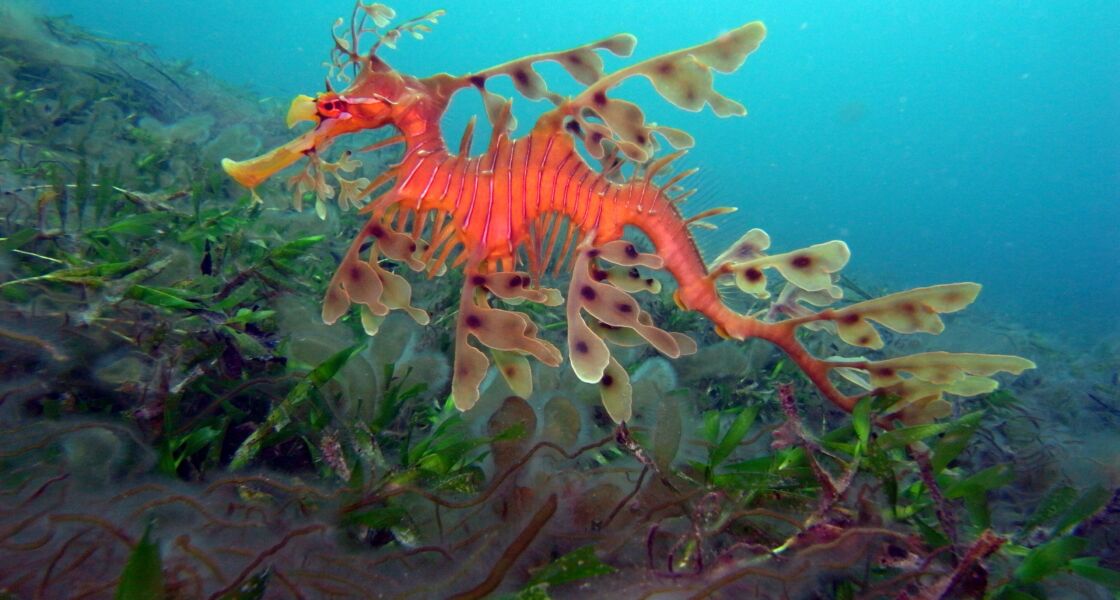
Off the southern coast of Australia floats what looks like a loose scrap of seaweed. Then it blinks, and a tiny eye gives it away. That drifting piece of “kelp” is a fish: the leafy seadragon, maybe the best disguise in the whole ocean.
A Fish Dressed as Seaweed
The leafy seadragon is a close cousin of the seahorse. But where a seahorse looks like a curled chess piece, this fish wears a full costume of leaf-shaped flaps that sprout from its head, body and tail.
Those leafy bits are not fins. The seadragon cannot swim with them at all. Their only job is to make the fish vanish into the kelp and seagrass it lives among. When a current rolls through, the leaves sway exactly like the real plants around them.
The disguise even shifts with the surroundings. In shallow, sunny water, leafy seadragons tend to be yellow-brown or greenish. Deeper down, they turn darker, from brown to a rich burgundy red.
So How Does It Move?
If the leaves are just decoration, how does a leafy seadragon get anywhere? Very quietly. It has two small fins that are almost see-through: one on the back of its neck and a long thin one running down its spine.
Those clear fins flutter so fast that they are nearly invisible, and the tail works like a rudder for steering. The result is spooky. The fish seems to hang in the water and drift, with no obvious engine pushing it, just like a real piece of kelp on the current.
It is in no hurry. A leafy seadragon spends its days alone, hovering over rocky reefs and seagrass, trusting its costume instead of speed to keep it safe.
It has even given up equipment that most fish keep. Over time the leafy seadragon lost the tail fin and belly fins that many fish use to power through the water. What is left are those two faint, flickering fins and a body built to blend in rather than race away.
A Straw for a Mouth
Look past the leaves and you will find a long, thin, pipe-like snout with a tiny mouth at the tip. There are no teeth inside it. There is no stomach, either.
Instead, the leafy seadragon eats like a living drinking straw. It drifts up to a cloud of tiny shrimp, lines up that pipe snout, and sucks the prey straight in with a quick slurp.
Its favorite meal is the mysid shrimp, a shrimp so small it is sometimes called a sea louse. The seadragon also sips up other tiny crustaceans, floating plankton and baby fish. Because it has no stomach to store a big meal, it has to eat almost constantly, snacking its way across the reef all day long.
Dad Carries the Eggs
When it is time to breed, the leafy seadragon flips the usual script. The female does not carry the babies. The father does.
She presses a batch of bright pink eggs onto a special patch on the underside of the male’s tail. Estimates of the number vary, but it is often in the range of about 250 to 300 eggs. The skin there puffs up into little cups that cradle each egg and feed it oxygen.
The father then carries the whole clutch for roughly six to eight weeks, right up until the tiny seadragons hatch. Each newborn is a miniature version of its parents and swims off to fend for itself, costume and all, from day one.
A male may even produce more than one batch of young in a single breeding season, so a good year can send a whole crop of pint-sized seadragons drifting out over the reef.
Only in Southern Australia
You will not find a wild leafy seadragon anywhere else on Earth. They live only in the cool coastal waters of southern Australia, off Western Australia, South Australia and Victoria.
They stick to kelp-covered rocky reefs and seagrass meadows, usually from near the surface down to about 100 feet (30 meters). They are home bodies, too, sometimes spending a long stretch in the same small patch of reef where the camouflage works best.
Leafy seadragons are thought to live somewhere around seven to ten years. On the global IUCN Red List they are currently listed as Least Concern, and in Australia the species is protected. It is also the official marine emblem of the state of South Australia, which is a fitting title for a fish that turned hiding into an art form.