
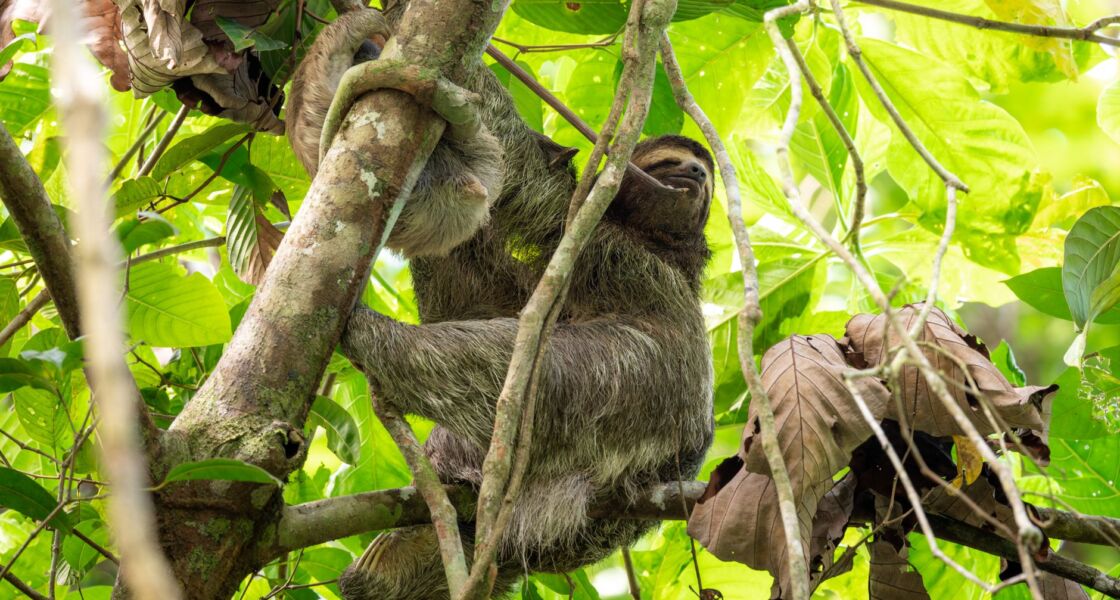
A three-toed sloth needs so little energy that a single potato’s worth of calories could keep it going for a day. Nothing about its slow life is laziness. Every part of it is built for saving energy.
The Slowest Mammal on Earth
National Geographic calls the sloth the world’s slowest mammal. It is so still that algae, tiny green living things, grow right on its fur.
The reason is food. Sloths eat leaves, and leaves are low in calories. So a sloth’s body runs on a very low setting. Its metabolic rate, the speed at which a body burns fuel, is only about 40 to 45 percent of what you would expect for an animal its size.
University of Wisconsin-Madison researchers who study sloths in Costa Rica say the three-toed sloth has the lowest energy needs of any mammal ever recorded. It saves even more by letting its body temperature drift up and down with the weather around it.
Moving slowly is not a flaw. It is the plan.
A Meal That Takes a Month
A three-toed sloth eats leaves from just a few kinds of trees, and some of those leaves contain natural poisons. So it chews and digests slowly. Its stomach has four chambers, and the poisons are broken down a little at a time.
How slowly? A leaf can take about a month to make its way through a sloth’s digestive system.
That is why a sloth only needs a bathroom break about once a week.
The Weekly Trip Down
Here is the strange part. Instead of going from up in the tree, a three-toed sloth climbs all the way down to the forest floor. It digs a small hole at the base of its tree and goes there.
On the ground, a sloth is in trouble. Its hind legs are weak, and its long claws get in the way. It has to pull itself along with its front legs, dragging its belly across the soil. Jaguars and eagles are among its predators.
The trip burns about a tenth of the sloth’s daily calories. In one study in Costa Rica, more than half of the sloth deaths the researchers documented happened on these bathroom breaks.
A Zoo in Its Fur
That risky trip has a reason, and it involves moths. Special sloth moths live in the fur. When the sloth heads down to the ground, the moths lay their eggs in the fresh dung. The caterpillars feed there, grow into adult moths, and fly off to find another sloth. As many as 120 moths have been counted on a single sloth.
The moths help the sloth in return. When they die and decay in its fur, they leave behind nutrients such as nitrogen. That works like fertilizer for the algae. The green algae help the sloth blend in with the leaves around it, which hides it from birds of prey overhead. Researchers have even found algae in sloths’ stomachs, so it may also be a snack.
Scientists are still studying exactly why sloths take the dangerous trip, but the partnership with moths and algae is part of the story.
Built for Hanging Around
A sloth’s long, curved claws hold on like hooks. A sloth eats, sleeps, mates and gives birth in the trees. Three-toed sloth babies cling to their mothers for about the first nine months of life.
Three-toed sloths also have extra neck bones, which lets them turn their heads about 270 degrees. That is nearly all the way around. They have short, stubby tails too.
And sloths are not as sleepy as their reputation. Zoo sloths were once measured at about 16 hours of sleep a day. But when scientists fitted wild sloths in Panama with tiny brain-wave recorders, they slept only about 9.6 hours a day.
Slow, but Not Helpless
Sloths are surprisingly good swimmers. They sometimes drop from a rainforest tree right into a river, then stroke along with their long arms.
If a predator catches one, a sloth does not simply give up. It bites and slashes with claws that can be 3 to 4 inches long. Sloths are also stronger than they look.
These odd habits have worked for a long time. National Geographic notes that sloths have survived for at least 50 million years.
Where Sloths Live
Three-toed sloths live in the tropical forests of Central and South America. In the wild, they spend nearly all of their time high in the canopy.
Sloths are not related to monkeys. Their closest relatives are anteaters and armadillos. One more oddity: even though sloths sometimes get compared to koalas, the two animals are not closely related. They both ended up with leafy diets and slow metabolisms on their own.
Three-toed sloths have a high-pitched call that sounds like “ahh-eeee.” Because of it, they are sometimes called ais, pronounced “eyes.” It is one of the few sounds you will ever hear from an animal that spends most of its life being quiet and still.
Some sloths are rare. The pygmy three-toed sloth lives only on one small island off the coast of Panama, and it is listed as critically endangered.