
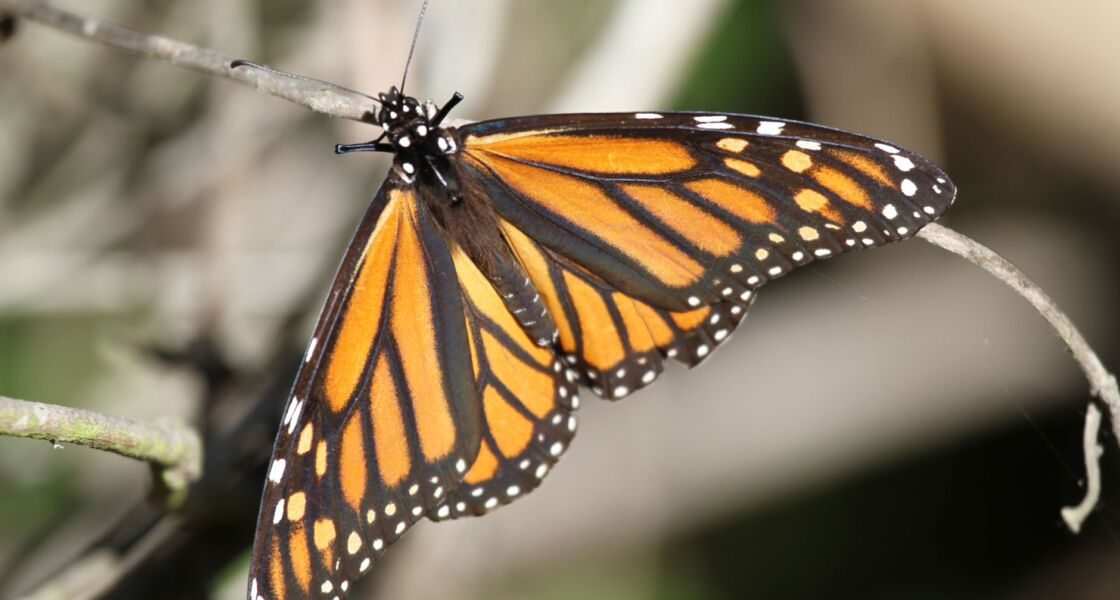
A monarch butterfly weighs less than a dollar bill. Yet in the fall, an eastern monarch can fly up to 3,000 miles to spend the winter in the mountains of Mexico.
A monarch is not large, either. Its wingspan is up to about four inches (10 cm), roughly an inch wider than its look-alike, the viceroy.
Here is the twist. The butterflies that make the trip have never been there. They are several generations removed from the ones that left Mexico in spring.
A relay race with wings
Eastern monarchs do not fly the whole loop in one lifetime. Think of it as a relay. In spring, the monarchs that wintered in Mexico head north, lay eggs, and die. National Park Service writers describe the migration as “multi-generation,” and scientists count three to four generations of butterflies that repopulate the northern range each year.
Most of these butterflies are short-lived. During the northward journey, adults live only two to six weeks. Each generation lays the eggs for the next.
Growing up is quick, too. An egg can become an adult in as few as 25 days, according to the National Park Service.
The northward trip starts from Mexico in mid-March. Between March and June, the spring generation moves into the southeastern United States, then keeps spreading north from there.
Then comes the last generation of the year. It is the one that flies south.
The super generation
Late-summer monarchs are born with a different job. Researchers call the fall group the “super generation.” Instead of mating right away, these butterflies pause their breeding. Scientists call this pause diapause, a kind of reproductive rest. They also build up extra fat for the trip, and they live far longer than their parents: the last generation of the season can live for as long as about nine months.
They fuel up on flower nectar along the way. Goldenrod and asters, which bloom in autumn, are two of the flowers they visit.
How do they find the way?
Nobody hands these butterflies a map. Researchers have found that migrating monarchs use a time-compensated sun compass. In plain words, they steer by the sun, and they correct for the fact that the sun moves across the sky during the day.
That is a clever trick. Imagine holding a compass that quietly adjusts itself every hour. Monarchs do that, flying toward the south and southwest until they reach the mountains of central Mexico.
The trip is long, but it is not the same for every butterfly. The National Park Service puts the fall flight at 2,000 to 3,000 miles (3,200 to 4,800 km) back to central Mexico. Where a monarch starts matters. Some begin in southern Canada. Others start in the Great Plains.
Winter in the sacred firs
The destination is a patch of mountain forest in central Mexico. The trees are oyamel firs, also called sacred firs. Monarchs roost on their branches in huge groups and huddle to share body heat.
These forests are a good winter home. The mountains offer a microclimate that is warm and humid enough for the butterflies to survive the season, save their fat, and avoid drying out. The Monarch Butterfly Biosphere Reserve, a UNESCO World Heritage Site, protects these areas.
The monarchs rest there through the winter, and then the cycle begins all over.
Do any of them fly the whole loop?
Mostly, no. The butterflies that leave Mexico in spring do not come back. Their descendants take over the northward trip.
But the super generation is not stuck in Mexico forever. Recent science suggests that up to 10 percent of them continue on and make the complete return journey to the northeastern United States, according to the National Park Service.
A poison snack
Monarch caterpillars eat only one kind of food: milkweed leaves. Milkweed contains compounds that are poisonous to most other animals, but monarchs have adapted to handle them.
The caterpillars carry that chemical protection with them. Grown monarchs are packed with toxic substances from their milkweed meals, which makes them unpalatable to many predators.
Where monarchs stand today
The eastern monarch winter count has changed a lot over the years. National Geographic reported in early 2024 that eastern monarch numbers had fallen about 80 percent since the 1980s. It also reported that the International Union for Conservation of Nature (IUCN) listed the migratory monarch as endangered in 2022, then moved it to vulnerable in October 2023.
Scientists keep counting each winter, using the area of forest the butterflies cover.
Another famous long-haul flier is the ruby-throated hummingbird.
One small butterfly, a few generations, thousands of miles, and a sun compass. Not bad for something lighter than a dollar bill.