

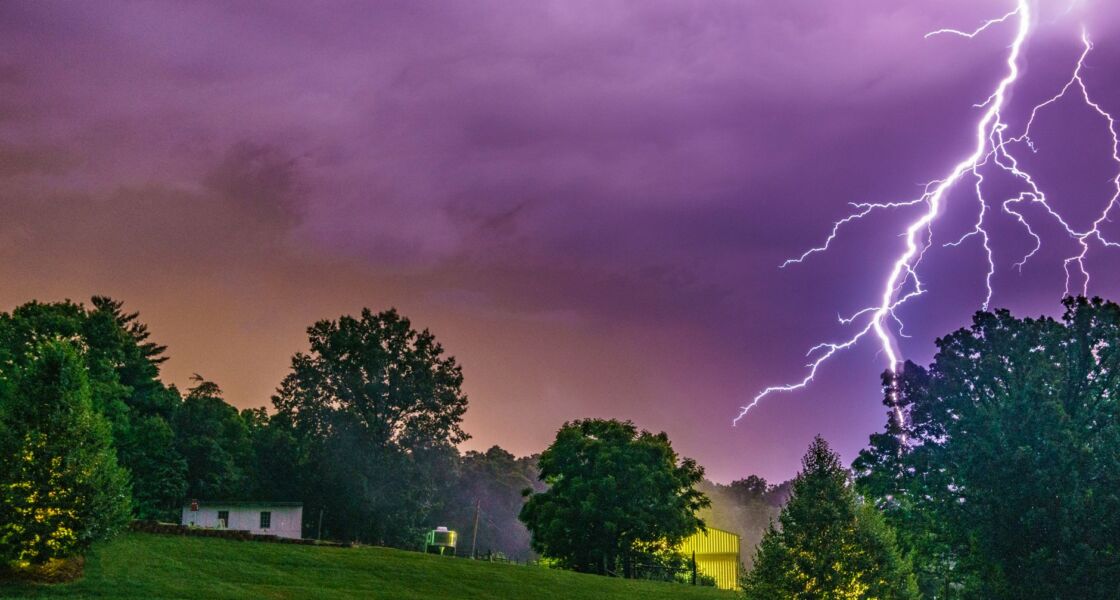
Does lightning never strike the same place twice? It is one of the most repeated sayings about storms, and it turns out to be exactly backward.
Where the saying comes from
The idea is comforting. A bolt rips out of the sky, hits a spot, and we tell ourselves that spot is now safe. Lightning got its one shot, so it will move on next time.
It is easy to see why the saying stuck. A single lightning bolt lasts a fraction of a second. It looks random, like it could land anywhere, so it feels fair that it would spread its hits around rather than return to the same place.
But lightning does not read sayings, and it is not trying to be fair. It follows the easiest path to the ground, and some paths are a lot easier than others.
The verdict: Myth
Myth. Lightning can strike the same place twice, and it regularly does. The National Weather Service lists this as a myth and points to a clear example: the Empire State Building in New York is hit an average of 23 times a year. Tall, pointy, isolated objects get struck again and again.
So the spot that just took a hit is not off the hook. If anything, it may be more likely than the field next to it to get hit again, because the thing that drew the first bolt is still standing there.
What’s really going on
Lightning is looking for the shortest, easiest route between a storm cloud and the ground. Height, a pointed shape, and standing alone with nothing nearby are the features that make an object a target.
A tall building or a lone tree sticks up closer to the cloud than everything around it. That extra height shortens the trip for the electricity, so the bolt tends to choose it over the flat ground nearby.
Height is not the whole story, though. The National Weather Service describes how a bolt and the ground reach for each other: as the stepped leader nears the surface, objects below send up faint channels of their own, called upward streamers, and the taller objects are the ones most likely to produce them. When a streamer connects, the bright return stroke races back up that channel. That is why tall, pointed, isolated objects get struck again and again, storm after storm.
Now think about what that means over a whole thunderstorm season. The Empire State Building does not move. Neither does a mountain peak or a radio tower. Storm after storm, the same tall shapes keep offering the easiest path, so the same spots keep getting hit.
It helps to picture how often lightning is happening in the first place. National Geographic says the Earth as a whole is struck by more than a hundred bolts every second. The United States alone averages about 25 million cloud-to-ground strokes a year. With that much lightning flashing down, the same favorite spots are bound to get hit more than once.
One storm, many strikes
The same place can even get hit several times during a single storm. Lightning is not one clean bolt but a quick flicker of strokes, which is why a flash can seem to pulse. A tall target can draw stroke after stroke as the storm passes overhead.
And lightning is not neat about staying in one lane. National Geographic notes that a spark can stretch more than five miles (eight kilometers) and carry a hundred million volts. A bolt can also reach out well beyond the rain, striking miles from the part of the sky that looks stormy.
Lightning rods play along
People figured out the same-place rule a long time ago and put it to work. A lightning rod is a metal point placed at the top of a building on purpose, so that lightning hits the rod instead of the roof. The strike then travels safely down a wire into the ground.
In other words, a lightning rod is a spot designed to be struck over and over. It only works because lightning is happy to return to the same easy path again and again.
The man who proved it the hard way
If a tall, exposed object keeps drawing the same bolt, what about a person who spends decades outdoors? Roy Sullivan was a park ranger at Shenandoah National Park in Virginia’s Blue Ridge Mountains, and according to Guinness World Records he was struck by lightning seven times between 1942 and 1977.
He survived every single strike, and he still holds the record for the most lightning strikes survived. Sullivan is a one-person reminder that lightning does not keep a tally and politely move along. The same saying that is supposed to reassure us simply does not match what happens in the real world.
The next time a storm rolls in, remember that the old saying has it upside down. Lightning does not avoid the place it just hit. Sometimes it comes right back.