
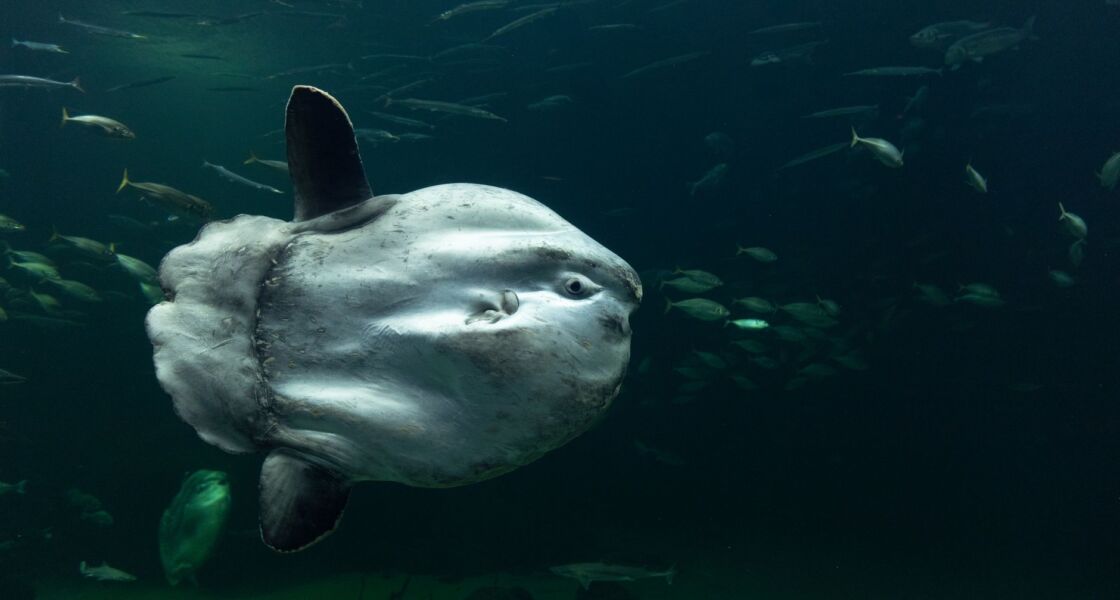
Picture a fish almost as heavy as a small pickup truck. Now picture it shaped like a dinner plate standing on its edge, with a tail that looks like someone forgot to finish it. That is the ocean sunfish, the heaviest bony fish on Earth.
A Giant That Looks Like Half a Fish
National Geographic says the ocean sunfish, also called the mola, “seems like only half a fish.” It is round and flat from side to side, with a tall fin on top and another on the bottom. Where a tail should be, there is just a short, rounded edge.
That edge has a name: the clavus. The sunfish is born with a back fin, but the fin never grows. Instead it folds into itself as the fish matures and becomes a rounded rudder for steering.
The name fits, too. In Latin, mola means “millstone,” the big round stone once used to grind grain.
Think of it as a swimming head with fins. Its body is a silvery disk with rough skin, and its mouth is small and a little surprised looking.
How Big Is Big?
Very. Large sunfish can weigh nearly 5,000 pounds. Oceana puts the top weight at 4,927 pounds (2,235 kg). Adults can reach about 10 feet long and 14 feet from the tip of the top fin to the tip of the bottom fin.
That is taller than a basketball hoop, which stands 10 feet high. National Geographic Kids says the heaviest ones weigh almost as much as a small pickup truck.
Many are smaller. NOAA notes that giant ocean sunfish often reach eight feet in length.
Sharks and rays can weigh more, but their skeletons are made of cartilage, not bone. Among fish with bones, nothing is heavier than the sunfish.
A Very Fast Growing Kid
Young sunfish grow at an astonishing rate. Oceana says a juvenile can gain up to 1.8 pounds every single day.
For comparison, a human baby ends up about 30 times heavier than at birth. The sunfish is playing a different game entirely.
Lying Down at the Office
Why “sunfish”? Because these fish like to bask. They float on their sides near the surface, soaking up the sun. People sometimes spot the tall top fin sticking out of the water and mistake it for a shark.
The basking may also be a warm-up break. Oceana explains that sunfish sometimes swim down into deep, cold water to catch prey, then rest at the surface to warm up.
It is not a speedy life. Sunfish are clumsy swimmers. They waggle their big top and bottom fins from side to side and use the clavus to steer.
They are harmless to people, and National Geographic says they can be curious enough to approach divers. In the United States, NOAA says sunfish drift into the Stellwagen Bank National Marine Sanctuary off Massachusetts during the summer months, looking like a floating pancake.
An Ocean Wanderer
Sunfish live in temperate and tropical oceans around the world. Oceana lists the Atlantic, Pacific and Indian Oceans and the Mediterranean Sea. They mostly stay in the open ocean, though they sometimes visit kelp beds and coral reefs.
Up close, a sunfish is silvery, with rough skin. It does not look like a fish built for speed, and it is not. It looks like a fish built to drift, nibble jellyfish and enjoy a sunny afternoon.
Lunch Is Mostly Jellyfish
A sunfish’s favorite food is jellyfish. NOAA says the fish feeds primarily on jellyfish and other gelatinous zooplankton, which are soft, jelly-like drifters. National Geographic adds that it will also eat small fish, huge amounts of zooplankton and algae.
Its teeth are fused into a beak-like shape, and its small mouth cannot fully close. Soft, squishy prey is a good match for that mouth.
The Parasite Spa
Sunfish often carry skin parasites, which are tiny animals that live on the outside of another animal. They have some clever ways to cope.
A sunfish can swim to where smaller fish gather, and those fish nibble off the parasites for a meal. Seagulls can land on a sunfish floating at the surface and peck at them, too. The fish even flips over so the birds can reach the other side.
Sometimes a sunfish takes a bigger step. Molas have been known to leap as high as ten feet and land with a loud smack, which may help shake the pests loose.
Still Here, but Vulnerable
The ocean sunfish is listed as Vulnerable, and National Geographic reports its population trend as decreasing. Sunfish often get caught by accident in fishing nets meant for other fish. They can also choke on floating plastic bags, which look a lot like jellyfish.
Oceana reports estimates that their populations are declining by at least 30 percent every 24 to 30 years. It also notes that Morocco has phased out drift gillnet fishing, a type of net that catches sunfish by accident.
For a fish that looks half finished, the sunfish has found a pretty good way to be a giant.