
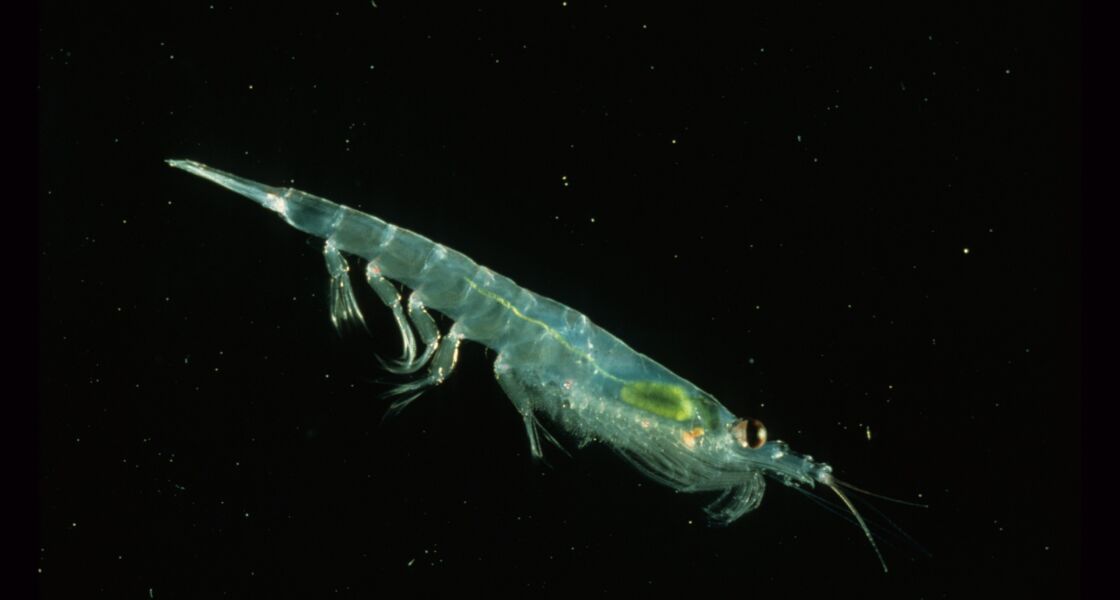
An adult Antarctic krill is about 2 inches long and weighs about as much as a paperclip. Yet one Australian estimate puts the Southern Ocean’s krill at around 400 million metric tons. That is a lot of paperclips.
What are krill?
Krill are small, shrimp-like animals. They are crustaceans, the same big group as crabs, lobsters and shrimp. Scientists know of about 85 kinds, and the best known is the Antarctic krill, Euphausia superba.
Look closely and a krill is almost see-through. Its shell has a red tinge from tiny pigment spots. It has large black eyes. Its gut shows through and glows a vivid green, colored by the microscopic plants it eats.
The Australian Antarctic Division calls krill the “cornerstone” of the Antarctic ecosystem. It also describes them as the world’s most abundant crustacean.
A swarm you can see from space
Krill gather in swarms. Inside a dense one, there can be up to 30,000 krill in a single cubic meter, a space about a yard on each side. Some swarms are thick enough to turn the sea reddish-brown. National Geographic says swarms can be dense enough to be seen from space.
In 2021, scientists off East Antarctica found a super-swarm that was 3,200 meters long, 300 meters wide and 100 meters thick. That is about two miles long. They said it was bigger than any swarm they had met before.
Who is in a swarm? That is still a puzzle. Some swarms are made up entirely of young krill, and others entirely of females or entirely of males. Scientists are still studying how swarms are organized.
Krill are not only an Antarctic story. Krill of many kinds live in oceans around the world, from the tropics to the polar seas.
Who eats krill? Nearly everyone
The Australian Antarctic Division puts it like this: “Nearly everything in Antarctica has krill for dinner.” The list includes fish, squid, albatrosses, petrels, penguins, some seals, and humpback and blue whales.
A whale can eat several tons of krill in a single day. That includes the blue whale, the largest animal on Earth.
How many krill are there? Nobody knows exactly, because counting a moving swarm in the open ocean is hard. One Australian estimate is about 400 million metric tons (roughly 440 million US tons) in the Southern Ocean. National Geographic reports estimates that range from 125 million to 6 billion tons. Either way, it is a mountain of tiny animals.
Up and down, every day
Krill follow a daily routine. At night they feed near the surface. During the day they sink deeper, to hide from predators. National Geographic puts their daytime depth at about 320 feet (100 meters).
The food is worth the trip. Krill graze on phytoplankton, tiny floating plants that grow in the sunlit water. Think of it as a daily commute: up for dinner, down for safety.
In winter, krill switch to algae growing under the pack ice, scraps on the seafloor, and even other animals. In laboratory studies, krill have survived more than 200 days without food. They can even shrink in length when food is scarce, and they keep molting for life. Using their own body proteins as fuel helps them get through the lean months.
Eggs that sink more than half a mile
A krill egg is about half a millimeter across. A female can lay several batches in a season, with up to 8,000 eggs in a batch. The eggs sink to about 1,000 meters (3,300 feet), and that is where they hatch. The tiny larvae then begin the long swim back to the surface, changing shape many times over several months.
Krill live a long time for their size. Scientists estimate that an Antarctic krill can live 5 to 10 years, though a krill’s age is hard to pin down.
The Australian Antarctic Division runs a krill aquarium that it calls the only research lab in the world where the entire life cycle of Antarctic krill can be studied.
Young krill have their own pantry. They eat algae growing on the underside of sea ice.
The breeding season can last up to five months. That gives a female time for those several batches.
Krill and people
People fish for krill too. According to the Australian Antarctic Division, krill have been fished commercially for more than 50 years, and catches have been near 400,000 metric tons a year over the last decade. An international commission uses survey data to set precautionary limits, meant to leave enough krill for the animals that depend on them.
The next time you see a whale or a penguin in a nature film, remember what is probably on the menu. It is a shrimp-like animal about two inches long, and there are a great many of them.