
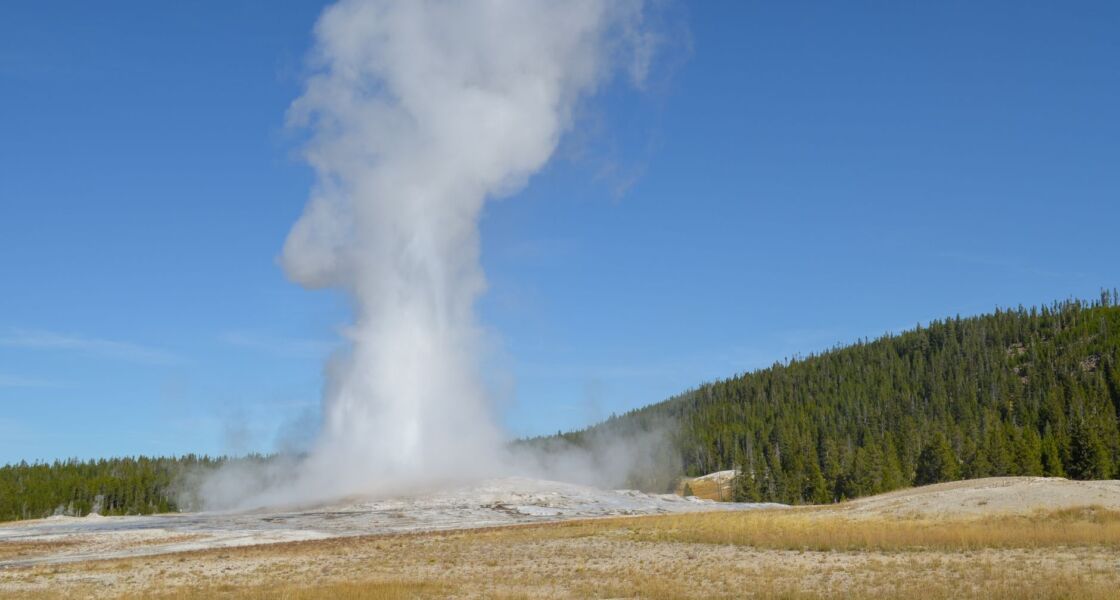
Every hour or so, in the middle of Yellowstone, the ground lets out a roar and throws a column of hot water more than a hundred feet into the air. It is called Old Faithful, and it has been doing this for as long as anyone has watched.
A geyser is one of the rarest things on Earth. To make one, nature has to line up three ingredients at exactly the same spot, and almost nowhere does.
Three Things a Geyser Needs
The National Park Service lists the recipe plainly: heat, water, and a natural “plumbing” system of underground cracks. Miss any one of them and you get no geyser.
The heat comes from magma, the molten rock sitting a few miles beneath Yellowstone. The water comes from above. Snow and rain slowly soak down through layers of cracked, spongy rock, sinking deeper and deeper until they reach the hot zone near the magma.
Down there, something strange happens to that water.
Water That Is Too Hot to Boil
You might expect water that hot to turn straight to steam. It does not, because of all the water and rock stacked on top of it. That weight presses down so hard that the water stays liquid even past its normal boiling point.
The Park Service calls the result superheated water, and it can climb well above 400 degrees Fahrenheit while still staying liquid. Think of a pot with a heavy, clamped-down lid: the pressure lets the water get hotter than it ever could in an open pan.
Now all that trapped, superheated water needs just one thing to let loose. A way out.
The Narrow Neck That Makes the Magic
This is the part that turns an ordinary hot spring into a geyser. A plain hot spring has an open channel, so hot water drifts up, cools, and sinks in a lazy loop without ever exploding.
A geyser is different. It has a constriction, a narrow neck in its plumbing, usually close to the surface. The Park Service explains that this pinch point stops the water from circulating freely, so pressure and steam build up behind it instead of escaping.
Steam bubbles form deep down and try to rise, but the narrow neck is too small to let the big ones through. They pile up underneath, squeezed and shaking, until the pressure has nowhere left to go.
The Chain Reaction
Here is the moment it all breaks loose. The trapped steam bubbles finally shove some water up through the narrow neck, and a little splashes out of the vent at the top.
That tiny spill is the trigger. With a bit of water gone, the pressure on everything below suddenly drops. And superheated water that was only staying liquid because of that pressure can no longer hold on.
In an instant, as the Park Service describes it, much of the water flashes into steam. Steam takes up far more room than liquid water, so it expands with enormous force and hurls the water above it straight out of the ground. The eruption rolls on until the underground reservoir runs dry or the leftover water cools down. Then the cracks quietly refill, the heat builds again, and the whole countdown starts over.
Why Old Faithful Is So Faithful
Old Faithful got its name because you can count on it, but it is not a clock. The National Park Service tracks its rhythm closely. As of early 2025, eruptions came about every 102 minutes, give or take 10, with gaps ranging anywhere from 54 minutes to almost 2 hours.
What makes it predictable at all is a neat relationship rangers noticed. A short eruption releases less water and heat, so the geyser refills and reheats quickly and goes off again sooner. A long eruption empties more, so it needs longer to recharge. Time one eruption, and you can make a good guess about the next.
When it does go, Old Faithful usually reaches about 130 feet, though it can top 180, and it throws out thousands of gallons of water in a burst that lasts a minute and a half to five minutes. Over the last 30 years the gap between eruptions has slowly stretched by about half an hour, a small sign that even a “faithful” geyser is always slowly changing underground.
Why Yellowstone Has So Many
Geysers are genuinely rare. The exact plumbing has to survive without clogging or collapsing, which almost never happens. Across the entire planet there are only a few places with large numbers of them.
Yellowstone is far and away the champion. The park holds more than 500 geysers, more than anywhere else on Earth. They sit among over 10,000 hydrothermal features in all, including hot springs, bubbling mud pots and hissing steam vents. The reason is that giant pool of magma beneath the park, feeding heat up through just the right kind of cracked, mineral-rich rock.
The water that finally bursts from Old Faithful’s vent has been measured there at around 204 degrees Fahrenheit, a few degrees above boiling for a spot that high up in the mountains. Hotter, deeper water waits below, and it is that buried heat that powers the next show.
So the next time you see Old Faithful go off, remember what had to happen first: rain and snow soaking down for years, water heated past boiling but held in check, and a narrow stone throat that finally, faithfully, lets go.