
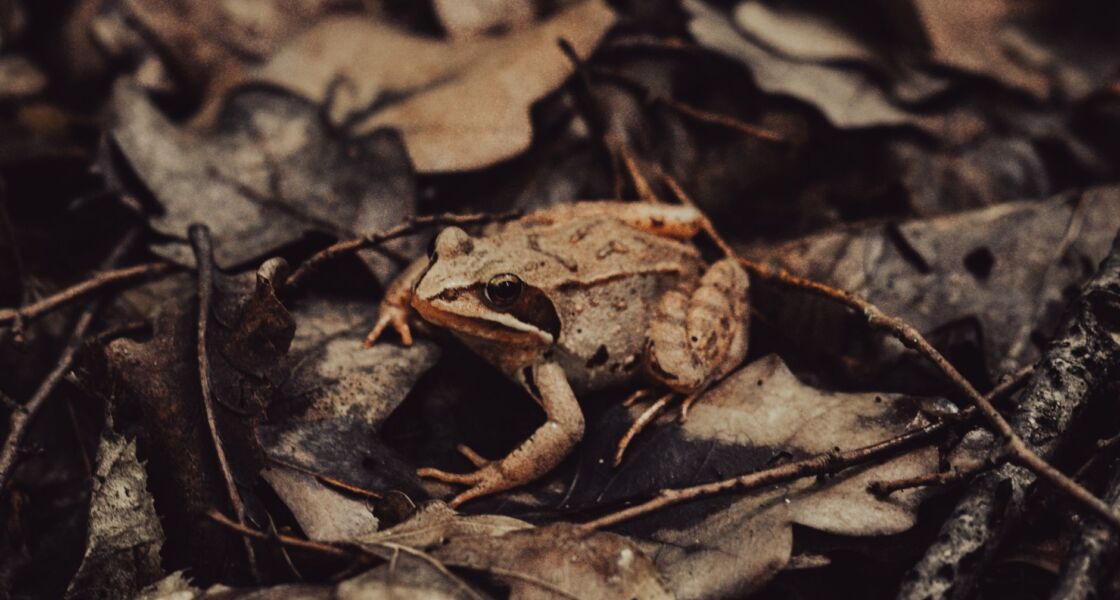
Here is a frog that spends part of the winter frozen like an ice cube. Its heart stops. Its blood stops moving. For weeks, there is no breathing and no heartbeat at all. Then spring warms the ground, the frog thaws, and it simply hops away.
A Frog That Freezes Solid
The wood frog is a small, brown frog found across North America, from the Southeast all the way up into Alaska. When winter closes in, it does not dig deep underground to escape the cold the way many animals do. It tucks itself under leaf litter, close to the surface, and lets the freeze come.
As the temperature drops below freezing, ice begins to form. It fills the frog’s body cavity and surrounds its organs. Ice even forms between the layers of skin and muscle. The eyes turn white because the lens freezes.
As much as 35 to 45 percent of the frog’s body can freeze into solid ice. During this time there is no muscle movement, no heartbeat, and no breathing. By most everyday measures, the frog looks like it is no longer alive.
The Trick Is Sugar
So how does a living thing freeze and come back? The answer starts in the liver. When the first ice touches the frog’s skin, its body sends a fast message to the liver, which floods the bloodstream with glucose, a kind of sugar.
That sugar does two jobs. It lowers the freezing point of the water inside the frog’s cells, so the cells themselves do not freeze. And it keeps those cells from drying out and collapsing as water pulls away to form ice outside them. A wood frog getting ready to freeze can carry blood sugar levels about 100 times higher than normal.
The frog uses a second helper, too: urea, a waste chemical that most animals just get rid of. In the wood frog, extra urea builds up and works alongside the glucose as a natural antifreeze. Together they let ice form safely around the outside of cells while the insides stay liquid and protected.
Thawing Back to Life
When spring arrives, the frog does not thaw all at once. It warms from the inside out. The core organs, like the heart and liver, freeze last and thaw first, so the most important parts come back online soonest.
First the heart starts beating again. Then the brain wakes up. Then the legs begin to move. Within hours, a block of frozen frog becomes a frog again, blinking in the cold spring air and ready to get on with its year.
No other frog in North America does this as well. Wood frogs living in Alaska can freeze harder, and stay frozen longer, than wood frogs anywhere else.
The Only Frog North of the Arctic Circle
That cold-weather superpower lets the wood frog live where no other frog can. It is the only frog found north of the Arctic Circle, in a land of long, dark, deep-frozen winters.
You can spot a wood frog by the dark patch across its eyes. It runs back from each eye like a little bandit’s mask, which is the easiest way to tell this frog from its relatives. The rest of the body is usually some shade of brown, red or gray, perfect for disappearing into dead leaves on a forest floor.
A Race to the Spring Pools
Because the wood frog thaws so early, it gets a head start on spring. It is one of the first frogs to breed each year, often in early March, while there is still a chill in the air and ice at the edges of the water.
The frogs gather at vernal pools, shallow ponds that fill with snowmelt and rain in spring and often dry up by late summer. Those pools have no fish, which means no fish to eat the eggs. The downside is a deadline: the young have to grow up before the water disappears.
The breeding is a loud, fast scramble. Males call, frogs pile in, and a female lays a jelly-like mass of 1,000 to 3,000 eggs. Then it is over almost as quickly as it began, and the adults head back into the woods.
Life in the Woods
For the rest of the warm months, the wood frog lives up to its name. Adults spend their time in woodlands, hunting across the damp forest floor and snapping up insects, spiders, worms, slugs and snails with a quick, sticky tongue.
A wood frog does not usually live very long. In the wild, most do not make it past about three years. But in that short life it manages something almost nothing else with a backbone can do: it freezes nearly solid, waits out the winter as a frog-shaped ice cube, and thaws back to life when the sun returns.