

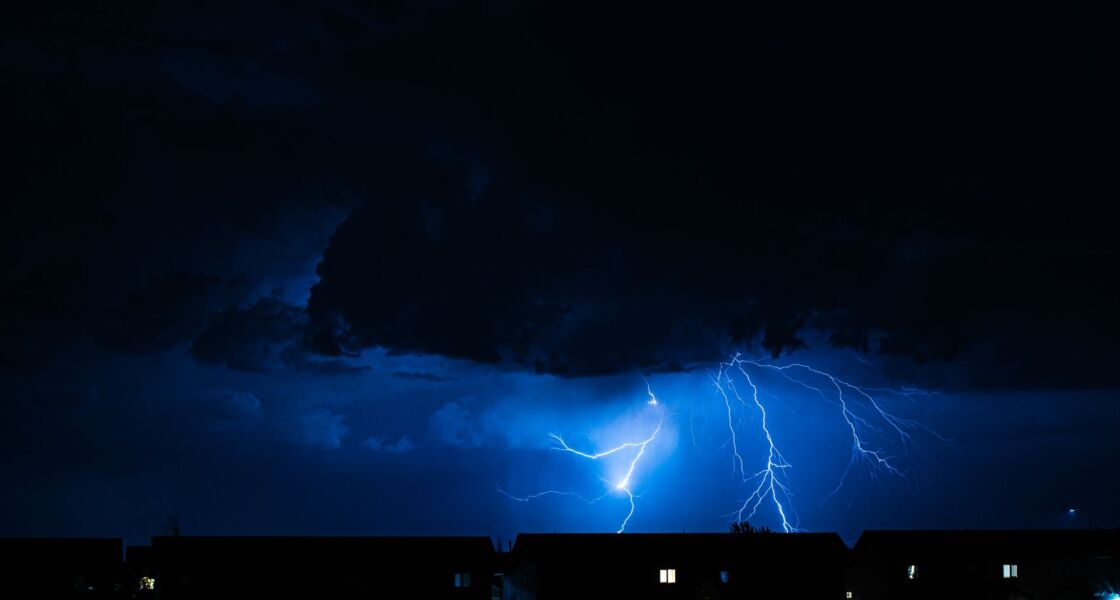
A bolt of lightning is hotter than the surface of the Sun. Not a little hotter. About five times hotter.
When lightning rips across the sky, the air inside that thin, bright channel can hit around 50,000 degrees Fahrenheit. The Sun’s surface, by comparison, sits at a relatively cool 10,000 degrees Fahrenheit. For a flash that lasts a fraction of a second, a strip of our own air outshines a star.
How a Spark Beats a Star
Here is the fair-play note first. The Sun has a core that is far, far hotter than lightning, about 27 million degrees Fahrenheit. But we never see the core. The part we see, the surface the Sun shows the sky, is the photosphere, and that is the part lightning beats.
So the headline is true with one honest footnote: lightning is hotter than the Sun’s surface, not hotter than the whole Sun.
Even with that footnote, 50,000 degrees is a staggering number for a bolt of weather. The Sun is a ball of burning gas more than a hundred times wider than Earth. Lightning is a jagged line of light you could cover with your thumb. And the line wins on heat.
Why Lightning Gets So Hot
The secret is not fire. Lightning is electricity.
Inside a storm cloud, static charge builds up, the same kind of charge that makes your hair stand up or snaps when you touch a doorknob. The cloud gathers far more of it. When enough piles up, it has to go somewhere, and it jumps, between parts of the cloud or down to the ground. That jump is the lightning.
An enormous amount of electrical energy pours through a narrow path of air in almost no time at all. Air does not carry electricity easily, so it fights back, and all that energy forced through in an instant heats the channel to around 50,000 degrees Fahrenheit. It is less like lighting a candle and more like a city’s worth of electricity shoved through a wire thinner than a pencil.
The heat is so sudden because the whole event is so fast. A lightning stroke flashes by in less time than a blink. There is no slow warming up. The air goes from ordinary sky to five times hotter than the Sun’s surface and back again before you can finish the word “lightning.”
The Bang Is the Air Getting Out of the Way
When air is heated that fast, it does what any gas does when it suddenly gets hot. It expands. But at 50,000 degrees, it does not drift outward gently. It explodes outward.
That violent push shoves the surrounding air aside and sends a shock wave racing out in every direction. By the time the wave reaches your ears, it has spread and softened into the rumble and crack you know as thunder.
So thunder is not a separate thing that follows lightning. It is the lightning, heard instead of seen. The flash is the channel glowing white-hot. The boom is that same superheated air slamming into the cooler air around it.
That is also why you see the flash before you hear the boom. Light travels to your eyes almost instantly. Sound is far slower, so it arrives a few seconds late, trailing behind the strike that made it.
Counting Your Way to the Storm
That delay is handy. Because sound lags behind light, the gap between them tells you how far away a strike was.
Count the seconds from the flash to the boom, then divide by five. The answer is roughly how many miles away the lightning hit. A ten-second gap means the strike was about two miles off.
If the flash and the bang land almost together, the storm is right on top of you. A long, lazy pause means the worst of it is still a comfortable distance away.
One strange detail: the same strike can sound completely different depending on where you stand. Up close, thunder is a sharp, tearing crack. Farther off, it softens into a long, rolling grumble. The air itself smooths out the sound as it travels, trimming away the sharp, high notes and leaving the low rumble to reach the far-off ear.
Five Times Hotter, in Real Numbers
It helps to lay the two numbers side by side. Lightning: about 50,000 degrees Fahrenheit. The Sun’s surface: about 10,000 degrees Fahrenheit. Divide one by the other and you land on that “five times hotter” claim, from a trusted weather source, not a tall tale.
Ten thousand degrees is already hard to picture. An oven tops out near 500 degrees. A wood fire might reach a couple thousand. The Sun’s surface is many times hotter still, hot enough to warm your face from across the solar system.
Now take that already-blazing number and multiply it by five. That is the air inside a lightning channel. For one flash, a line in the sky over your town is doing something no campfire, no oven, not even the face of the nearest star can match.
A Star You Can Watch From the Porch
There is something wonderful hiding in all of this. Most of the hottest things in the universe are impossibly far away or locked inside stars. A thunderstorm puts a strip of star-beating heat right over your neighborhood.
You cannot touch it, and you should never try to be near it. But from a safe, dry spot indoors, you can watch one of the hottest events on Earth light up the sky, then count the seconds and listen for the air itself booming back into place.
The next time a storm rolls through, remember what you are really seeing. For a sliver of a second, a thread of ordinary air has turned hotter than the face of the Sun, and the thunder is that air telling the whole sky to move.