
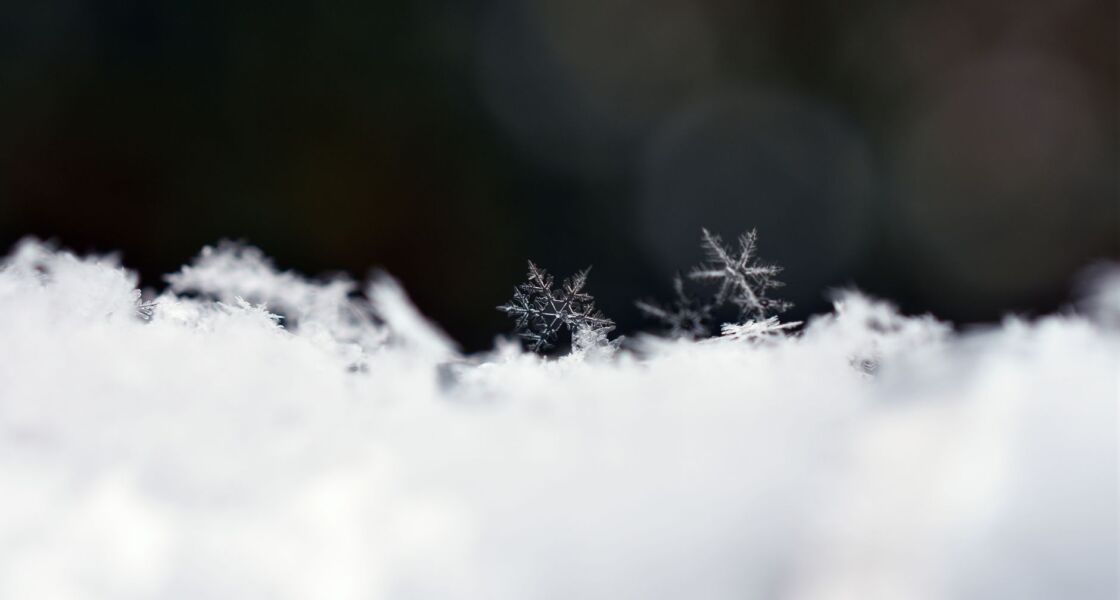
Catch a snowflake on a dark glove and look closely. You are holding a tiny six-pointed star, built in the sky, that very likely has never existed before and never will again.
That is the quiet magic of snow. Each flake is a little ice sculpture, and the way it forms almost guarantees that no two complicated ones ever come out the same.
It All Starts With a Speck of Dust
A snowflake does not begin as a frozen raindrop. It begins as water vapor, the invisible moisture in the air, high up inside a cold cloud where the temperature is below freezing.
That vapor needs something to grab onto. Up in the clouds, it finds tiny bits of dirt that the wind has carried into the sky. The water vapor freezes onto one of these specks, and a tiny ice crystal is born.
From that first moment, the crystal grows. More water vapor keeps freezing onto it, layer by layer, and the speck of ice slowly becomes a snowflake. When it grows heavy enough, it drifts down toward the ground.
Why Snowflakes Have Six Sides
Here is the first clue to a snowflake’s shape. Almost every snow crystal has six sides, or six arms. Think of the paper snowflakes people cut from folded paper. Real ones share that same six-fold pattern.
Why six? It comes down to the water itself. The six-sided shapes, called hexagons, form because of how water molecules line up and organize themselves as they freeze. The molecules can only click together neatly in one pattern, and that pattern has six corners.
So the number six is not a lucky accident. It is baked into the shape of water the instant it turns to ice.
Temperature Picks the Shape
If every crystal is a six-sided piece of ice, why do they look so different? The answer is that temperature acts like a sculptor, choosing what kind of crystal grows.
At one temperature, a crystal grows into a flat, six-sided plate. At another, it stretches out into a long, thin column. Cool it differently again and it becomes a prism shape. The temperature where a crystal is growing decides which of these basic forms it takes.
The amount of water vapor in the air matters too. Snowflakes come in all shapes and sizes depending on the temperature of the air and how much moisture it holds. More vapor tends to grow fancier, more branching crystals.
A Different Journey Every Time
Now put those two ideas together, and the real secret appears. A snowflake does not grow in one still spot. It drifts and falls through the cloud, and the air it passes through keeps changing.
One moment it is in slightly warmer, wetter air, growing flat plates. A moment later it falls into colder, drier air, and its arms start branching in a new way. Each change in temperature and moisture nudges the shape a little further.
Because every flake takes its own winding path down, no two flakes feel exactly the same string of conditions. And since all six arms of a single crystal travel together, they experience the same changes at the same time. That is why the six arms usually grow to match one another, even as each whole flake turns out unlike its neighbors.
So Are No Two Really Alike?
This is where scientists get careful. The famous saying is that no two snowflakes are alike, and for big, fancy flakes that is almost certainly true.
Physicist Kenneth Libbrecht, who studies snow crystals at Caltech, puts it this way: it is extremely unlikely that two complex snowflakes will look exactly alike. There are so many ways a branching crystal can grow, he explains, that out of all the snowflakes made over the entire history of the planet, it is unlikely any two complex ones have ever looked completely the same.
The reason is the sheer number of possibilities. A complex snowflake can have a hundred tiny features, and every one could have grown a little differently. The number of ways to arrange all those features is staggeringly huge, far larger than anyone could ever count.
The Surprising Exception
But there is a twist, and it is a fun one. The smallest, simplest snow crystals can look alike.
Some snow crystals never grow into lacy stars. They stay as plain six-sided prisms, tiny and simple. With a shape that basic, Libbrecht notes, it is not hard to imagine finding two that look essentially the same under a microscope. Simple crystals are very common, so plenty of them do look pretty much alike.
There is also a deeper level to the question. Even two flakes that look identical through a microscope are almost never identical molecule for molecule. Probably no two snowflakes have exactly the same arrangement of water molecules inside them, even if they can look alike to the eye.
So the honest answer has two parts. Tiny plain crystals can be look-alikes. But a big, branching snowflake, shaped by its own unique fall through the sky, is very likely one of a kind.
The next time snow is falling, remember what is drifting past your window. Each flake is a tiny record of the exact path it took to reach you, written in ice.