
Look up on a clear afternoon and the sky is blue. Watch that same sky at sunset and it glows orange and red. The strange part is that nothing about the sunlight has changed. The light leaving the Sun is the same color all day.
What changes is the air between you and the Sun, and a tiny game of pinball that light plays with it.
Sunlight Is Secretly Every Color
The light from the Sun looks white, but it is really a mix of every color of the rainbow blended together. A prism, or a raindrop, can split that white light back into its colors. That is how you get a rainbow.
Each color travels as a wave, and the waves are not all the same size. Blue and violet move in short, tight waves. Red and orange move in longer, lazier waves. In fact, red light has a wave almost twice as long as violet light.
That difference in wave size is the whole secret. It decides which colors bounce around the sky and which ones fly straight to your eyes.
Why the Daytime Sky Is Blue
Earth’s air is full of tiny molecules, far too small to see. When sunlight hits them, the light scatters, which just means it bounces off in new directions, like a cue ball breaking a rack of pool balls.
Here is the twist: those tiny molecules scatter the short blue waves much more easily than the long red ones. So blue light gets knocked all over the sky, bouncing from molecule to molecule until it seems to pour down at you from every direction. Scientists call this Rayleigh scattering, after the physicist who explained it.
Because the scattered blue light comes at you from all over, the whole sky lights up blue. The red and orange light, mostly ignoring the molecules, keeps sailing straight ahead. This is why we see a blue sky most of the time.
Why Sunsets Turn Orange and Red
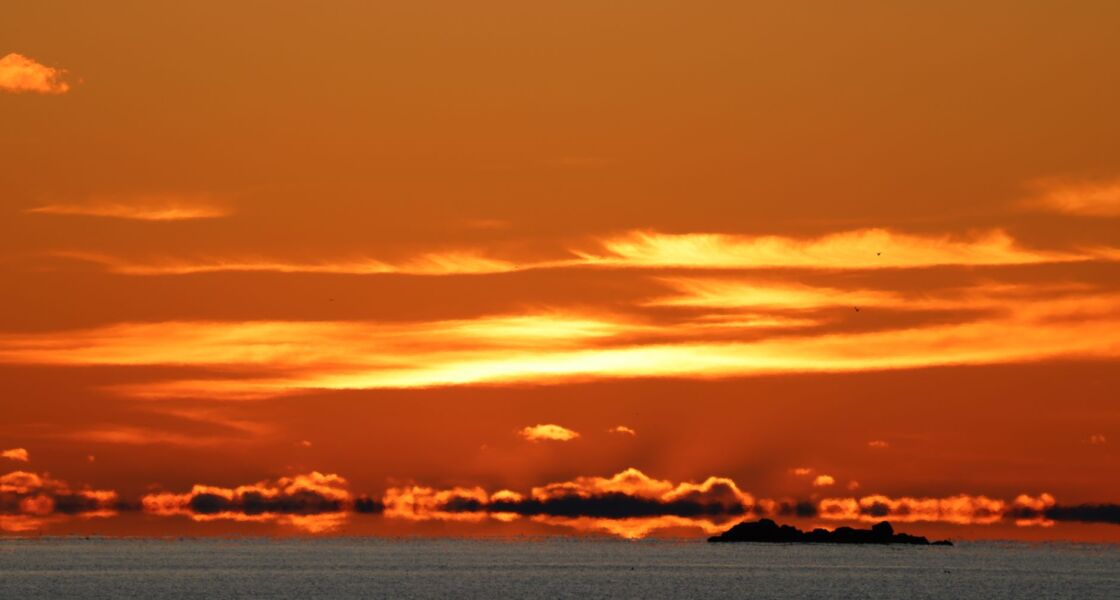
At sunrise and sunset, the Sun sits low on the horizon. Its light now comes in at a slant, so it has to travel through a much thicker stretch of air before it reaches your eyes.
Over that long path, the air scatters away almost all the blue, and then even the greens and yellows start to get scattered too. What is left to come straight through is mostly red and orange, the colors with the longest waves and the best chance of making the trip. So the low Sun and the sky around it glow warm.
Dust, smoke and other tiny bits floating in the air scatter blue light as well. That is why a sunset after a wildfire, a dust storm, or a big volcanic eruption can turn an even deeper, fiery red.
So Why Isn’t the Sky Violet?
Here is a fair question. If short waves scatter the most, violet scatters even more than blue, so shouldn’t the sky be violet?
Part of the answer is your own eyes. Human eyes are simply not very sensitive to violet light, so even though plenty of it is bouncing around up there, your eyes mostly read the sky as blue. The color you see is a team-up between the sky and the way your eyes are built.
So Why Are Clouds White?
If the air turns the sky blue, why do the clouds floating in it look white? The answer comes down to size. The molecules that scatter blue light are far smaller than a wave of light. The water droplets inside a cloud are different: they are about the same size as the waves of light themselves.
When droplets and light waves are that close in size, the light scatters in a new way that scientists call Mie scattering. Unlike the air, these bigger droplets do not pick favorites. They scatter every wavelength of light about the same, so red, green and blue all bounce around together. Mix all those colors back together and you get white, which is why a puffy cloud looks white against a blue sky.
It also explains gray clouds. As a cloud grows thick and tall, less and less sunlight can push all the way through it. With the light blocked, the underside of the cloud turns a moody gray, the same cloud, just too crowded for the Sun to get through.
On Mars, the Sunset Is Blue
Here is where it gets strange. Earth’s daytime sky is blue and its sunsets glow red. On Mars, it is almost the other way around. The daytime Martian sky is a dusty yellow-orange, but near the setting Sun, the sky turns blue.
The reason is the dust. Mars is wrapped in extremely fine dust, and NASA’s rovers found that those tiny grains happen to be just the right size to let blue light slip through the air a little more easily than other colors. As a Curiosity science team member put it, when blue light scatters off the dust, “it stays closer to the direction of the Sun than light of other colors does.”
So a blue glow pools around the low Sun, while the rest of the Martian sky stays yellow to orange. Rovers like Curiosity have photographed these blue sunsets from the surface, a quiet reminder that the same sunlight can paint two planets in opposite colors.
So the next clear evening, watch the blue drain out of the sky and the orange pour in. You are really watching sunlight lose a long game of pinball with the air.