
You may have heard that the green flash is a myth, a sailor’s tall tale. It is not. Just as the Sun slips out of sight, its very last sliver can flash green for a second or two.
NASA says it plainly: the green flash does exist, and its cause is well understood. The Sun itself does not turn green. The air around Earth does the trick.
The sky is acting like a prism
A prism is a chunk of glass that splits white light into a rainbow. Earth’s atmosphere can do a tiny version of the same thing. NASA’s description is that layers of the atmosphere act like a prism.
Sunlight looks white, but it is a mix of colors. When it enters the air at a low angle, as it does at sunset, each color bends by a slightly different amount. Blue bends the most, green a little less, and red the least.
That means the Sun is really a stack of slightly shifted copies, one for each color, piled on top of each other. The green copy sits a bit higher than the red one. So as the Sun sets, the red copy drops below the horizon first and the green copy goes last.
Where did the blue go?
If blue bends even more than green, why is the flash not blue? Because the air steals the blue on the way. Tiny air molecules and specks of dust scatter the shortest wavelengths of light, the blue and violet ones, away from your eyes. This is the same scattering that makes the daytime sky look blue.
With most of the blue gone, green is usually the last color left at sunset. In smoggy city air, even the green can get filtered out, and the flash turns out a plain yellow. Sometimes a flash does show a little blue. EarthSky shares reader photos of flashes with a touch of blue.
The twist: you need a little mirage
Here is the part that surprised even many textbooks. The ordinary, everyday bending of light is too small to make a flash you can see. The separation between red and blue is only about 20 arc seconds, a speck of sky. A person with sharp eyes can only pick out details about six times bigger.
Atmospheric scientist Andrew Young, who studies green flashes, writes that a calculation from 1955 showed a plain, “normal” atmosphere makes a green flash about ten times too small for the naked eye. What stretches it into something visible is a mirage.
A mirage is a trick of bending light caused by layers of warm and cool air. You may have seen one shimmering over a hot road. Over the ocean, a warm or cool layer near the surface can bend sunlight a second time and magnify the gap between colors. That pulls the green apart from the red so you can see it.
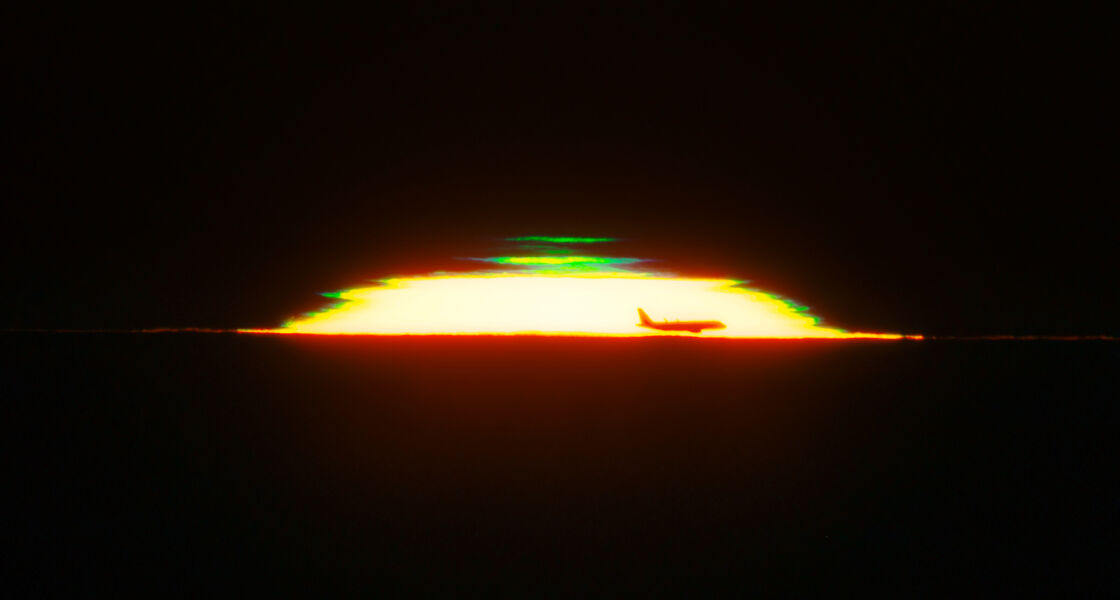
EarthSky says a mirage at sunset can make the Sun look shaped like the Greek letter omega. The photo at the top of this page shows a Sun with its top sliced into thin glowing layers, with green edges along the top.
Is it all just in your eyes?
People have guessed that the flash is an afterimage, the ghost color you see after staring at something bright. That cannot be the whole story, because green flashes also happen at sunrise, when your eyes have not been staring at anything. Young also points out that a color photograph shows real flashes.
Your eyes do add a little at sunset, though. Young says that after you look at the orange-red Sun for a few seconds, your eyes tire of red. That can make a flash look greener than it photographs. Sunrise flashes, he writes, are almost pure physics. Sunset flashes are a mix of physics and eyes.
NOIRLab, a program of the US National Science Foundation, describes it a little differently. Its photo caption says a thin green rim is present at every sunset, but it is too thin to see with the naked eye and lasts only a handful of seconds. Experts explain the details in different ways. NOIRLab says photography is the best way to catch it.
How to look for one
EarthSky says you need two things: a clear day with no haze or clouds on the horizon, and a far, sharp horizon. Over the ocean is the classic spot. A mountaintop or a tall building can work, and it is possible over land if the horizon is far enough away.
One safety tip matters more than any other. Do not look at the Sun until it is almost entirely below the horizon. Looking sooner can hurt your eyes, and it spoils your chances for that day.
The 35-minute flash that was not
You may also read that Admiral Byrd saw a green flash that lasted 35 minutes. Young says the real story is smaller but still neat. During a long polar sunset on one of Byrd’s expeditions, the Sun kept sinking and reappearing, and his men called it the “green sun.” The green came and went. Each green flare lasted from a fraction of a second to several seconds.
It is a good reminder. The green flash is real, and the true story is brief, delicate and a little odd. That is plenty.
Next clear evening with a wide-open horizon, watch the last sliver of the Sun. Then blink, and you might miss it.