
The Moon never changes shape. Not once. It is a round ball of rock tonight, and it was a round ball of rock last week.
So why does it look like a thin silver fingernail one evening and a bright, glowing circle two weeks later? The answer has nothing to do with the Moon itself. It is all about the angle from which we see the Moon.
The Moon has no light of its own
Here is the first surprise. The Moon does not make light. In our solar system, the only object that shines with its own light is the Sun. What we call moonlight is really sunlight bouncing off the Moon’s surface and traveling to your eyes.
The Sun is always lighting up one half of the Moon, the half that faces it. The other half is dark. This is just like Earth, which also has a sunny day side and a dark night side. At any moment, the Moon is half lit and half in shadow.
The Moon’s shape never changes. What changes is how much of that lit half we can see from here on Earth.
A month-long trip around Earth
The Moon travels in a big loop around our planet. As it goes, our viewing angle changes a little every night, and so does the slice of the lit half that points toward us.
Try picturing it with a ball and a lamp. Put a lamp on one side of a dark room and hold a ball at arm’s length. Slowly turn in a circle while holding the ball out in front of you. The lamp always lights half of the ball. But as you turn, you see the lit part from different angles: first all dark, then a sliver, then half, then the whole face. That is the Moon’s monthly cycle, in miniature.
These changing views are called the Moon’s phases. NASA lists eight of them, in order: new Moon, waxing crescent, first quarter, waxing gibbous, full Moon, waning gibbous, third quarter and waning crescent. The cycle repeats about once a month, every 29.5 days.
Reading the eight phases
Once you know the pattern, the Moon works like a slow clock in the sky. Here is what each phase means.
New Moon. The Moon sits in the same part of the sky as the Sun, so it rises and sets with the Sun. The side facing us is the dark side, so we cannot see it.
Waxing crescent. A thin curve of light appears. “Waxing” means growing. In the Northern Hemisphere, the light is on the right side.
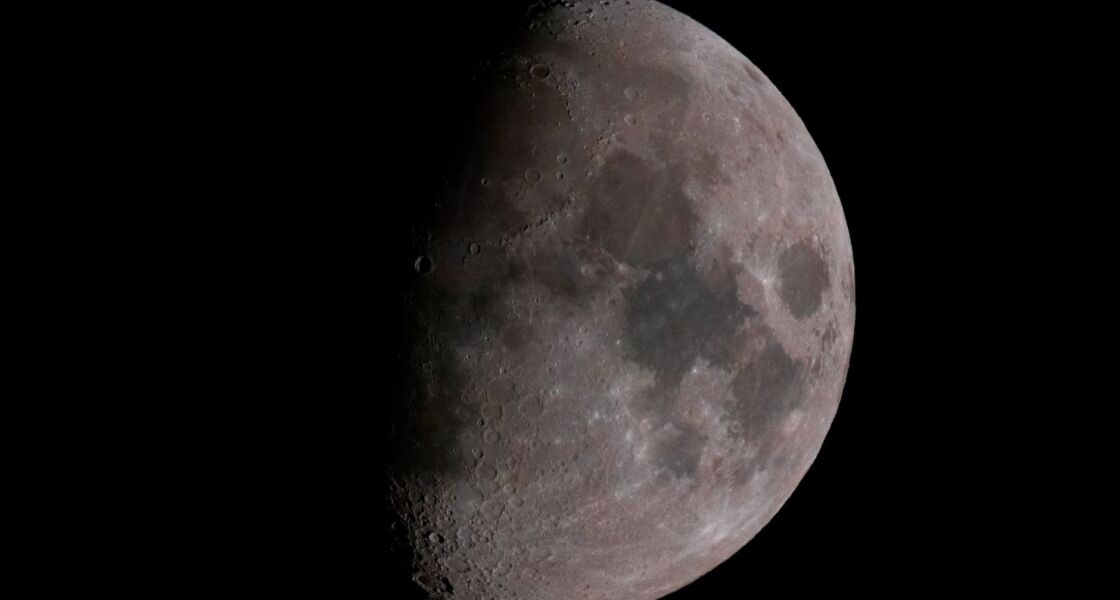
First quarter. You see what looks like a half Moon. It is called a quarter because the Moon is a quarter of the way through its monthly trip. Space.com notes that the first quarter Moon is 90 degrees away from the Sun in the sky.
Waxing gibbous. More than half of the Moon’s face is lit. “Gibbous” is the word for that bulging, slightly oval shape.
Full Moon. The Moon is opposite the Sun in the sky, so we see the whole sunlit side. A full Moon rises around sunset and sets around sunrise.
Waning gibbous, third quarter and waning crescent. Now the show runs in reverse. “Waning” means shrinking. The lit part seems to shrink, but the Moon is simply carrying its bright side out of our view. The waning crescent shows its light on the left side in the Northern Hemisphere.
Why the Moon keeps showing up at odd hours
You may have noticed that the Moon does not always rise at night. Sometimes you can see it in the middle of the afternoon, pale against a blue sky.
That is not a glitch. The time the Moon rises and sets follows its phase, and it shifts later every day. NASA gives a handy cheat sheet.
- A waxing crescent Moon rises in the morning, after the Sun is up, and sets at night.
- A first quarter Moon rises around midday and sets around the middle of the night.
- A full Moon rises at sunset and sets at sunrise.
- A third quarter Moon rises around the middle of the night and sets around midday.
So if you spot a half Moon climbing the sky in the afternoon or high up in the evening, it is probably a first quarter Moon, on its way toward a good night of viewing. A third quarter Moon is the one you can catch hanging in the morning sky.
The dark part is not always completely dark
Look closely at a thin crescent Moon on a clear night. Sometimes you can see the dark part of the Moon glowing faintly, as if the whole ball were drawn in pencil.
This ghostly glow is called earthshine. When the Moon is a crescent, Earth looks nearly full from the Moon’s point of view. Sunlight bounces off our planet and onto the Moon’s dark side, lighting it up just enough to see. In other words, for a moment our own planet is the “moonlight” for the Moon.
Two kinds of month
Here is a small puzzle. The Moon takes about 27.3 days to circle Earth once. But the time from one new Moon to the next is about 29.5 days. Why the difference?
NASA explains that the longer figure comes from how sunlight hits the Moon. Circling Earth once is one trip. Going from one new Moon to the next is another, and it takes a couple of extra days. The 29.5-day count is the one that sets the rhythm of the phases you see.
What about eclipses?
Many people think Moon phases come from Earth’s shadow falling on the Moon. They do not. Earth’s shadow only reaches the Moon in a lunar eclipse, and that happens only now and then.
The Moon’s orbit is tilted compared to Earth’s path around the Sun. So at most full Moons, the Sun, Earth and Moon do not line up perfectly, and the shadow misses. Space.com explains that when they do line up, Earth’s shadow crosses the Moon’s face and we get a lunar eclipse. Phases, on the other hand, happen every single month.
Tonight, step outside and look up. You are not watching the Moon change. You are watching your own place in space, as the Moon swings around us once again.