
You live inside a galaxy. Right now. You cannot see its edges, because you are sitting in the middle of the crowd.
That galaxy is the Milky Way, and it is home to about 100 billion stars. Our Sun is one of them. So is every star you have ever wished on.
A glowing band, and how it got its name
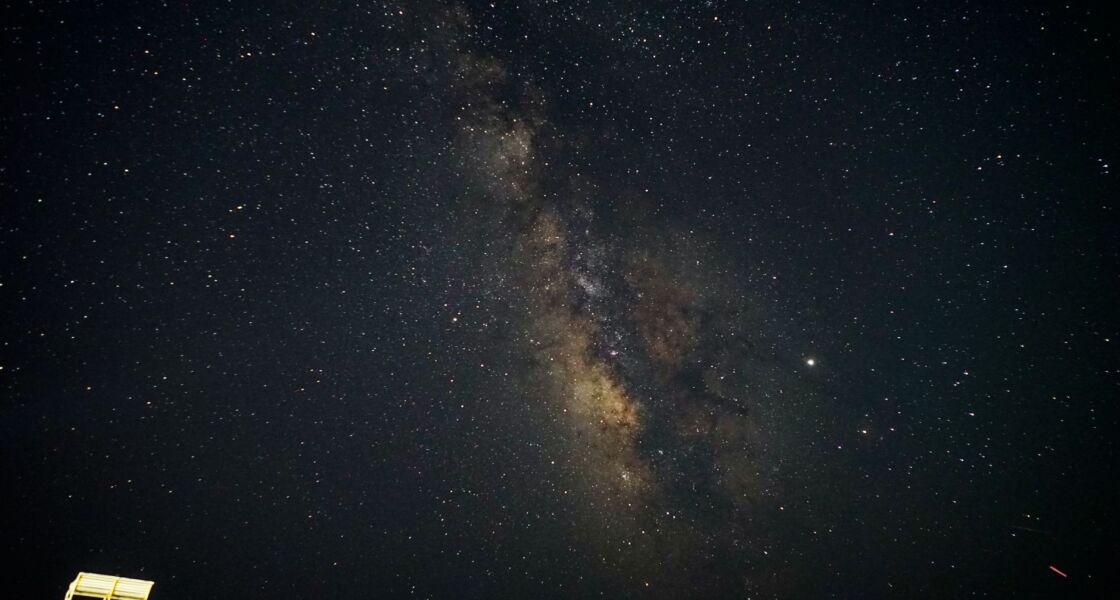
On a dark night, far from city lights, you can see a faint, cloudy stripe of light stretching across the sky. It looks like a spill of milk. That is exactly where the name comes from.
NASA explains that from Earth, the Milky Way looks like a faint, milky band of light arcing across the entire sky. That band is the flat disk of our galaxy seen edge on. We are looking along the disk from inside it, so billions of faraway stars blur together into one soft glow.
Most of those stars are too far away and too dim to pick out one by one. Your eyes see the glow instead. It is the combined light of a crowd.
What shape is our galaxy?
If you could fly far above the Milky Way and look down, you would see a giant spiral, a bit like a pinwheel. Stars in the disk are arranged in spiral arms, and they all orbit the center of the galaxy.
The middle is not round, though. The central bulge is stretched into a shape that resembles a peanut-shaped bar, with a half-length of about 10,000 light-years. A light-year is the distance light travels in one year. A galaxy with a bar like this is called a barred spiral, and that is what the Milky Way is. The bulge alone holds about 10 billion stars, mostly old and reddish.
Around the bulge sits the stellar disk, where most of the Milky Way’s stars live. NASA says the disk spans more than 100,000 light-years. ESA, the European Space Agency, describes it as flattened, with a radius of about 50,000 light-years but a height of only about 1,000 light-years. That makes our galaxy far wider than it is thick, like a very flat pancake.
Beyond the disk, a thin, ball-shaped cloud of stars called the stellar halo reaches out to a radius of about 100,000 light-years. It holds many globular clusters, tight balls of stars that are among the oldest in the galaxy.
Where is Earth in all this?
Not in the center, and not on the edge. Our Sun sits about 26,000 light-years from the galactic center, roughly halfway between the middle and the outskirts. NASA puts Earth along one of the galaxy’s spiral arms, about halfway from the center.
The giant at the center
At the very heart of the Milky Way sits a supermassive black hole called Sagittarius A* (say “A-star”). Its mass is about four million times the mass of the Sun. Its gravity governs the orbits of stars close to it. Some of those stars have been seen circling at distances of only a few light-days.
Our own neighborhood is far from all that. The Sun is about 26,000 light-years from the center, and it circles the middle of the galaxy along with all the other disk stars.
The part we cannot see
Here is a twist. Astronomers think the Milky Way is wrapped in an even larger halo of dark matter. Dark matter gives off no light, so we cannot see it. Scientists can only infer that it is there indirectly, from its gravity and its effect on how stars move in the galaxy.
So the Milky Way we see glowing overhead may be only part of the story. Much of it stays invisible.
Have we ever seen the whole thing?
Not exactly. Nobody has ever traveled outside the Milky Way to take a picture of it. The glowing spiral you see in books and on NASA pages is an illustration, built from what astronomers have measured from the inside.
That is a little like drawing a map of your whole town while you are standing in one backyard. It takes a lot of careful measuring.
A map with nearly two billion stars
How do we know so much about a galaxy we are stuck inside? Partly, a spacecraft named Gaia helped. From 2014 to 2025, ESA’s Gaia mission made more than three trillion observations of about two billion stars and other objects, tracking their positions and motions.
That sounds huge, but ESA notes that two billion stars is only about 1% of all the stars in the Milky Way. Gaia’s second data release alone pinned down positions for nearly 1.7 billion stars. For some of the brightest ones, the precision is like spotting a Euro coin lying on the Moon from Earth.
Our galactic neighborhood
The Milky Way is not alone. It sits in a group of more than 50 galaxies called the Local Group. The members range from small dwarf galaxies, with up to a few billion stars, to Andromeda, our nearest large galactic neighbor.
NASA notes that Andromeda is a barred spiral too. Like us, it has a bar-shaped center.
How to see it from the US
The trouble with seeing the Milky Way is the glow from our own lights. The National Park Service says the brightening of the night sky from human-made light is not limited to cities, and that the glow from cities has been documented at distances of over 200 miles from national parks.
So the best view comes from a truly dark place, away from town lights. The National Park Service also notes that light pollution keeps your eyes from fully adjusting to the dark, so give them time.
When you finally spot that faint stripe overhead, remember what you are seeing. It is the combined glow of a crowd of stars, and you are standing in the middle of it.