
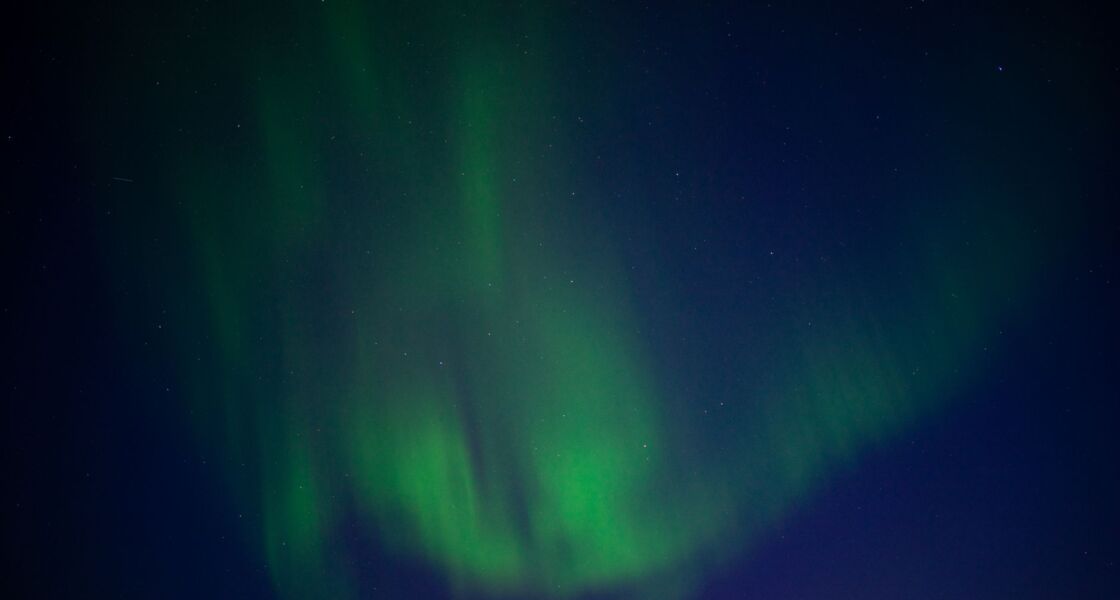
The northern lights are not one color. They can glow green, red, pink, blue and even purple. And the colors depend on two things you are breathing right now: oxygen and nitrogen.
The show happens far above your head. Charged particles from the Sun crash into those gases in the upper atmosphere, and the gases answer with light. Which gas gets hit, and how high up, decides the color.
A message from the Sun
The Sun is always sending out a stream of charged particles. Scientists call it the solar wind. It blows past Earth all day and all night.
Earth has a magnetic shield around it. When the solar wind meets that shield, energy can build up. When the energy is released, much of it pours down into the atmosphere, according to NASA. That is what sets off an aurora.
Here is the key step. Energetic particles from space collide with gases in our air. Each hit gives an atom or molecule a little extra energy. The gas cannot keep it, so it lets the energy go as light.
Think of a neon sign. Electricity goes in, and colored light comes out. An aurora works in a similar way, only the “sign” is miles tall and hangs in the sky.
The Geophysical Institute at the University of Alaska Fairbanks puts it simply. Earth’s upper atmosphere is mostly oxygen and nitrogen. Electrons from streams of charged particles strike those gas molecules, and the molecules then give off light.
So there are only two main ingredients, but they can make a whole box of crayons.
Green: the most common color
If you see an aurora, it is most likely green. NASA says green is the most common color. It comes from oxygen that gets excited by electrons about 60 miles (100 km) above the ground.
NASA lists green as forming between about 60 and 120 miles (100 to 200 km) up.
The Geophysical Institute at the University of Alaska Fairbanks has a name for this shade: the “oxygen green line.” It describes the color as pale green with a slightly yellow cast.
Red, pink, blue and purple
Oxygen is a two-color gas. Oxygen excited to different energy levels can produce green and red, NASA says. Red shows up higher, at about 120 miles (200 km) and above.
An aurora that is red from top to bottom is rare and memorable. The Geophysical Institute says those come from oxygen atoms very high in the atmosphere.
Nitrogen joins in too. NASA lists nitrogen as the source of blue light at 60 to 120 miles (100 to 200 km) up, and pink light at 60 miles (100 km) or lower. What you see depends on the type and energy of the particle that hits it.
Some auroras also have a red lower edge. The Geophysical Institute says that red border comes from nitrogen. Some nitrogen light is violet, a color our eyes pick up poorly. Other nitrogen light is closer to true red.
Colors can also blend. NASA says the light from different gases can mix, making an aurora look purple, pink or even white.
Why the lower edge seems to race
Auroras do not just sit there. They ripple, fold and flicker. The Geophysical Institute points to one clue in the colors themselves.
It says nitrogen lets go of its light faster than oxygen lets go of its green. The difference is perhaps about seven-tenths of a second, according to the Institute. That is why the red lower edge can seem to move faster than the green curtains above it.
Why you look north (or south)
Auroras are most often seen near the poles. NASA says they usually happen where a planet’s magnetic field lines meet its atmosphere. It also describes the polar cusp, a region of Earth’s magnetic field over the poles where energetic particles funnel into and out of the atmosphere.
The ones that stay near the Arctic and Antarctic circles happen far more often than the big storm-driven displays, NASA says. Those smaller, more regular shows come from events called geomagnetic substorms.
The same thing happens at both ends of the planet. In the north it is called the aurora borealis, or northern lights. In the south it is the aurora australis, or southern lights. “Aurora” is the Latin word for “dawn,” so aurora borealis means “northern dawn.”
Where to look in the United States
The National Park Service lists 13 parks where you may be able to catch a glimpse of the aurora, “if the conditions are right.” Eight are in Alaska. They include Denali National Park, Katmai National Park and Preserve, and Kenai Fjords National Park.
The rest are in the lower 48. They are Ebey’s Landing National Historical Reserve in Washington, Great Sand Dunes National Park and Preserve in Colorado, Isle Royale National Park in Michigan, Theodore Roosevelt National Park in North Dakota, and Voyageurs National Park in Minnesota.
NASA notes that large geomagnetic storms are relatively rare, so it pays to be patient. If you are curious about another sky color, read why the sky is blue.
A message from the Sun, delivered in oxygen and nitrogen.