
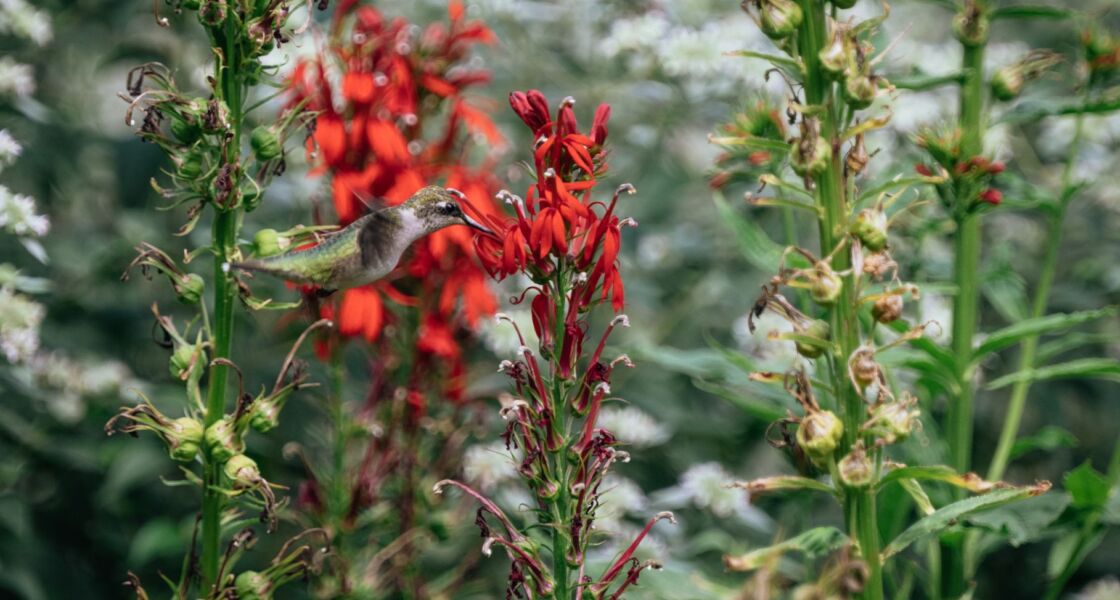
Twice a year, a bird that weighs less than a nickel flies out over open water and does not stop. No tree to rest on. No place to drink. Just the ruby-throated hummingbird, the shimmering green jewel of backyards across the eastern United States, taking on the Gulf of Mexico.
A Tiny Bird With a Big Engine
The ruby-throated hummingbird is small even for a hummingbird. It measures about 3 to 4 inches long and weighs roughly a tenth of an ounce, less than a US nickel.
Inside that small body is a busy engine. Its wings beat about 50 times every second. That is far too fast for our eyes to follow, so all we see is a blur and a hum.
Those wings do tricks almost no other bird can manage. A ruby-throated hummingbird can hover in one spot like a tiny helicopter. It can also fly straight backward, and even upside down, tipping and sliding through the air to reach a flower from any angle.
A Heart That Races
To keep those wings going, the hummingbird’s heart works overtime. While the bird is active, its heart beats about 1,200 times a minute. A human athlete sprinting hard reaches only around 150.
All that effort burns a lot of fuel. A ruby-throated hummingbird eats about twice its own body weight in food each day, mostly flower nectar and small insects and spiders. Picture eating twice your weight before dinner, every single day.
The Sleep That Looks Like Switching Off
A body that burns fuel this fast has a problem at night. The bird cannot feed in the dark, and a racing heart would run its tank dry before morning.
So the ruby-throated hummingbird has a trick. On cold nights it can drop into a deep, sleep-like state called torpor, which is a bit like a short, nightly version of hibernation. Its body cools down and its systems slow way down to save energy.
A bird in torpor looks almost switched off. It may hang upside down from a twig, still and cold, barely breathing. When the morning warms up, it slowly powers back up and gets on with its day.
A Nest the Size of a Walnut
The female builds one of the smallest nests you will ever find. It is a tiny cup, about the size of half a walnut shell, woven from soft plant fibers and bits of grass.
She binds it together with spider silk, which stretches as the chicks grow, then decorates the outside with flecks of lichen and dead leaves. The result is so well camouflaged that it can look like a small bump on a branch.
Inside, she lays two eggs about the size of coffee beans. She raises the chicks on her own, often high above the ground on a slender tree limb.
The Nonstop Flight Over the Gulf
Here is the part that stops scientists in their tracks. The ruby-throated hummingbird is the only hummingbird that nests across most of the eastern United States, and nearly all of them leave for the winter, heading to Mexico and Central America.
On the way, the birds reach the Gulf of Mexico, a stretch of open water hundreds of miles wide. Many of them simply fly across it in one nonstop trip, with no land to rest on in between.
It is a remarkable feat, but the full story has a twist. Not every bird crosses. Some ruby-throated hummingbirds take the open-water shortcut, while many others play it safer and travel the long way around, following the coast of Texas. Both routes end up in the same warm wintering grounds.
Fueling Up for the Crossing
A bird that might fly nonstop over the sea cannot leave on an empty stomach. Before the trip, ruby-throated hummingbirds feast and pack on fat, nearly doubling their tiny weight.
That stored fat is the fuel for the long haul. Flower by flower, the hummingbird turns nectar into enough energy to carry itself across water that would swallow a bird its size in an instant.
A Welcome Backyard Guest
You do not have to travel to meet one. From spring through early fall, ruby-throated hummingbirds visit gardens, parks and backyards all over the eastern US, drawn to red tubular flowers like trumpet vine and cardinal flower.
They will also sip sugar water from feeders, which is why so many people hang one by a window. Plain sugar water is best; the birds do not need the red dye some feeders add.
So the next time a hum buzzes past your ear and a flash of green hangs in the air, take a good look. That little blur may be weeks away from flying across an ocean’s worth of water, on wings beating fifty times a second.