
Picture a fish that makes its home inside an animal that stings almost everything else to death, then hardly ever leaves. That is the clownfish, and its whole life is stranger than the cartoon lets on.
A Safe House Made of Stingers
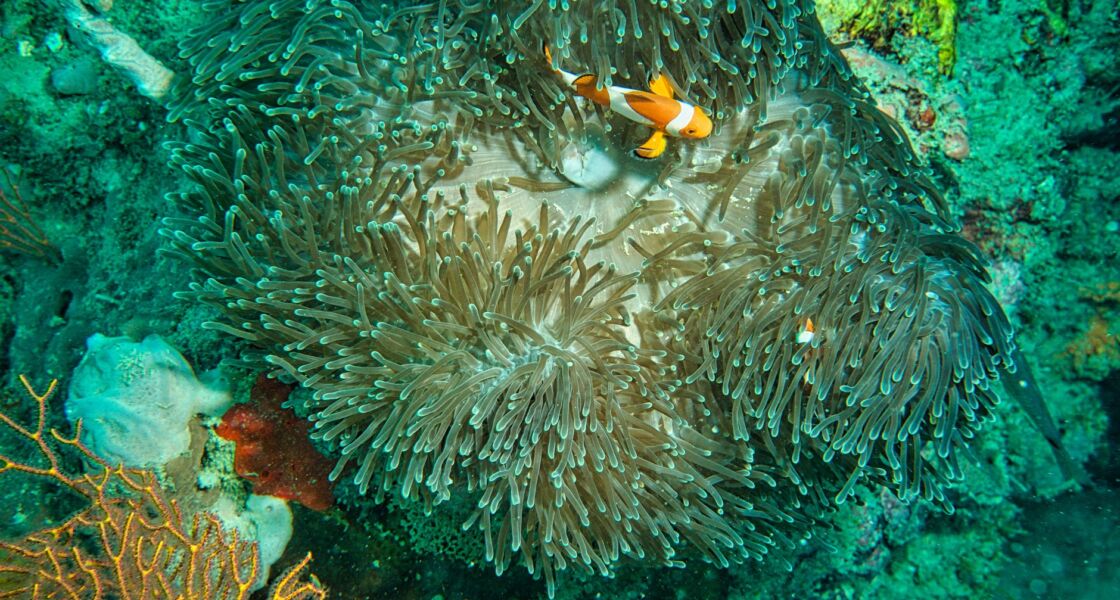
A sea anemone looks like a flower, but each of those waving tentacles can fire tiny stinging darts. Most small fish that drift too close become dinner. The clownfish swims right in and stays.
It gets away with this thanks to a special coat of slime. National Geographic says a layer of mucus on the clownfish’s skin makes it immune to the anemone’s lethal sting. So the fish can tuck itself among the tentacles that would harm almost any other visitor.
The clownfish does not get this protection for free. Before it moves in, it performs a careful dance, gently brushing its body and fins against the tentacles over hours or even days until a thick layer of mucus forms. Only then is it ready to call the anemone home.
Two Animals, One Deal
This living arrangement is a trade, and both sides come out ahead. Scientists call that mutual symbiosis, which just means two different species helping each other.
The clownfish gets a fortress. Tucked inside the stinging tentacles, it is safe from the bigger fish that would gladly eat it. In return, the clownfish works as a tiny guard and cleaner. According to National Geographic, it drives off intruders and preens its host, removing parasites.
The Monterey Bay Aquarium adds that the anemone also gets a share of the clownfish’s meals, snapping up the scraps that float by. The Florida Museum of Natural History notes the anemone may even benefit from the fresh water the fish fans over it as it swims.
Every Clownfish Starts Out Male
Here is the fact that surprises most people. Every clownfish is born male. National Geographic puts it plainly: all clownfish are born male, and they can switch their sex only to become the dominant female of a group.
And once a clownfish becomes female, there is no going back. National Geographic notes the change is irreversible. So in every anemone, the single breeding female was once a male that grew up and took the top job.
Scientists have a name for an animal that starts male and can turn female: a protandrous hermaphrodite. The clownfish is a classic example.
A Strict Pecking Order
Life inside an anemone follows strict rules of size. The Florida Museum of Natural History describes the ladder clearly: the largest fish is the female, the second largest is the breeding male, and the rest line up as non-breeders that get smaller the further down you go.
That order holds until something changes. If the breeding female dies, the museum says the largest male becomes the female, taking her place at the top. The next fish in line then steps up to become the breeding male.
So an anemone is not just a home. It is a tidy little society, ranked by size, with one queen and a waiting list behind her.
Homebodies of the Reef
For all the drama, a clownfish does not wander. It spends almost its entire life within and around a single anemone, rarely straying more than a few feet away. That host is its food source, its shelter and its nursery all at once.
That stay-at-home habit is why the cartoon idea of a clownfish crossing the ocean is such a stretch. In real life, a clownfish that loses its anemone is in serious trouble, because out in the open reef it has nowhere to hide.
You will not find clownfish just anywhere, either. The Monterey Bay Aquarium places them throughout the tropical Indo-Pacific, living among coral reefs. National Geographic adds that they are not found in the Caribbean, the Mediterranean or the Atlantic Ocean at all.
Small Fish, Big Appetite for Tiny Things
A clownfish is not large. The Monterey Bay Aquarium lists it at up to about 4.5 inches long, roughly the length of a chunky crayon.
What it eats is smaller still. The Florida Museum of Natural History lists a menu of algae, copepods, isopods and other zooplankton, the tiny drifting animals of the sea. The clownfish grabs bits that float past its anemone and tidies up leftovers from its host.
So the next time you see one peeking out from a nest of tentacles, remember what you are really looking at. A fish that was born male, lives in a stinging trap on purpose, keeps its whole world within a few feet, and might one day become the queen of it all.