
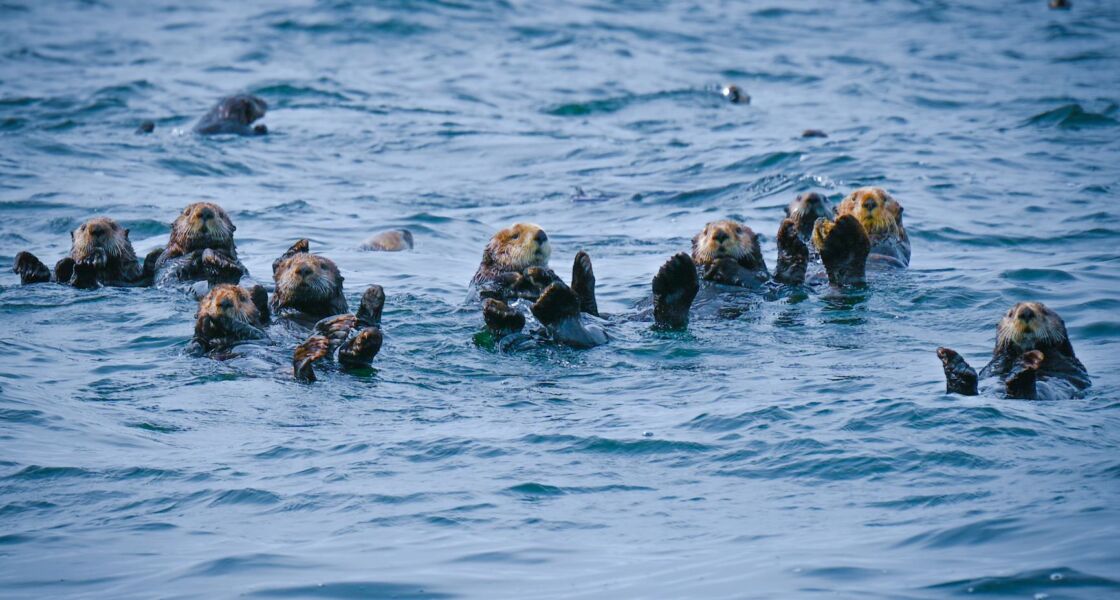
A sleeping sea otter has a problem. It floats on its back at the ocean’s surface, and the water keeps trying to carry it away. So sea otters rest together in groups, and sometimes hold onto each other, so the tide does not pull them apart in the night.
A Raft of Otters
When sea otters rest, they gather into floating groups called rafts. A raft can be just a couple of animals or a crowd of a hundred.
To keep from drifting while they rest, sea otters often wrap themselves up in kelp, the long ribbons of seaweed that grow up from the seafloor. The kelp works like a loose anchor, holding an otter in place while it dozes on its back.
Otters in a raft also rest close together, and are often seen holding onto one another. A mother will hold her pup on her chest. Side by side, wrapped in kelp or paw to paw, a raft stays together instead of scattering across the sea.
The Warmest Coat in the Animal Kingdom
Most ocean mammals, like whales and seals, stay warm with a thick layer of fat called blubber. Sea otters do not have that. Instead, they wear the densest fur of any animal.
How dense? Count the hairs on one square inch of a sea otter, roughly the size of a postage stamp, and you could reach somewhere between 850,000 and a million. A whole human head holds about 100,000 hairs. A sea otter packs more than that into a patch you could cover with your thumb.
That coat traps a warm layer of air against the otter’s skin, keeping the body near 100 degrees Fahrenheit even in chilly water. To keep the fur working, an otter spends hours a day grooming, blowing and rubbing air back into it. A clean coat is a warm coat.
A Tool and a Pocket
Sea otters eat hard food: crabs, snails, clams, mussels and sea urchins. Cracking all that open takes a tool, and the otter has one. It uses a rock.
Floating on its back, an otter rests the rock on its chest like a little anvil and pounds a shell against it until the shell breaks. Sea otters are one of the few animals that use tools this way.
They also come with built-in pockets. Under each front leg is a flap of loose, baggy skin. An otter tucks food into these pouches during a dive, then carries the meal, and sometimes a handy rock, up to the surface to eat.
They need all that food. A sea otter eats about a quarter of its own body weight every single day, the fuel its fast body burns to stay warm.
The Otter That Guards a Forest
Here is where one small animal changes a whole seascape. Sea otters are what scientists call a keystone species, an animal whose presence holds an entire habitat together.
It comes down to sea urchins. These spiny creatures munch on kelp, and if nothing eats the urchins, their numbers explode. A swarm of hungry urchins can mow down a kelp forest until only bare rock is left.
Sea otters eat sea urchins. By keeping the urchins in check, otters let the kelp grow tall and thick. Those underwater forests then shelter fish, crabs and countless other animals.
Scientists have watched this happen for real. Where sea otters disappeared, urchins multiplied and clear-cut the kelp down to bare rock. Where otters returned, the forest grew back. Take the otters away, and the forest can vanish. Bring them back, and it recovers.
From California to Alaska
Sea otters live in the cold coastal waters of the North Pacific. In the United States you can find them along the central coast of California and in the cooler seas of Alaska, where they rest in the giant kelp forests near shore.
They are the smallest marine mammal in North America, yet they spend nearly their whole lives at sea, floating, grooming, diving and resting on the open water. A sea otter can live up to about 23 years in the wild.
So the next time you picture an otter, picture this: a small, warm animal wrapped in a ribbon of kelp, a rock balanced on its chest, holding on so the sea cannot carry it away.