
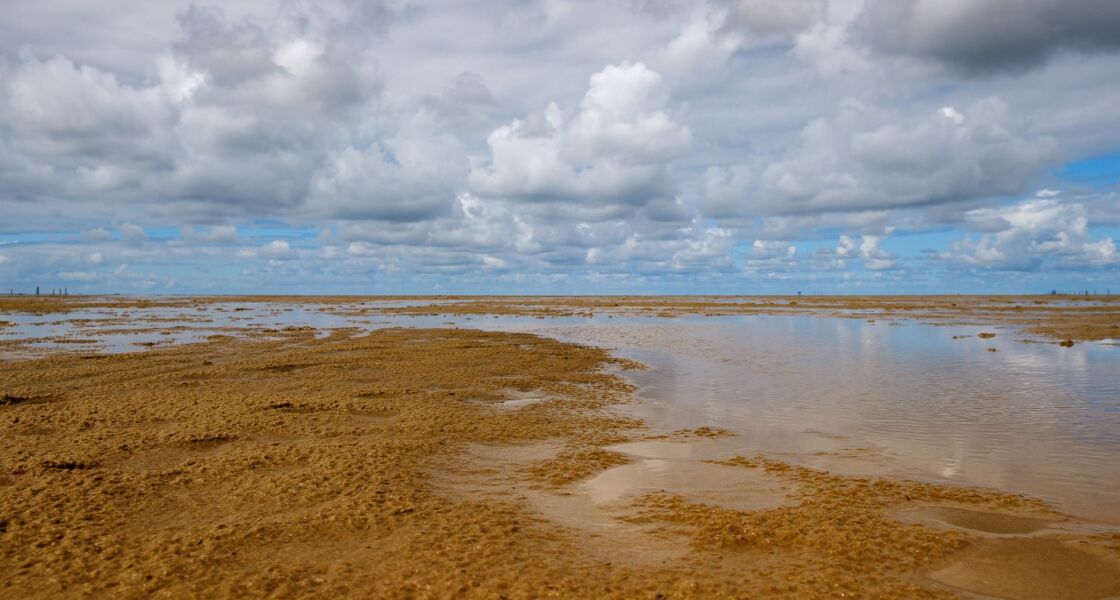
Twice a day, in slow motion, the ocean leans against the land and then backs away. The water climbs up the beach, covers the rocks, floats the boats, and then slides back out, leaving wet sand and tide pools behind.
Something has to be pulling all that water around. And the thing doing most of the pulling is far out in space: the Moon.
The Moon Tugs on the Sea
Everything with mass has gravity, a pull that tugs on everything around it. The Moon has plenty, and even across all that empty space it reaches out and tugs on Earth, including our oceans.
The water on the side of Earth facing the Moon is the closest, so the Moon pulls it the hardest. That water gets drawn toward the Moon and heaps up into a gentle mound. Scientists call that mound a tidal bulge. When your stretch of coast rotates into a bulge, the sea climbs higher and you get a high tide. When it rotates out of one, the water drains away into a low tide.
So a tide is not a quick wave. It is one enormous, slow swell of the whole ocean, rolling in and out as the planet turns.
Why Most Coasts Get Two High Tides a Day
Here is the part that surprises people. There is not one heap of high water. There are two, on opposite sides of the planet, and only one of them points at the Moon.
The near bulge is easy to picture. The Moon pulls that close water toward itself. But the Moon’s gravity grows weaker with distance, so the water on the far side of Earth feels the weakest pull of all. That water gets left behind and bulges outward on the opposite side.
The result is two bulges of high water, one facing the Moon and one facing away. As Earth spins through them, most coastlines pass through both in a day. That is why most shorelines get two high tides and two low tides, not just one.
The 24-Hour-and-50-Minute Day
That 50-minute drift is not random. While Earth spins once, the Moon has moved a little farther along its own orbit, traveling in the same direction Earth turns. So Earth has to spin an extra 50 minutes to line back up with the Moon.
That stretch of time is called a lunar day, and it runs about 24 hours and 50 minutes, a bit longer than the day on your clock. Packed inside it are two highs and two lows. High tides come about 12 hours and 25 minutes apart, and it takes roughly 6 hours and 12 minutes for the water to creep from low all the way up to high.
That slow pace is why the ocean seems to breathe. In and out, a little later every day, keeping time with the Moon instead of the Sun.
The Sun Joins In
The Moon runs the show, but it is not pulling alone. The Sun has gravity too, and it tugs on the oceans as well.
You might expect the Sun to win easily, since it is far more massive than the Moon. It has about 27 million times the Moon’s mass. But it is also around 390 times farther away, and distance drains gravity’s tide-raising strength fast. In the end, the Sun’s pull on the tides comes out to a little less than half the Moon’s. So the Sun does not run the tides, but it can nudge them bigger or smaller.
Spring Tides and Neap Tides
Twice a month, around the new moon and the full moon, the Sun, the Moon and Earth line up in a row. When they do, the Sun’s pull adds to the Moon’s, stacking the bulges higher. The highs climb extra high and the lows drop extra low. These big swings are called spring tides, though they have nothing to do with the season.
About a week later, the Moon sits at a right angle to the Sun, in the quarter-moon phases. Now the Sun’s pull works against the Moon’s and partly cancels it. The tides go mild, with highs that are not very high and lows that are not very low. Those gentle tides are called neap tides.
So the ocean runs on two clocks at once. The Moon sets the daily rhythm of highs and lows, and the Sun swings the whole pattern bigger and smaller as the month turns.
A Wave as Wide as an Ocean
Scientists describe a tide as a wave, but not the kind you ride at the beach. It is a wave with a crest and a trough stretched across an entire ocean. The crest is your high tide; the trough is your low tide. The gap between them, measured top to bottom, is the tidal range.
That incoming, outgoing water even has its own names. The water rushing in toward shore is called the flood current, and the water sliding back out to sea is the ebb current.
So the next time you watch the sea climb a beach and then slip away, picture the Moon far overhead, quietly pulling the whole ocean along behind it.