
Do ostriches bury their heads in the sand when they get scared? It is one of the most repeated animal “facts” around, and it turns out the bird never does it at all.
Picture the cartoon version: a giant bird with its whole face plunged into the dirt, tail feathers sticking up, waiting for trouble to pass. It is a funny image, and that is part of why it stuck. People even use the phrase for a person who refuses to face a problem. But a real ostrich would suffocate long before it hid that way, so where did the story come from?
Where the idea comes from
The myth is old and it travels well, because a picture that vivid is hard to forget even when it is wrong. And it comes from something real.
Watch an ostrich from far away and you can see how an onlooker might fill in the rest of the story the wrong way. The bird really does put its head down near the ground, for a couple of good reasons, and distance does the rest.
The verdict: Myth
Myth. Ostriches do not bury their heads in the sand. The San Diego Zoo and National Geographic both say so plainly. The bird does lower its head to the ground for real reasons, and from a distance that can look like a head disappearing into the dirt.
So the image that launched a thousand cartoons is a mix-up, not a behavior. The next time someone pictures an ostrich with its face plunged underground, you can tell them the bird is doing something much smarter.
Reason one: turning the eggs
Ostriches do not build nests up in trees. They scrape a wide, shallow pit right into the ground and lay their eggs in it. The eggs sit down low in the dirt, so the parents have to reach down low to look after them.
Several times a day, an ostrich pokes its head and neck into that pit to turn the eggs over, the way you might rotate something baking so it cooks evenly. From across a field, all you might see is a huge bird with its head down near the sand, moving things around. The Smithsonian’s National Zoo points to exactly this habit as a likely source of the myth.
Reason two: hiding by lying flat
The other reason is a clever escape trick. When an ostrich feels threatened and cannot outrun the danger, it can drop to the ground and lie flat, stretching its head and long neck straight out along the dirt.
Up close it is still clearly a very large bird. But from a distance, with its pale head and neck pressed to pale ground, the ostrich can look like a low mound or a bush. National Geographic describes this as an optical illusion: the head seems to vanish into the sand. The ostrich is not hiding its eyes from the world. It is trying to make its whole self hard to spot.
Meet the real ostrich
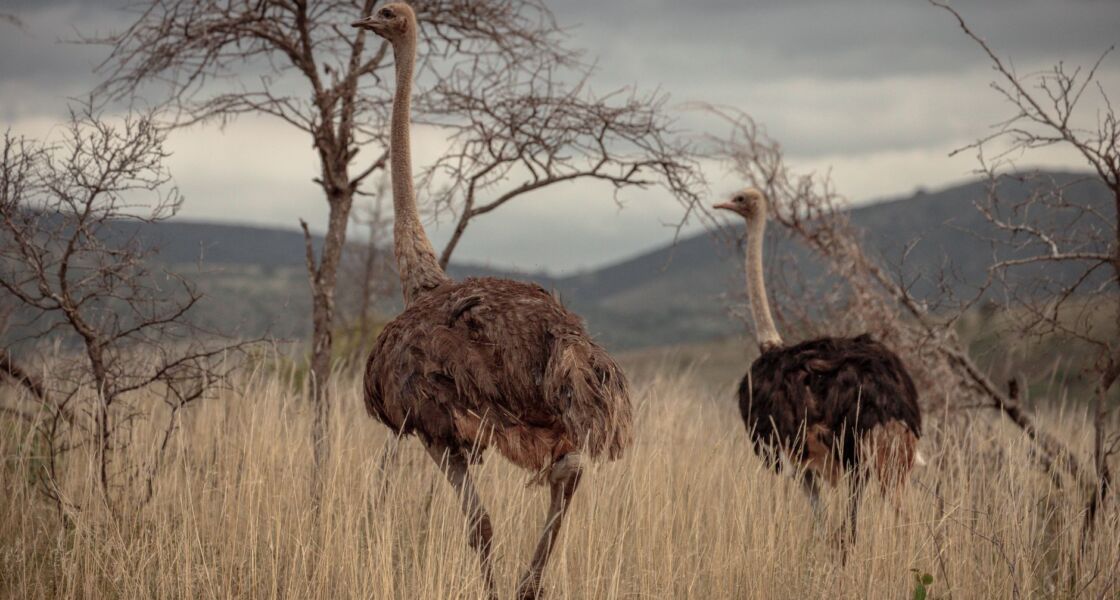
Once you set the myth aside, the actual bird is far more impressive. The ostrich is the largest and heaviest living bird on Earth. Including its neck, a grown ostrich can stand up to about 9 feet tall, and adults weigh somewhere between 200 and 300 pounds (90 to 136 kilograms). That is roughly half the weight of a motorcycle, walking around on two legs.
Those legs are the real headline. An ostrich cannot fly, but it is the fastest bird on land. The San Diego Zoo says it can sprint in short bursts up to about 43 miles per hour and hold a steady 31 miles per hour over longer distances. Few animals could chase one down, which is exactly why hiding is a last resort rather than a first move.
The legs are also the ostrich’s main weapon. Each foot has just two toes, one of them tipped with a long, sharp claw. If a predator gets too close, the bird kicks forward with enough force to injure or even kill a lion. An animal that can do that has very little reason to stick its head in the ground and hope for the best.
Big eyes, big eggs
Those enormous eyes are not just for show. They give the ostrich sharp, long-range vision across open grassland, so it can spot a lion or a cheetah while it is still far away and simply run. Good eyesight and fast legs are a much better survival plan than hiding, and it is the plan the bird actually uses.
The eggs are record-breakers too. A single ostrich egg is about 6 inches (15 centimeters) long and can weigh around 3 pounds (1.4 kilograms), which is roughly two dozen chicken eggs in one shell. It is the largest egg laid by any living bird. Sitting low in that ground nest, an egg that size is worth bending down to tend several times a day.
The smarter bird underneath the myth
So the ostrich never buries its head, and it would be a strange thing for such a well-equipped animal to do. Instead it watches the horizon with the biggest eyes on land, runs faster than almost anything chasing it, and kicks hard enough to stop a lion when running is not an option.
The old saying got one small thing right: the ostrich does put its head down near the sand. It just does it to care for its eggs or to flatten out of sight, never to pretend the world has gone away.