

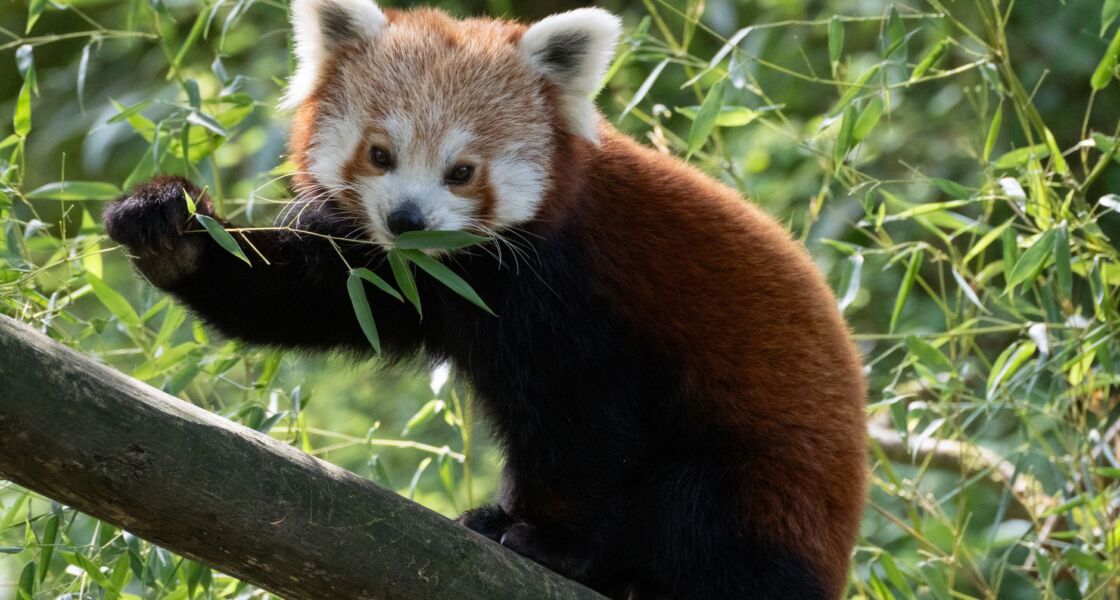
The red panda is not a panda. It is not a raccoon, either, even though it has a raccoon’s ringed tail. It is the only living member of its own animal family, and it has been sitting in a tree eating bamboo while scientists argued about where it belongs.
Meet the red panda: an animal about the size of a house cat, dressed in rusty fur, with a white-masked face and a long, ringed tail.
Is a red panda a panda?
Sort of, and mostly no. The giant panda and the red panda share a name and a love of bamboo, but they are not in the same family. Scientists once filed the red panda with raccoons and bears. Then DNA research showed it deserves a spot of its own.
That spot is a family called Ailuridae, and the red panda is its only living member. Its nearest relatives are in a big group of mammals that includes weasels, otters, raccoons and skunks. So the red panda is a little like a cousin who moved far away and developed some very particular habits.
It is still in the order Carnivora, the big group of mammals known as meat-eaters. That fact becomes important in a moment.
A bamboo eater with a meat-eater’s gut
Bamboo makes up about 95 percent of what a red panda eats, according to the Smithsonian’s National Zoo. Another study puts it at over 90 percent. This animal is picky, too. It chooses the most nutritious leaf tips and tender shoots, and can eat up to four pounds (1.8 kg) of bamboo in a day.
Here is the twist: a red panda still has the digestive system of a meat-eater. Researchers describe it as keeping digestive features typical of carnivores, even though it lives on plants.
A red panda does not live only on bamboo. It also nibbles roots, grasses, fruit and insects, and sometimes grubs, birds and small mammals. But bamboo is the main course, and young pandas switch to it after they stop drinking their mother’s milk.
The false thumb
Look closely at a red panda’s paw and you will not find a real thumb. You will find something clever: an extra-long wrist bone that works almost like one. Scientists call it a pseudo-thumb, which means “false thumb.”
The red panda uses it to grip bamboo while it eats. Giant pandas have a similar wrist bone for the same job. It is a handy trick for an animal that spends most of its life in trees.
A tail that does two jobs
The red panda’s tail is long and bushy, about 15 to 19 inches (37 to 47 cm). Its rings alternate between red and buff, a pale, sandy tan.
The tail helps with balance when the animal climbs, and it works like a scarf. It protects the panda from cold and wind. In very cold weather, a red panda can curl up in a tight ball to hold in its heat. In winter, red pandas also climb trees to sunbathe.
Life in the high forest
Red pandas live in cool, high-altitude forests with bamboo growing underneath. Their home stretches across the Himalayas and other high mountains, from Nepal and India to northern Myanmar and parts of China.
In zoos, they are mostly active at dawn and dusk and spend only about 45 percent of the day awake. They are solitary, apart from breeding season. A single panda may roam an area of about one square mile.
They are also pretty quiet. Their calls are small: squeals, twitters and a funny sound known as a huff-quack.
A red panda even tests smells with its tongue. The underside of the tongue has a cone-like structure that collects liquid and brings it close to a gland inside the mouth. The Smithsonian’s National Zoo says the red panda is the only carnivore with this adaptation.
Cubs, and a possible second species
Females typically have one to four cubs at a time. Males show little or no interest in the babies.
The red pandas of China may be a separate species from the ones elsewhere in the Himalayas. National Geographic notes that the Chinese animals have a larger body and more distinct rings on the tail. The question is still open.
How many are left?
The red panda is listed as Endangered by the International Union for Conservation of Nature, or IUCN. The Smithsonian’s National Zoo says its population is believed to have fallen by about 40 percent over the past two decades.
It is legally protected in India, Bhutan, China, Nepal and Myanmar. Counting a shy animal in thick mountain forest is hard, so the exact number of red pandas in the wild is still a mystery.