

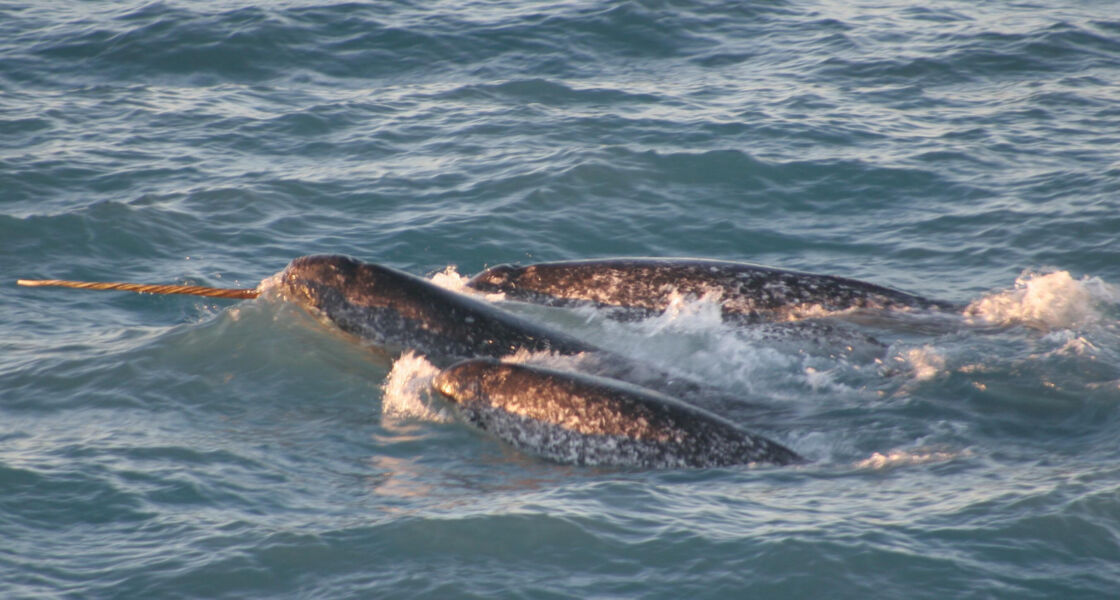
The narwhal is known as the “unicorn of the sea,” and its spiral “horn” sticks out nearly ten feet in front of its face. But it is not a horn at all. It is a tooth.
Narwhals are whales that live in the Arctic. The tusk is the thing everyone remembers, yet scientists are still working out what it is for.
A tooth that grows through the lip
A narwhal tusk is a long, spiral tooth from the upper jaw. In males, the left tooth usually grows forward through the lip when the whale is two or three years old. It can reach about 9.8 feet (3 m) long and weigh more than 20 pounds (9 kg).
Most narwhals have only one tusk. The other tooth stays hidden inside the jaw on the opposite side of the mouth. Some narwhals do grow two tusks, and some females grow one, though most females keep their tooth tucked inside.
The tusk is built in a surprising way. Harvard researchers describe it as a hard rod in the center wrapped in a flexible outer layer. That is the opposite of a human tooth, which is hard on the outside.
A tooth that can feel the sea
Most of us think of a tooth as a tool for chewing. The narwhal’s may be more like an antenna.
The outer layer of the tusk is full of tiny pores, called tubules. A research team led by dental researcher Martin Nweeia found nerves and sensory-related genes in the tooth that help connect it to the brain. They reported the work in a 2014 paper in the journal The Anatomical Record.
The team also tested living narwhals. They fitted a clear tube over the tusk and sent water that was very salty or less salty over it. The animals’ heart rates changed depending on the water. The whales were released unharmed in under 30 minutes.
That does not settle everything. NOAA Fisheries says the tusk may help narwhals sense changes in their surroundings, but it lists other possible jobs too.
So what is the tusk for?
Nobody has one tidy answer. NOAA Fisheries says its main job is to act as a status signal. It lets males show off without fighting. It may also play a role when females choose a mate.
Then came a surprise from the sky. In 2017, footage came out of narwhals filmed by drone in Tremblay Sound, Nunavut, Canada. Adam Ravetch shot it for WWF Canada, with researchers from Fisheries and Oceans Canada. The footage showed narwhals using their tusks to stun Arctic cod by hitting them. A stunned fish is an easier meal.
So the tusk may be a status badge, a sensor and a fishing tool all at once. The experts are still sorting that out.
Built for the frozen north
Narwhals live in the Arctic Ocean, mostly on the Atlantic side. Their main range stretches from central Canada to Greenland and eastern Russia.
An adult is about 13 to 16 feet (4 to 4.9 m) long and weighs roughly 1,760 to 3,530 pounds (800 to 1,600 kg).
Their color changes with age. Young narwhals are brownish-gray. Teenagers are black with white mottling. Adults slowly lighten until they are white with black mottling.
Narwhals follow the ice through the year. In winter they stay in the pack ice and breathe through cracks and holes. In spring they move toward inshore waters, in summer to the coast, and in fall back out to open water.
Deep, long dives
Narwhals feed at or near the bottom in deep water. They use suction from their mouths to catch fish such as Arctic cod, polar cod and turbot, plus squid and shrimp.
To reach that food, they can dive up to 3,937 feet (1,200 m) and stay down for up to 25 minutes. That is about three-quarters of a mile down.
Groups, calves and lifespan
A pod usually has two to ten narwhals. In summer, in open water, they can gather in groups of hundreds to thousands.
A calf is born in summer. It is about 5 feet (1.5 m) long and weighs about 176 pounds (80 kg). Narwhals are known to live at least 25 years and may reach 50.
How the narwhal is doing
In the United States, narwhals are protected under the Marine Mammal Protection Act. NOAA Fisheries lists climate change, hunting and loss of sea ice among the things that affect them.
A whale of the frozen north, and a mystery that still hangs on a single tooth.