
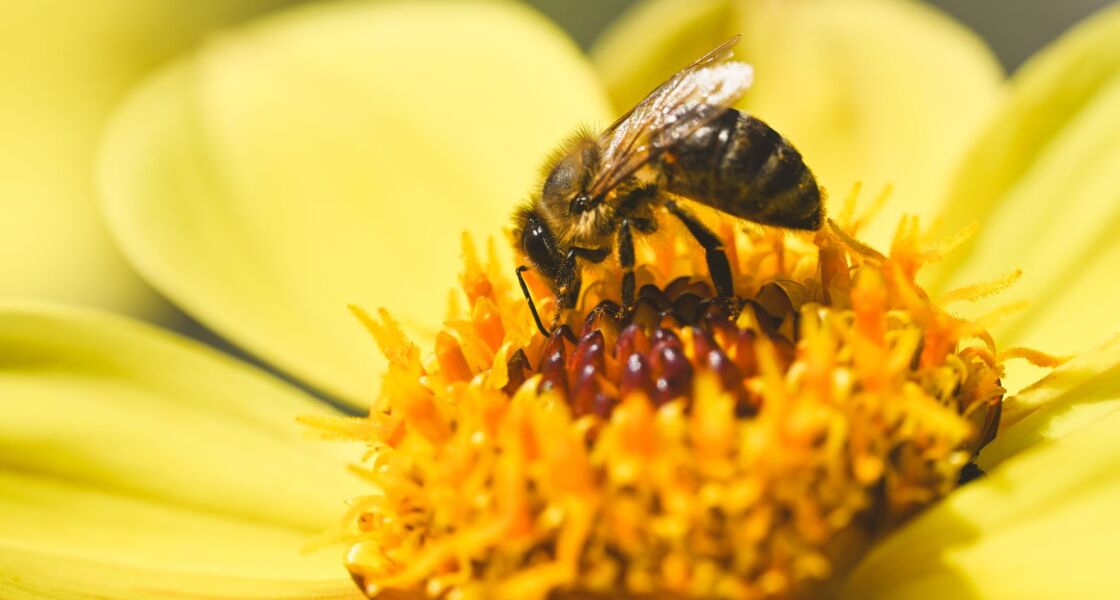
Deep inside a beehive, in total darkness, a honeybee is giving directions. She can’t point. She can’t speak. So she dances. She runs in a straight line, shaking her body from side to side, then loops back and does it again. To the bees crowded around her, that little shimmy is a map. It tells them which way to fly and how far to go to find flowers.
Scientists call it the waggle dance, and it may be one of the most surprising forms of animal communication we know of.
A map made of movement
A honeybee colony is a city of tens of thousands of bees. There is one queen, who mostly lays eggs. There are a few hundred males, called drones. And there are the workers: thousands of females who do nearly every other job, from cleaning cells to guarding the entrance to flying out for food.
When a worker finds a good patch of flowers, she doesn’t keep the secret. She flies home and tells the others. The hard part is that the flowers might be in any direction, and might be close or far. A buzz won’t cover it. So she turns the information into a dance that her sisters can read with their bodies in the dark.
The heart of the dance is the straight part in the middle, where she waggles. That waggle run carries two pieces of news at once: which way to fly, and how far.
How a wiggle points the way
Here is the clever part. Bees dance on the wall of the hive, which hangs straight up and down. The angle of the waggle run compared to straight up tells the other bees the angle they should fly compared to the sun.
If the dancer runs straight up, it means “fly toward the sun.” If she runs straight down, it means “fly away from the sun.” If she runs at an angle off to the left, the flowers are at that same angle to the left of the sun. The bees watching translate “up” into “the sun” and head out the door at exactly the right heading.
Distance gets its own code. The longer the waggle run lasts, the farther away the flowers are. A short shimmy means a short trip. A long one means pack a lunch.
The scientist who cracked the code
For a long time, nobody knew what the dance meant. Then an Austrian scientist named Karl von Frisch spent years watching bees and worked it out. Starting in the late 1920s, he noticed that a bee returning with nectar performed a special pattern, a kind of dance that showed the other bees nearby where to find the food.
It was such an important discovery that in 1973 von Frisch shared the Nobel Prize in Physiology or Medicine, together with two other animal-behavior scientists, for their work on how animals act and communicate. Not bad for watching bugs dance in a box.
Why bees go to all this trouble
Flowers are a moving target. A field that is full of blossoms today might be bare next week, and a fresh patch might open up a mile away overnight. A hive that can quickly send a crowd of foragers to the best flowers has a real advantage. The dance is how the whole colony shares a changing map, hour by hour.
And the payoff is sweet, literally. Bees drink nectar, the sugary liquid inside flowers, and carry it home. Back at the hive, they turn that nectar into honey by adding an enzyme and fanning it dry with their wings. They also gather pollen, a dusty protein that feeds the growing young.
All that flower-hopping does something else, too. As a bee brushes against one bloom and then the next, she carries pollen from flower to flower. That is pollination, the step many plants need to make seeds and fruit. A huge share of the crops people eat depend on bees and other pollinators doing exactly that.
A language without words
Think about what the waggle dance really is. A tiny animal flies out into a huge world, finds one good spot among thousands, flies home, and describes both the direction and the distance to her neighbors, all without a single word, in a room where no one can see.
Bees have been doing this for millions of years, long before anyone was around to watch. The next time a honeybee lands on a flower in your yard, remember: she may be memorizing the spot. And later, in the dark, she just might dance about it.