
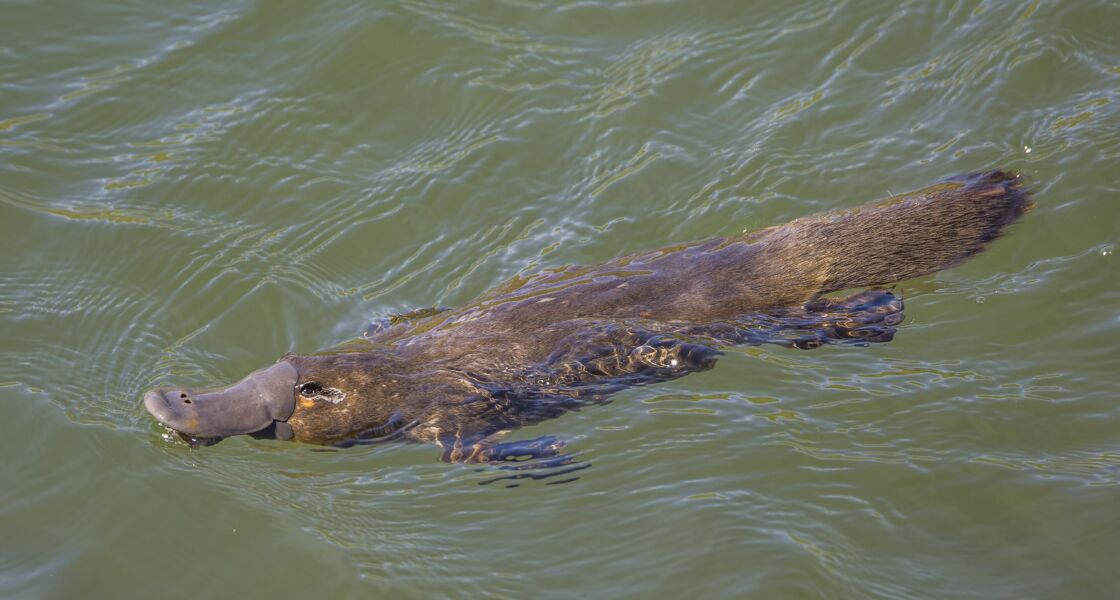
Picture an animal with the bill of a duck, the tail of a beaver, and the webbed feet of an otter. Then learn that it lays eggs, hunts with its eyes shut, and carries venom in its ankles. That animal is real, and it lives in the rivers of eastern Australia.
A Mammal That Lays Eggs
The platypus is a mammal. It has fur, and the mother feeds her young with milk. But it does not give birth to live babies the way almost every other mammal does. It lays eggs.
The platypus and the echidna are the only living mammals that lay eggs. Scientists call them monotremes. A female platypus usually lays one to three eggs, most often two, and the eggs hatch after about ten days.
The babies are tiny and helpless when they hatch. The mother has no nipples, so milk simply seeps out through her skin, and the young lap it up from grooves in her fur.
It Hunts With Its Eyes Closed
Here is the strangest part of the platypus story. When it dives to hunt, it shuts its eyes, its ears, and its nostrils. It cannot see, hear, or smell its prey. And yet it finds food in the dark, muddy water with ease.
The secret is in that rubbery bill. The bill is packed with about 40,000 tiny sensors called electroreceptors. Every time a shrimp flicks its tail or a worm wriggles, its muscles give off a faint electrical signal. The platypus feels those signals and homes in on the exact spot.
This sense is called electroreception. It lets the platypus build a kind of map of moving prey using nothing but the tiny sparks their bodies make. The bill also senses pressure, so the animal can tell how far away something is.
One of the Few Venomous Mammals
Most mammals are not venomous. The male platypus is an exception. On the back of each ankle, he has a sharp, horny spur connected to a venom gland in his thigh.
The venom is not meant for hunting. Males use their spurs mostly against other males during the breeding season. A jab is not deadly to a person, but it causes pain so intense it can last for weeks, and the venom can kill a medium-sized dog.
Built for a Life in Water
The platypus is made for swimming. Its front feet are webbed well past the claws, turning them into broad paddles. It pulls itself through the water with those front feet and steers with its back feet and flat tail.
When it climbs onto land to dig a burrow, the webbing on the front feet folds back out of the way, so the claws can do the digging. The tail does double duty, too. It stores fat the animal can live on when food is scarce.
A platypus has thick, waterproof fur that traps a layer of air and keeps the skin dry even after hours in cold water. That fur hides another oddity, one that no one noticed for a very long time.
Fur That Glows in the Dark
In 2020, scientists shining ultraviolet light on museum platypus specimens found something no one expected. Under normal light the fur looks plain brown. Under UV light, it glows a soft blue-green.
The study, published in the journal Mammalia, used preserved platypuses from a museum in Chicago. It was the first time this kind of glow, called biofluorescence, had been seen in an egg-laying mammal.
Nobody is quite sure why the fur glows. One idea is that it helps the platypus hide from predators that can see UV light. It is also possible the glow does nothing useful at all, and is simply a leftover from the animal’s distant ancestors.
No Teeth and No Stomach
A grown platypus has no teeth. When it scoops up a mouthful of insect larvae, shrimp, and worms, it also grabs bits of gravel from the riverbed. It stores the food and the gravel in cheek pouches, then grinds the meal between the grit and tough pads in its mouth.
It also lacks a true stomach. Most animals have a stomach that makes acid to break down food. In the platypus, the stomach has been reduced to a simple widening of the food tube, and it no longer makes that acid, so the meal runs almost straight to the gut.
A platypus eats a great deal to fuel all this hunting. It can forage for ten to twelve hours and needs to eat close to a fifth of its own body weight each day.
A River Animal of Eastern Australia
Wild platypuses live only in the freshwater rivers, streams, and lakes of eastern Australia, from the tropical far north of Queensland all the way south to the cool island of Tasmania. They are shy and active mostly at night, so many Australians have never seen one in the wild.
For a small animal, the platypus can live a long time. In the wild and in zoos, individuals have reached around twenty years of age. Every one of those years is spent doing something that breaks the usual rules for mammals, which is exactly what makes the platypus so hard to forget.