
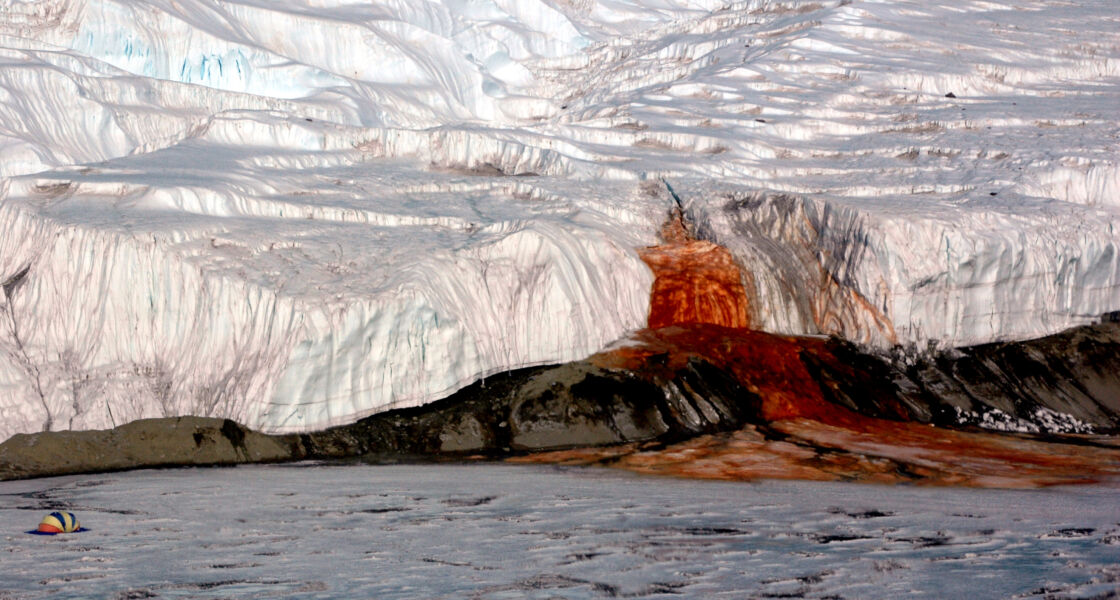
In one of the whitest places on Earth, there is a red stain. It spills down the face of a glacier in Antarctica, and it is one of the strangest sights on the continent.
It is called Blood Falls. The name is only a description of the color. There is no blood in it. What comes out of that ice is salty, iron-rich water that has been hidden beneath the glacier.
A Red Stain at the Edge of Taylor Glacier
Blood Falls sits at the end of Taylor Glacier, in a part of Antarctica called the McMurdo Dry Valleys. Scripps Institution of Oceanography describes it as a red-stained outflow that spills from the face of the glacier into a cold, dry landscape.
The Dry Valleys are an odd corner of the continent. Researchers describe them as the largest ice-free region in Antarctica, covering roughly 4,000 square kilometers (about 1,500 square miles). It is a polar desert, with strong winds, almost no precipitation and bitter cold.
Against that pale, frozen backdrop, a stream of orange and deep red stands out like a paint spill on a white tablecloth.
People once guessed the cause was something living. National Geographic notes that the color was initially chalked up to red algae. Later work pointed to something much simpler: iron.
Why the Water Turns Red
The secret is what happens when the water meets the air.
Deep below the glacier, the brine (very salty water) is rich in iron. At its source it has no oxygen in it at all. Scientists who studied the outflow report that when this brine flows out from under the glacier and is exposed to the atmosphere, it becomes oxidized. Oxidation is a chemical change that happens when iron meets oxygen. As it happens, a red salt cone, the part we call Blood Falls, builds up at the edge of the ice.
So the water is not red when it starts its journey. The air does the painting. Fresh from underground, the brine is carrying iron. Out in the open, that iron changes, and the stain appears.
The red shows up on the ice, but it is a mineral color. It is not a sign of anything alive and bleeding, and it is not algae.
How Salty Water Keeps Flowing in the Freezer
Here is a puzzle. If it is that cold, why does the water not simply freeze solid?
National Geographic reports on a study in the Journal of Glaciology that used radar to peer into the ice. The team found that the brine stays liquid through two things working together. One is its high salt content. The other is the heat released when water freezes, which scientists call latent heat.
Think of how salt is spread on an icy road. Salt lowers the temperature at which water turns to ice. In the brine under Taylor Glacier, there is a lot of salt. When some of the water does freeze, it gives off a little heat, which helps keep the rest from freezing.
The imaging also revealed a network of subglacial rivers and a subglacial lake, a body of water beneath the glacier, all filled with brine high in iron.
Where All That Salt Came From
Salty water in the middle of a continent of ice raises an obvious question. How did it get there?
Researchers who analyzed the water think it began as seawater. In a 2007 study of Blood Falls, the authors wrote that the brine is thought to be a remnant of seawater from the last time the sea flooded into the Dry Valleys, about 5 million years ago. Back then, the valleys were fjords, which are long, narrow inlets of the sea.
The idea is that the ocean once reached in, then retreated. Some of the water got sealed under the ice and stayed there. Over time, the cold concentrated the salt even more. The authors say the brine is “thought to be” a remnant of seawater, so treat the date as a best estimate, not a certainty.
Today, the brine does not simply pour out nonstop. The researchers say it drains out episodically, meaning in bursts.
Life Without Sunlight
Now for the part that surprises almost everyone. That hidden brine is not empty.
When researchers studied the water coming from Blood Falls, they found bacteria living in it. In the 2007 study, about 46 percent of the bacterial gene library matched a microbe related to Thiomicrospira arctica, a cold-loving marine bacterium that gets energy from sulfur. The authors concluded that the brine under Taylor Glacier hosts a living community that gets its energy from chemicals in iron and sulfur compounds.
That matters because the world under the glacier is permanently dark. There is no sunlight to power plants or algae. Instead, these microbes use chemistry. The researchers wrote that the physical isolation, constant low temperatures and permanent darkness make the setting ideal for studying how such communities work.
The story keeps growing. In 2026, a study in Nature Geoscience reported molecular evidence of an active community of tiny organisms with marine ties in the red mud and sediment near the glacier’s end. The team looked at 167 samples. Marine-associated diatoms, single-celled algae with glass-like shells, made up more than 60 percent of the diatom community in samples near Blood Falls.
The researchers say that does not mean there is a frozen copy of an ancient ocean there. It means the place may be keeping traces of an older link between the Dry Valleys and the sea.
A Window Into Old Antarctica
Blood Falls is a small stain on a very big continent. Still, it gives scientists a rare look at how life can hang on in cold, salty, dark and isolated places.
It also reminds us that a landscape can hide long stories. A red trickle on a white wall of ice carries iron from underground, salt from an ancient sea and tiny living things that never see the Sun.
Not bad for a waterfall that is mostly a stain.