
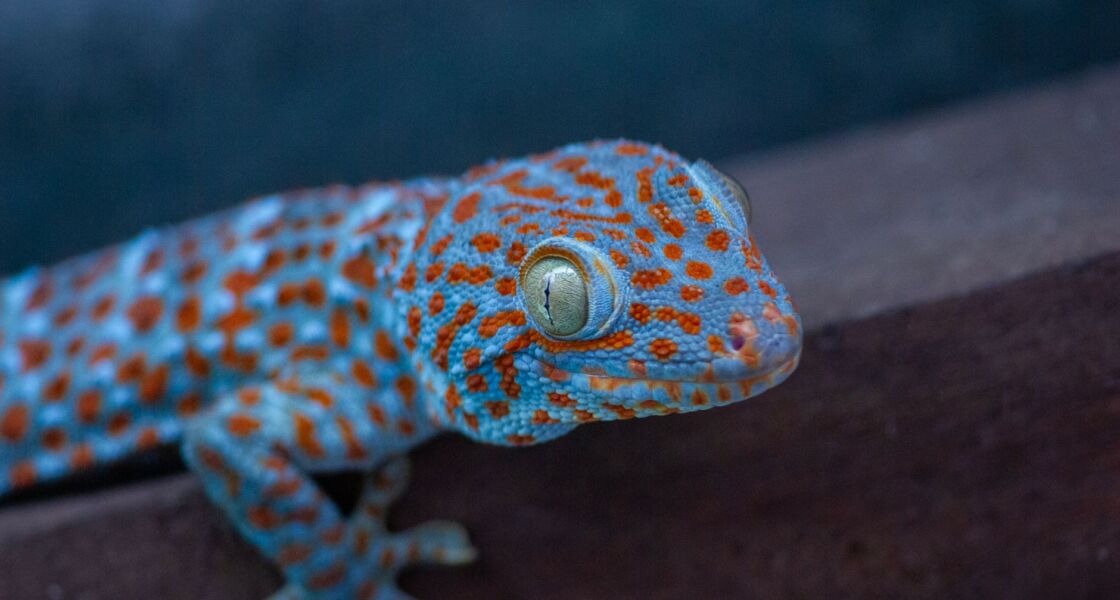
A gecko can run straight up a glass window and hold its whole body weight with a single toe. It has no glue and no suction cups. What it has is a foot covered in hairs too small to see.
Hairs on Every Toe
Look at a gecko’s toe pad under a microscope and you will find millions of tiny hairs called setae (say it SEE-tee). The word is plural. One hair is a seta.
Each seta is only about as long as two widths of a human hair. At its tip, it splits into about 1,000 even smaller pads called spatulae. Each one is around 200 billionths of a meter wide, which is smaller than the wavelength of visible light.
The setae are made of keratin, a tough natural material. A gecko’s foot is not sticky like tape. There is no glue anywhere on it.
The Force That Does the Work
So what holds the gecko on? Around the year 2000, scientists tested the old ideas one by one. Geckos have no glue glands and leave no residue. Suction does not explain it, because geckos can stick to a smooth surface even in a vacuum. Friction alone cannot hold an animal on a ceiling.
The answer is van der Waals forces: very weak attractions between molecules that only work across tiny distances. One pair of molecules barely notices them. But the hairs let about a billion spatulae get close to the surface at once, and all those weak pulls add up.
The result is strong. A single seta can lift an ant. A million setae, which would fit on the area of a dime, could lift a 45-pound child. The Smithsonian’s National Zoo says the grip of a tokay gecko can support about 450 pounds.
Unsticking Is the Hard Part
Sticking is easy for a gecko. Getting off the wall is the real challenge, and a running gecko has to do it again and again.
Researchers found that a gecko uncurls its toes onto the wall, like a party favor that unrolls when you blow into it. A small push into the surface and a small pull backward makes the hairs grip. To let go, the angle of the hairs gets steeper. At that angle, the hairs simply pop off the wall.
Because of this trick, a gecko running up a wall can stick and unstick its feet about 15 times a second. A later review by the same lead researcher says geckos can attach and detach their toes in milliseconds.
A Foot That Cleans Itself
Tape picks up dust and quickly stops working. Gecko feet seem to do the opposite. In one experiment, scientists clogged the hairs with tiny dirt particles. Five steps later, the hairs were clean again.
Geckos have not been observed grooming their feet, yet the pads keep working between shedding cycles. Researcher Kellar Autumn describes gecko setae as the first known self-cleaning adhesive. Geckos can stick to nearly every material, and the adhesive works underwater and in a vacuum.
Where the Grip Gets Weaker
Even a gecko has limits. In a 2022 study, University of California, Riverside researchers tested tokay geckos on eight surfaces, from very smooth acrylic glass to rough 100-grit sandpaper. Rough surfaces gave much lower adhesion than smooth ones.
That makes sense. The hairs need to touch the surface up close, and a rough surface leaves gaps. The same study found something else. Setal density, how tightly the hairs are packed, stayed constant as geckos grew from about 5 grams to about 125 grams. A hatchling’s hairs are packed as tightly as an adult’s.
Meet the Tokay Gecko
The tokay gecko is one of the largest geckos alive. It lives in southeast and east Asia, in rainforests, rock crevices and buildings, where it eats insects that bother people. In the US, tokays have settled in Hawaii and Florida.
Its colors are a trick of their own. Tokays can lighten or darken their skin to blend in. Skin folds along the body open up while the gecko rests on a tree, so it casts no shadow.
If a predator grabs it, a tokay can drop its tail. The tail keeps moving for several minutes, which gives the gecko time to escape. A new tail grows back in about three weeks, though usually not as long as the first.
And the name? It comes from the male’s loud call, a “to-kay” repeated in a crescendo that can be heard several meters away.
Geckos live on every continent except Antarctica, and every one of them is a little masterclass in tiny forces.