
Start with one small fact that changes how the whole thing looks: the melted rock inside a volcano is lighter than the solid rock around it. So it floats upward, slowly, the way a bubble climbs through water.
That rising rock is the real engine of an eruption. By the time you see lava, the hard part is already over. To understand why volcanoes erupt, it helps to follow that melted rock from deep underground all the way to the surface.
First, the rock has to melt
Most of the ground beneath your feet is solid, even far down. Melting rock is not easy, and it does not happen just because a place is hot. Something has to tip the balance.
The National Park Service describes two main ways it happens. In some places, hot mantle rock rises and the pressure on it drops, and that lets it melt. In other places, water is the trick. When one slab of the planet’s crust slides down beneath another, water gets carried down with it and released into hot rock above. National Geographic explains that this water slightly lowers the melting point of that rock, forming magma that can work its way toward the surface.
Scientists have a useful habit here. They call the melted rock magma while it is still underground, and lava only once it erupts and reaches the surface. Same rock, two names, depending on where it is.
Why the magma rises
Once rock melts, it is less dense, which is a scientist’s way of saying lighter for its size. The U.S. Geological Survey, writing about Hawaii, puts it plainly: the magma is lighter than the surrounding solid rock, so it rises through the mantle and crust.
Picture a drop of oil let go at the bottom of a glass of water. It does not need a push. Being lighter is enough, and up it goes. Magma does the same thing through cracks and weak spots in the rock, gathering in pockets and pushing higher over time.
This is also why volcanoes tend to line up in certain places rather than popping up at random. Most sit along the edges of the giant plates that make up the planet’s surface, where plates pull apart or grind together and the rock below is melting. A smaller group sits over hotspots instead.
The part that makes it an eruption
Rising magma is only half the story. The other half is gas.
Deep down, under enormous pressure, magma holds gases dissolved inside it, mostly water vapor, carbon dioxide, and sulfur dioxide. You cannot see them, because the pressure keeps them tucked away in the liquid rock. It works a lot like a bottle of soda. The gas is in there the whole time; you just cannot see it while the cap is on.
Now open a soda, or shake it first, and watch what happens. As the pressure drops, the gas rushes out as bubbles, fast. Magma does the same thing as it climbs toward the surface and the pressure on it falls. The dissolved gas comes out of the liquid and forms bubbles that expand and push upward. That expanding gas is what turns a slow rise into an eruption.
Quiet lava or a violent blast
Here is where volcanoes split into two very different moods, and it mostly comes down to one thing: how runny the magma is.
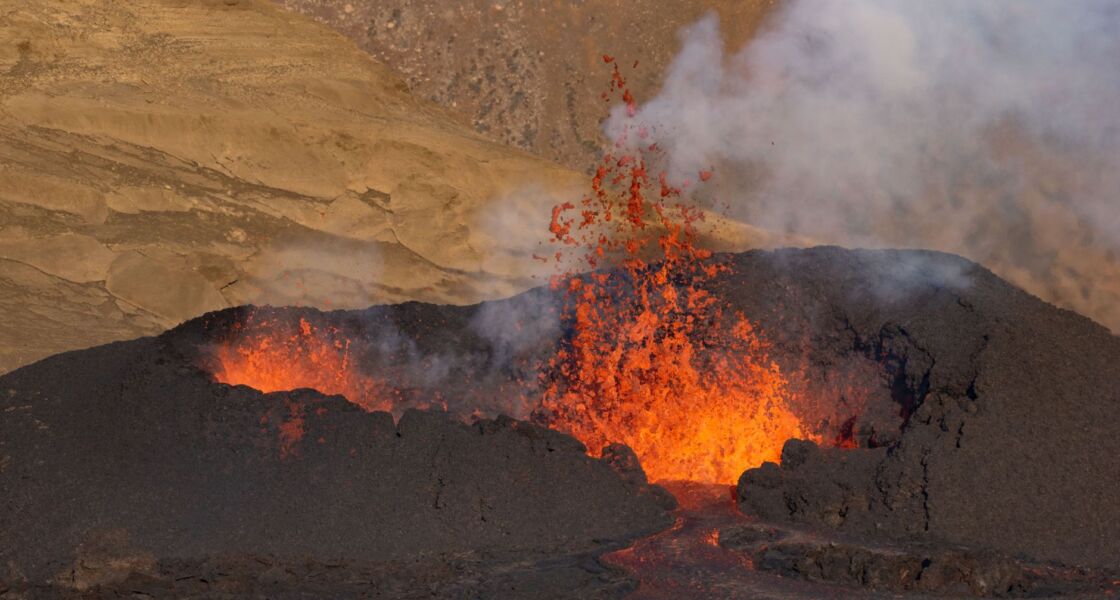
National Geographic lays out the two patterns. When magma is thin and runny, the gas bubbles can slip out easily. The pressure never builds up much, so the volcano simply oozes. Lava fountains and flows spill down the slopes, bright and dramatic but fairly gentle. This is the Hawaiian style, and people can often watch it from a safe distance.
When magma is thick and sticky, the gas cannot escape. The bubbles get trapped, pressure builds and builds, until the magma finally breaks free all at once. The U.S. Geological Survey notes that the most spectacular eruptions blast great clouds of gas-laden debris into the sky. These are the explosive ones, like Mount St. Helens, that send ash and gas high into the air.
So the same basic recipe, melted rock plus trapped gas, can make a calm river of glowing lava or a towering cloud of ash. The difference is mostly whether the gas gets a quiet exit or has to force its own.
How far the gas can travel
Those gases do not just vanish once they are out. The biggest eruptions push them so high they circle the whole planet.
When Mount Pinatubo erupted in the Philippines in 1991, NASA reports that it sent an estimated 20 million tons of sulfur dioxide and ash more than 12 miles (20 km) into the atmosphere. Up there, the sulfur gas turned into a haze of tiny droplets that scattered some of the sunlight heading for Earth. For two to three years afterward, that thin veil slightly cooled the lower atmosphere, a reminder that a single volcano can reach far past its own slopes.
None of this is a sign the planet is getting rougher, by the way. National Geographic notes that at least a dozen volcanoes are erupting on any given day, and that eruptions today are no more frequent than they were a century ago. Volcanoes have been melting, rising, and releasing their gas for a very long time. They are just doing what lighter-than-rock, gas-filled magma does when it finds a way up.