
November gives you long, early nights and a sky full of things to find. You do not need a telescope for most of them. You just need to step outside, let your eyes adjust for a few minutes, and look up.
Here is the short version: a supermoon on Thanksgiving week, two meteor showers known for slow fireballs, a famous little cluster of stars climbing the eastern sky, and a lineup of bright planets before dawn. Let’s walk through the month.
The full Beaver Moon rises on November 24
November’s full moon is called the Beaver Moon, and in 2026 it reaches its fullest point on Tuesday, November 24, at 9:53 a.m. Eastern Time. Because that peak happens in daylight for the US, the best time to look is the evenings on either side of it, Monday the 23rd and Tuesday the 24th, when the moon rises big and bright in the east around sunset.
This one is a supermoon, which means the moon is near its closest point to Earth. The Farmers’ Almanac puts that distance at about 360,768 kilometers, close enough that the moon looks a little larger and brighter than usual. It is the first of three supermoons in a row, with more in December and January.
Why “Beaver Moon”? One old explanation is that beavers spend October and November shoring up their lodges and dams before the ground freezes. Another ties it to the fur trade, when November marked the start of the trapping season.
Two meteor showers that favor fireballs
Before the moon gets bright, the first half of November belongs to the Taurids. There are actually two of them: the Southern Taurids, which peak around November 4 to 5, and the Northern Taurids, which peak around November 11 to 12. Both appear to stream out of the constellation Taurus the Bull.
The Taurids are not a big show by the numbers. You might see only about 5 to 10 meteors an hour from the Southern branch and around 5 from the Northern one. But they are famous for quality over quantity. They are slow movers, and the bits of comet dust that make them tend to be larger than average, so every so often one flares into a bright, colorful fireball that lingers a moment longer than you expect.
The Taurids trace back to Comet 2P/Encke, which keeps looping through the inner solar system and shedding debris. Earth plows through that debris every autumn, which is why the Taurids show up like clockwork and why some people call their fireballs the “Halloween fireballs.”
Then, in the middle of the month, the Leonids take over. They peak on the night of November 17 into the morning of the 18th and radiate from the constellation Leo the Lion. In 2026 the timing is kind: the first-quarter moon sets around midnight, so the darkest, best viewing hours have no moonlight washing out the sky.
The Leonids are a modest shower too, with roughly 10 to 15 meteors an hour under a truly dark sky. What they lack in numbers they make up for in speed. These are some of the fastest meteors of the year, hitting our atmosphere at about 71 kilometers per second, fast enough to leave a quick, bright streak. They come from Comet 55P/Tempel-Tuttle.
How to actually watch a meteor shower
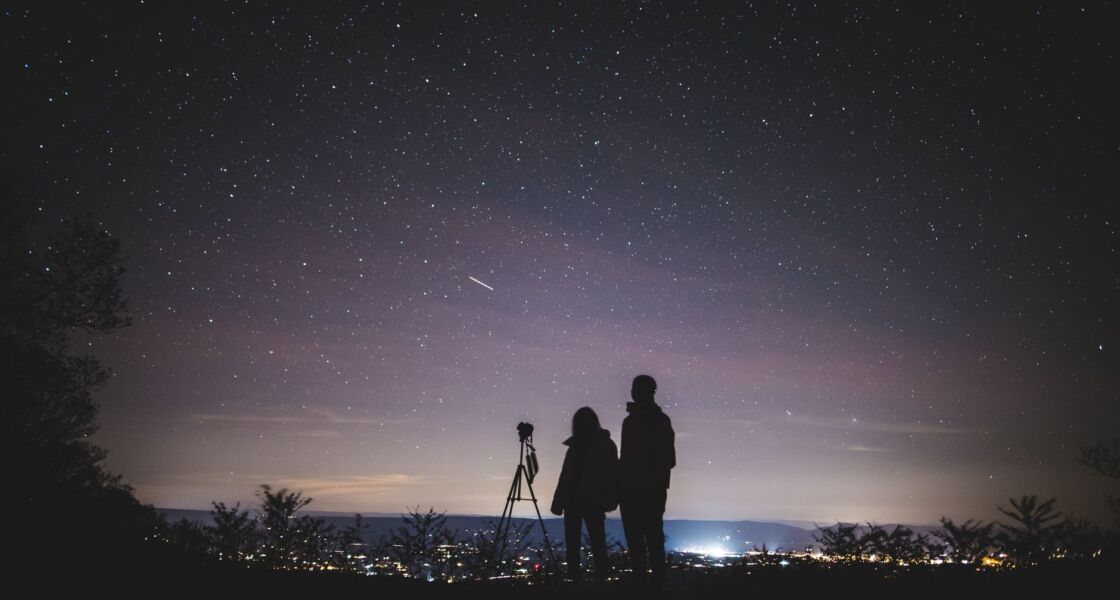
The advice is the same for all of them and it is refreshingly low-tech. Find the darkest spot you can, lie back, and look up at a wide patch of sky rather than one spot. Give your eyes at least 15 to 20 minutes to adjust, and keep your phone screen off so you do not reset them.
You do not need to stare at the constellation the meteors are named for. The shooting stars can appear anywhere overhead; the radiant is just the direction they seem to come from. For both the Taurids and the Leonids, the hours after midnight into the pre-dawn are usually best.
Bright planets gather before dawn
November mornings have a planet show of their own. Reddish Mars and brilliant white Jupiter spend the month in the late-night and pre-dawn eastern sky, and they draw closer together as the weeks pass. Around November 15 and 16 they pass within less than a degree of each other, right next to the bright star Regulus in Leo, a tight, eye-catching pairing.
Super-bright Venus is also there, very low in the east just before sunrise, and Mercury joins the group later in the month, reaching its highest point around November 20. For a stretch from about November 13 to 22, four planets line up in the morning sky at once. Over in the evening, yellowish Saturn is the easy one, sitting in the southeast at sunset and riding high in the south through the evening.
Telling a planet from a star is simple once you know the trick: planets usually shine with a steady light, while stars twinkle. Jupiter and Venus are the brightest points up there, so if something in the pre-dawn east is almost too bright to be a star, that is probably one of them.
Find the Pleiades, autumn’s little dipper of stars
If you want one easy target to point out to anyone standing next to you, make it the Pleiades. This small, sparkly cluster, also called the Seven Sisters, rises in the east in the evening and climbs higher as the night goes on. November is the best month of the year to see it, when it is up essentially all night long.
Most people spot six or seven of its stars with the naked eye, close together in a tiny shape that looks like a miniature version of the Big Dipper. Under a really dark sky, sharp eyes can pick out around 14. The cluster holds far more stars than that; roughly 3,000 belong to it, most of them too faint to see without help.
Finding it is easy. Locate the three stars of Orion’s Belt, follow that line toward the bright orange star Aldebaran in Taurus, and keep going in the same direction. Just past Aldebaran you will reach the little knot of blue-white stars. A pair of binoculars turns that handful into dozens.
Pick one clear night this month, step outside, and see how many of these you can tick off. The sky does the rest.