
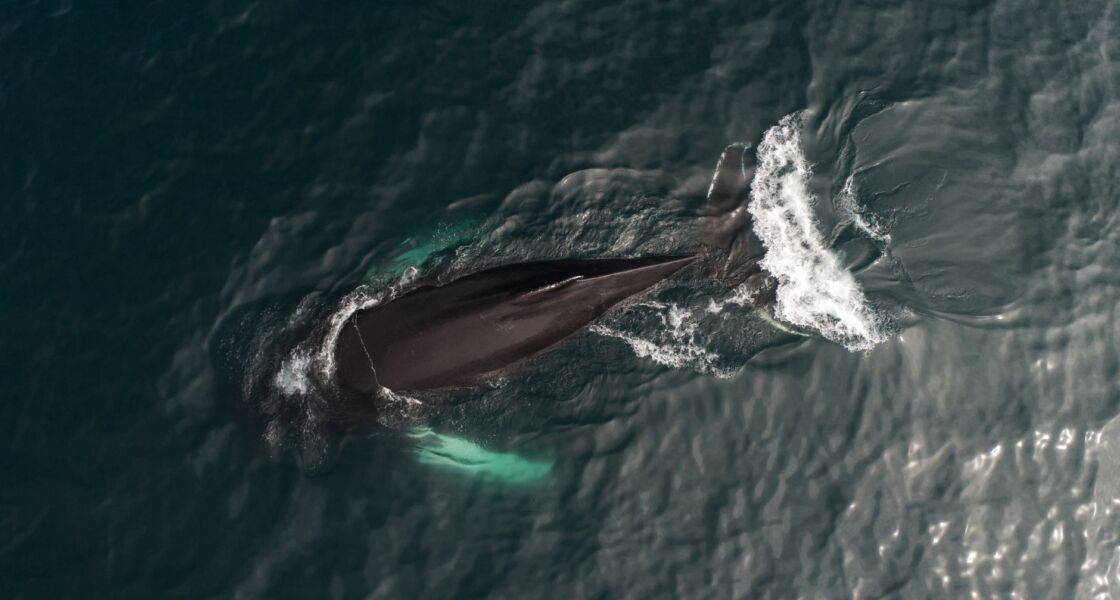
No animal has ever been bigger. Not the largest dinosaur, not anything. The blue whale can grow up to about 110 feet long, and its heart is the size of a small car.
Longer Than a Basketball Court
A blue whale can stretch up to about 110 feet, which is longer than a basketball court. It can weigh up to around 200 tons, and some estimates run even higher. That is heavier than a loaded tractor-trailer, several times over.
A newborn is already enormous. Calves are about 23 feet long at birth, roughly the length of a city bus, and they drink around 100 gallons of their mother’s milk a day. They pack on weight fast, because being huge is the whole plan.
Blue whales are a kind of baleen whale, which means they have no teeth. Instead, the upper jaw holds rows of stiff, bristly plates called baleen that work like a giant strainer.
A Giant That Eats Tiny Things
Here is the surprise. The biggest animal that has ever lived survives almost entirely on one of the smallest. Blue whales eat krill, tiny shrimp-like animals that are mostly no longer than your thumb.
To eat, a blue whale swims toward a swarm of krill with its mouth wide open, takes in a huge gulp of water, then pushes the water back out through the baleen. The krill stay behind, trapped on the bristles, and the whale swallows them down.
It takes an astonishing number of these little animals to feed something so big. In the busy feeding season, a blue whale can eat up to about 4 to 6 tons of krill in a single day. The Monterey Bay Aquarium puts the daily haul at up to around 7,900 pounds, which works out to roughly 40 million krill.
A Heart the Size of a Car
Everything about a blue whale is built on a scale that is hard to picture. Its heart is as large as a small car. Its tongue can weigh as much as an elephant, about two to four tons on its own.
A body that long needs a big engine to move it, and a big engine needs a big pump. So the heart grew to match, slowly beating as the whale glides through the cold, open ocean.
Among the Loudest Animals Alive
Blue whales are among the loudest animals on the planet. They make deep, low rumbles, so low that much of the sound sits below what human ears can hear.
Those calls carry a remarkable distance underwater. NOAA Fisheries says blue whales can hear each other from up to 1,000 miles away. The Monterey Bay Aquarium measures their sounds at around 188 decibels and says they can reach other whales hundreds of miles off.
Scientists think the whales use these far-reaching calls to stay in touch across the vast, dark ocean, where you cannot simply look around to find a friend. In water that stretches for hundreds of miles, a voice that travels is worth having.
Where Blue Whales Live
Blue whales swim in every ocean on Earth except the Arctic. Along the United States, they turn up off the West Coast, off Alaska, and off New England and the mid-Atlantic.
Many blue whales follow the food. In summer they feed in cooler waters near the poles, where krill gather in huge swarms. As winter comes, some travel toward warmer waters closer to the equator. Not every blue whale makes the trip, but those that do cover thousands of miles.
They are not very social. Blue whales usually travel alone or in pairs, and only now and then gather in small, loose groups. For such a loud animal, it lives a mostly solitary life.
A Comeback Still Underway
For all its size, the blue whale was no match for commercial whaling. From 1900 to the mid-1960s, roughly 360,000 blue whales were killed, according to National Geographic. The hunting pushed the species to the edge.
Protection arrived in 1966, when the International Whaling Commission banned the hunting of blue whales. Even so, the recovery has been slow. Oceana notes the species has been slow to bounce back, and the Monterey Bay Aquarium estimates about 15,000 blue whales remain today, with roughly 2,000 off California.
The blue whale is listed as endangered under the United States Endangered Species Act. NOAA Fisheries records it as protected throughout its range. Today’s biggest dangers are ship strikes and getting tangled in fishing gear.
The largest animal that has ever lived is still out there, somewhere in the open ocean, calling to the others in a voice too deep for us to hear.