
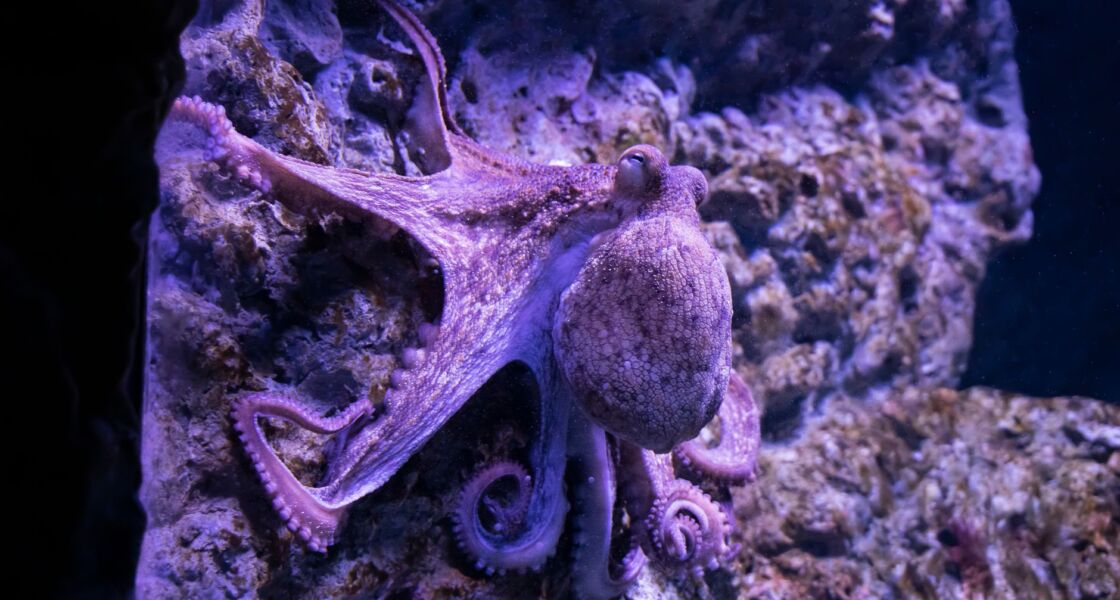
The giant Pacific octopus has three hearts. Two of them pump blood through its gills. The third drives that oxygen-rich blood out to the rest of its soft, boneless body.
Three hearts and blue blood
Those three hearts do one big job: keep oxygen moving through a soft, boneless body that lives in cold, dark water. Two smaller hearts send blood through the gills to pick up oxygen. The one larger heart then pumps that oxygen-rich blood to the arms, the eyes and everything in between.
Here is the part that catches people off guard. An octopus does not have red blood. It has blue blood. The color comes from a copper-rich protein called hemocyanin, which carries oxygen the way the iron in our red blood does. Copper tints the blood blue instead of red, and it works well in the chilly Pacific where this animal lives.
The biggest octopus in the sea
There are around 300 kinds of octopus, and this one is the heavyweight champion. Stretched from the tip of one arm to the tip of another, a giant Pacific octopus usually spans at least 7 feet (2 m), and often more than 13 feet (4 m). Picture a creature as wide as a small car is long.
A full-grown adult commonly weighs more than 50 pounds. The heaviest on record, according to the Monterey Bay Aquarium, was a giant that tipped the scales at around 200 pounds. Not bad for an animal that starts life hatching from an egg about the size of a grain of rice.
About 2,000 suckers that can taste
Run your eyes down one of those eight arms and you will find rows of suction cups. A female giant Pacific octopus has roughly 2,240 of them in total, and a male has about 100 fewer. That is close to 2,000 suckers on a single animal.
The suckers are not just for gripping. The octopus can smell and taste with its arms. So when an octopus reaches into a dark crack in the rocks, it is tasting the hiding spot before it ever sees what is inside.
Those arms do the hunting. A giant Pacific octopus is a carnivore, and its menu is mostly hard-shelled seafood: crabs, clams, scallops, shrimp, lobster and fish. The suckers pin a crab in place while the octopus pulls it close. Then a hard beak, hidden where the arms meet, cracks the shell open like a nutcracker.
A master of disguise
The giant Pacific octopus is one of the ocean’s best quick-change artists. Under its skin sit millions of tiny stretchy cells called chromatophores, each holding a dot of color. By squeezing and relaxing those cells, the octopus can shift its color and even its skin texture to match the rocks and seaweed around it.
It is clever, too. In aquariums, a giant Pacific octopus can learn to open jars, work through simple puzzles and tell its human caretakers apart. Because it is boneless, it can also pour its soft body into surprisingly tiny spaces, tucking itself into cracks and crevices in the rocks.
For an animal with no shell and no skeleton, a sharp brain, a quick disguise and a boneless, squeezable body are the best armor it has.
A short, dramatic life
All of this happens fast. A giant Pacific octopus usually lives only about three to five years. Near the end, it does something final: it finds a mate, reproduces once, and then dies soon after. Scientists call this semelparity, meaning an animal breeds a single time in its life.
A female lays tens of thousands of tiny eggs and guards them until they hatch, barely eating the whole time. By the time the babies drift off into the water, her life’s one great task is done.
Where they live
You do not have to cross the world to share a coast with one. The giant Pacific octopus lives across the northern Pacific, from Japan and Russia up around to Alaska and down the West Coast of the United States. It favors cold water, roughly 60 degrees Fahrenheit or colder, and can be found from the shallows down to depths of several thousand feet.
So the next time you stand on a rocky beach in California, Oregon, Washington or Alaska, remember what might be tucked into a crevice offshore: a soft, blue-blooded, three-hearted animal, tasting the dark with its arms.