
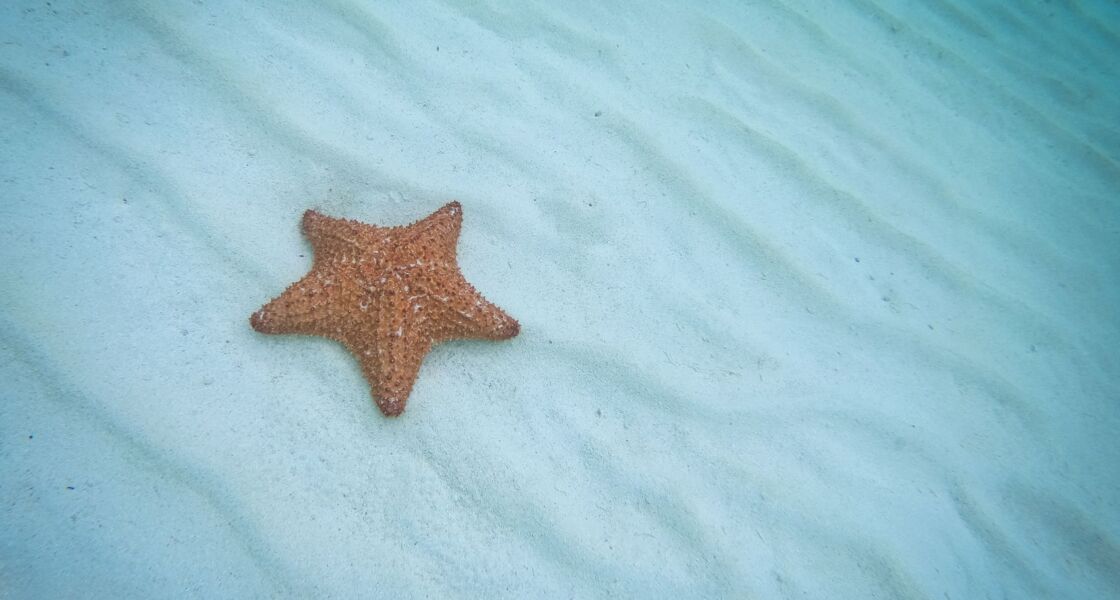
A sea star has no brain. It has no blood, either. And yet it crawls, hunts, and sometimes even regrows a lost arm.
Not a Fish at All
Most of us grew up calling it a starfish. Marine scientists would rather say sea star, because this animal is not a fish. It has no gills, no scales and no fins.
Sea stars belong to a group called echinoderms, which means “spiny skin.” Their close cousins include sand dollars, sea urchins and sea cucumbers. There are about 2,000 species, and every one of them lives in salt water. There are no freshwater sea stars, and only a few live in the mix of fresh and salt water called brackish water.
Most sea stars have five arms, which is the shape that comes to mind when you picture one. They have what scientists call five-point radial symmetry, meaning their body parts are arranged around a center like slices of a pie. But some species have 10, 20, or even 40.
A Body Plan With No Brain
Here is the surprise. A sea star has no brain. Scientists say it has no central organ or brain at all.
Instead, it has a ring of nerves around its mouth. A nerve branches off the ring and runs out to each arm. That simple setup is enough to move around and find food.
It even has a way to sense light. Look at the very tip of a sea star’s arm and you may spot a small red dot. It is an eyespot, and it can tell the difference between light and dark.
Walking on Tiny Suction Cups
Flip a sea star over and the underside looks like a tiny, wiggling forest. Each arm has rows of soft, tube-shaped feet. Each foot ends in a sticky little suction cup.
Water flows into the sea star through a pale spot on top of its body, called the madreporite. From there it moves through the canals and into the tube feet, and that water pressure makes the feet move.
The feet let a sea star hold tight to rocks in a tide pool. They do not make it fast. A Northern sea star would take about a week to travel a single mile. The adult sunflower sea star is a sprinter by comparison: it can move about 3 feet (1 meter) a minute on around 15,000 tube feet.
An Eye on Every Arm
Those little red dots are more than a light switch in some species. Scientists studying the sea star Linckia laevigata, which lives on coral reefs, found that each arm tip has a tiny compound eye. It is slow, colorblind and low in detail.
It still works. In the experiment, sea stars with intact eyes could navigate back toward their reef home after being moved away. Sea stars without intact eyes could not.
Dinner Happens Outside the Body
Sea stars have a very odd way of eating. The mouth is on the underside, in the middle. When a sea star finds a clam or a mussel, its tube feet grab the two shells and pull them apart, just a little.
Then the sea star pushes its stomach out through its mouth and into the gap. The stomach digests the meal right there, and the sea star pulls it back in afterward.
On the menu are shellfish such as mussels, clams, oysters and scallops, plus barnacles and sea snails. It is slow, patient hunting by an animal with no brain at all.
The Arm That Grows Back
Sea stars are famous for regrowing arms. A predator such as a crab or a gull may grab one, and the sea star can let go of that arm and escape. Then it grows a new one.
This works because most or all of a sea star’s vital organs are kept in its arms. Some species need their central body to stay intact. A few can even grow a whole new sea star from a single piece of a severed arm.
Armor Under the Skin
A sea star’s skin is tough. It is bony and hardened with calcium, which protects it from most predators. Many sea stars also wear bright colors that help them hide, or scare an attacker away.
You can find sea stars in every ocean, from warm tropical waters to the cold seafloor. In Maine’s Acadia National Park, Northern sea stars live in the lower part of the tide zone, on rocks and in tide pools. Higher up the shore, they would dry out in the sun at low tide.
Fair Warning: Hard Times for Some
Between 2013 and 2017, an outbreak of an illness called sea star wasting syndrome caused a steep drop in sunflower sea stars along the Pacific Coast. NOAA Fisheries has proposed listing the species as threatened under the Endangered Species Act. Scientists are still working to understand what raises the risk of the disease.
So the next time you see a sea star on a rocky shore, take a good look. It is an animal with no brain, no blood and a stomach that goes out for dinner.