
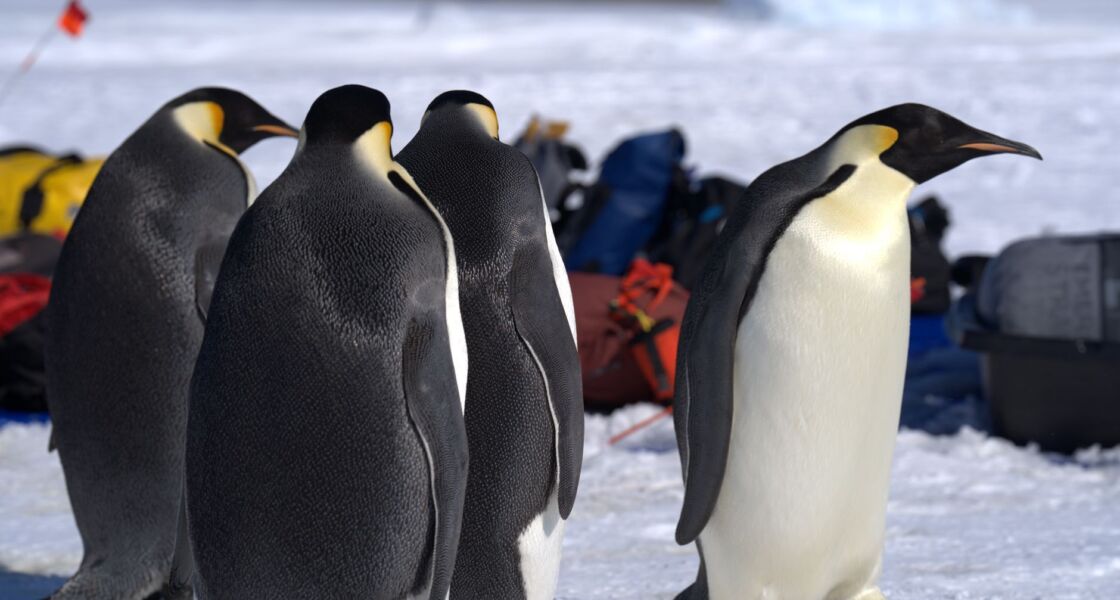
The emperor penguin raises its chick in the coldest, darkest, windiest place on Earth. While almost every other animal flees the Antarctic winter, the emperor walks straight into it.
It is the largest of the 18 penguin species, and everything about it is built for the cold. To survive, it does something no other bird even attempts: it breeds on the frozen sea during the long polar night.
Winter is the plan, not the problem
Most animals time their babies for spring, when food is easy and the weather is kind. The emperor does the opposite. It is the only animal that breeds during the Antarctic winter, laying its egg on sea ice as temperatures drop and the sun disappears for weeks.
There is a reason for this strange schedule. Breeding in winter means the chicks are ready to feed themselves by summer, when the ocean is at its richest. The parents simply have to outlast the hardest months first.
The dad who stands still for two months
After the female lays a single egg, she passes it to the male and heads back to sea to feed. From that moment, the whole future of the chick rests on his feet, quite literally.
The male balances the egg on top of his feet and tucks it under a flap of warm, feathered skin called a brood pouch. There it stays, off the ice and close to his body heat. He does this for about two months, through the deep winter, barely moving.
And he does it on an empty stomach. The male does not eat the entire time he is guarding the egg, living off the fat he built up before winter. By the time the female returns from her own two-month hunting trip, he has been fasting for weeks.
Huddling: a crowd that keeps everyone alive
One penguin alone would freeze. So the males don’t stand alone. They gather into tight huddles, pressing together so closely that as many as 10 birds can pack into a single square meter.
Inside that crowd, the temperature can climb to a toasty 75°F (+24°C), even as the storm rages outside. Huddling can cut a penguin’s heat loss by as much as half.
The clever part is the fairness. The birds slowly shuffle so that no one is stuck on the freezing outside edge for too long. A penguin on the windy rim eventually works its way into the warm center, while a warmed-up bird takes its turn facing the cold. The huddle is always gently rotating.
They need every trick they have. Winds on the Antarctic ice can blow at over 60 knots, about 70 miles per hour, and blizzards can reach speeds far higher.
Champion divers in a frozen sea
When it is time to eat, the emperor penguin turns into one of the best divers in the animal kingdom. It usually hunts at depths of 500 to 820 feet (150 to 250 meters), chasing fish through the dark water under the ice.
But it can go far deeper. The deepest emperor penguin dive ever recorded reached about 1,850 feet (565 meters), deeper than any other bird. Most dives last 3 to 6 minutes, yet the longest on record lasted a remarkable 22 minutes on a single breath.
Down there they hunt Antarctic silverfish and other fish, along with krill (tiny shrimp-like creatures) and squid. An adult eats a few pounds a day, and a growing chick needs many pounds of food delivered by each parent.
A life built on ice
Emperor penguins can be surprisingly long-lived. Some reach more than 40 years, though most do not make it that long in the wild, where leopard seals and the sheer harshness of the place take their toll.
Their whole way of life depends on one thing: solid sea ice to breed on. That ice is their nursery, their resting place and the floor beneath the huddle. Because the ice is changing, the emperor penguin is listed as Endangered on the IUCN Red List, with the loss of stable sea ice named as its biggest threat.
So the next time winter feels cold, picture a penguin father in the Antarctic dark, an egg balanced on his feet, waiting out two months of storms so that one chick can meet the summer sea.