
In the whole animal kingdom, there is one group where the father gets pregnant. The seahorse dad carries the babies in a pouch on his belly, then pushes them out into the sea. He really does give birth.
The Dad With a Belly Pouch
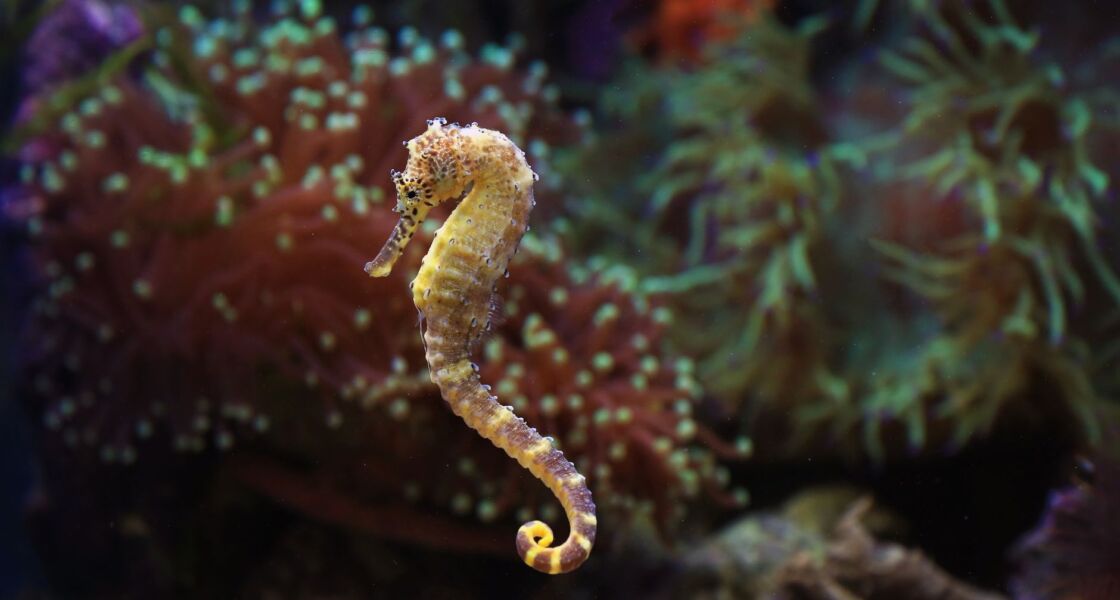
Most animals leave pregnancy to the mother. Seahorses flip the script. The male has a special pocket on his front called a brood pouch, a bit like a kangaroo’s, but tucked onto his belly.
When a pair is ready to start a family, the female does something unusual. She uses a tube called an ovipositor to place her eggs straight into the male’s pouch. He then fertilizes them inside, which is why there is never any doubt about who the father is.
From there, the pouch works a little like a tiny nursery. It keeps the eggs safe, shares oxygen, and even helps feed the growing babies while they develop.
How a Seahorse Gives Birth
After about two to four weeks, depending on the species, the big moment arrives. The male’s belly starts to ripple. Strong muscles squeeze, over and over, sometimes for hours.
Then out they come. A single seahorse father can release anywhere from a few dozen to as many as 1,000 fully formed babies in one go. Each one is a complete, tiny seahorse, ready to grip a blade of grass and fend for itself.
There is no cuddling afterward. The babies drift off on their own the instant they leave the pouch. Life is hard out there: scientists estimate only about half a percent of them live to grow up.
A Dance Before the Babies
Before any eggs change hands, there is a courtship. Many seahorses perform an elaborate dance that can go on for hours, or even days.
They swim side by side, spin around each other, flash new colors, and sometimes link their tails and twirl like dance partners. Most seahorse species studied in the wild appear to be monogamous, greeting the same partner each day to keep the bond strong.
That daily greeting is more than sweet. It helps the pair time things so the female’s eggs are ready exactly when the male’s pouch is ready to receive them.
A Fish That Can Barely Swim
For all their charm, seahorses are among the clumsiest swimmers in the sea. They have no big, powerful tail fin like most fish. Instead, they flutter a small fin on their back as fast as 70 times a second and inch slowly through the water, standing upright.
So how does such a weak swimmer avoid being swept away? It grabs on. A seahorse has a prehensile tail, meaning it can wrap and grip like a hand. It curls that tail around seagrass, coral or a mangrove root and simply holds tight while the current rushes by.
An Eater With No Stomach
Here is a strange one. A seahorse has no stomach. Food rushes through its body so fast that the animal has to eat almost constantly just to stay alive.
It has no teeth either. Instead, a seahorse has a long, tube-shaped snout that works like a straw. It sneaks up on tiny prey, then snaps its head forward and slurps the food in with a quick vacuum of suction.
On the menu: mostly tiny shrimp-like creatures called amphipods, plus other small crustaceans, baby fish and anything else small enough to fit. Seahorses are ambush hunters. They hitch onto a plant, hold still, and wait for lunch to drift within reach.
Masters of Blending In
Seahorses are hard to spot on purpose. Their skin holds special color cells called chromatophores that let them change color to match the plants and reef around them. Some even sprout little skin flaps and filaments so they look like a frilly piece of seaweed.
That camouflage matters, because a seahorse can’t outswim much of anything. Hiding in plain sight is its best defense.
You will find them in warm and cool seas all around the world, almost always in shallow, calm water: seagrass meadows, mangrove roots, estuaries and coral reefs. In the United States, the lined seahorse lives along the Atlantic coast and is the only seahorse found in the Chesapeake Bay.
Small, Odd, and Everywhere
Scientists now count 47 known seahorse species, and 14 of those were discovered only in the 2000s. They range from the big-bellied seahorse of Australia, which can top 12 inches, down to pygmy seahorses barely the size of a jelly bean.
Their scientific name, Hippocampus, comes from Greek words meaning roughly “horse sea monster.” For a tiny fish that can’t swim well, eats without a stomach, and lets dad do the hard part of parenting, that name fits better than you might expect.