
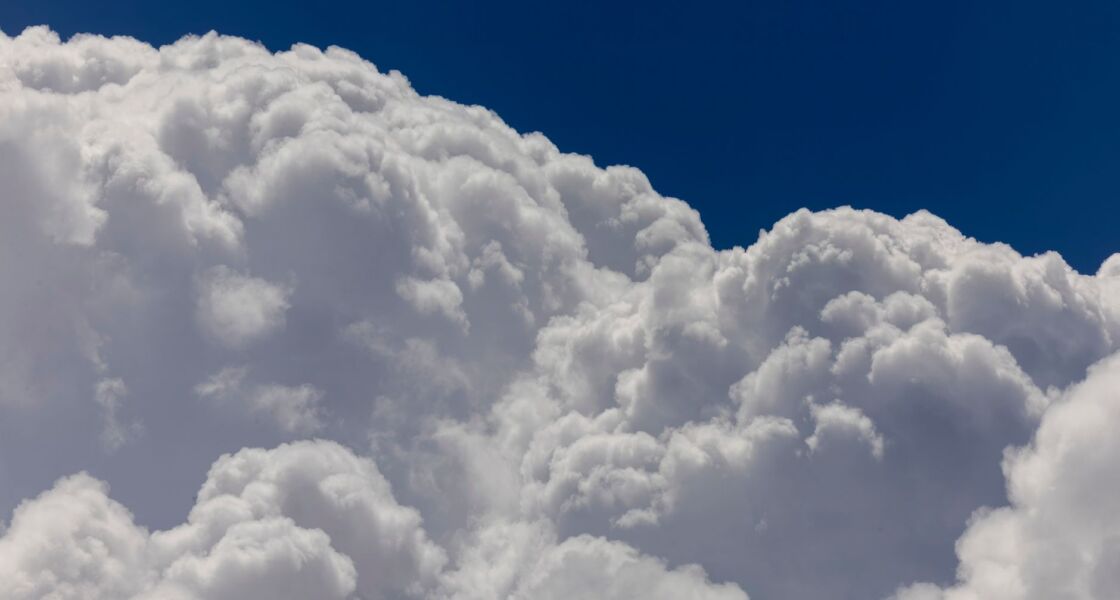
Here is a belief most of us carry around without thinking about it: clouds float because they are light. They look like cotton, they drift lazily across a blue sky, and surely anything that gentle must weigh almost nothing.
That is the myth. And the truth is a lot stranger. A single puffy fair-weather cloud can hold hundreds of tons of water. It is not light at all. So why does all that water just hang there, instead of crashing down on your head?
Where the myth comes from
It is an easy mistake to make. When you watch a cloud, you see something that behaves like a balloon. It moves slowly. It changes shape. It seems to rest on the air.
So your brain fills in the simplest explanation: the cloud must be lighter than air, the way a helium balloon is. If it were heavy, it would fall. Since it is not falling, it must be nearly weightless.
Every part of that reasoning sounds right. Only the conclusion is wrong, and it is wrong in a wonderful way.
The verdict: Partly true
Partly true. A cloud really is slightly less dense than the dry air around it, so in a sense it does float. But it is nowhere near weightless. The water inside a modest cloud can weigh as much as a few hundred elephants. It stays up for a completely different reason than a balloon does.
So clouds float, yes. But not because they are empty. They float because they are built out of pieces so tiny that gravity can barely get a grip on them.
A cloud made of dust and droplets
A cloud is not a puff of fog you could scoop up. It is a crowd of separate water droplets, each one almost unimaginably small.
The National Weather Service explains that a typical cloud droplet has a radius of only about 20 micrometers, roughly two hundredths of a millimeter across. Every droplet forms around an even smaller speck of dust, salt, or smoke. The National Oceanic and Atmospheric Administration calls these specks condensation nuclei, and says every single cloud droplet has one hidden at its core.
Now pack those droplets together. The Weather Service notes that one cubic meter of cloud, a box a little larger than a washing machine, holds about 100 million droplets. Multiply all those boxes across a whole cloud and the water adds up fast. A modest cumulus cloud can carry hundreds of tons of it, which is why “clouds are weightless” simply is not true.
Why the water does not fall
Here is the heart of it. Every droplet is pulled down by gravity. It just falls incredibly slowly.
Because each droplet is so small and meets so much air resistance, it drifts down at a crawl. The National Weather Service puts the speed of an average cloud droplet at about 1.3 centimeters per second in still air, slower than a snail. At that pace, a droplet starting from a low cloud base around 1,650 feet up would take more than ten hours to reach the ground.
And the air is rarely still. Clouds form where air is rising. The UCAR Center for Science Education describes how warm air near the ground becomes lighter and less dense than the air around it, so it rises, cools, and its water vapor condenses into a cloud. That same upward flow keeps nudging the droplets back up almost as fast as they sink. The Weather Service notes that droplets can stay suspended for a long time, especially while they sit in those rising currents.
So the cloud is not defying gravity. It is a slow-motion standoff: millions of tiny droplets falling at a snail’s pace, and rising air lifting them right back.
So when does the water finally come down?
The standoff breaks when the droplets stop being tiny. Inside the cloud, droplets bump into each other and merge. The National Weather Service describes how droplets collide and stick together, growing until they finally have enough weight to fall.
Once a droplet is big and heavy enough, rising air can no longer hold it. It drops out of the cloud, sweeping up more droplets on the way, and lands on you as rain. That is the moment the hidden tons of water in a cloud finally make themselves known.
Until then, the cloud just hangs there, quietly holding more water than a swimming pool, one speck of dust and one slow droplet at a time.