
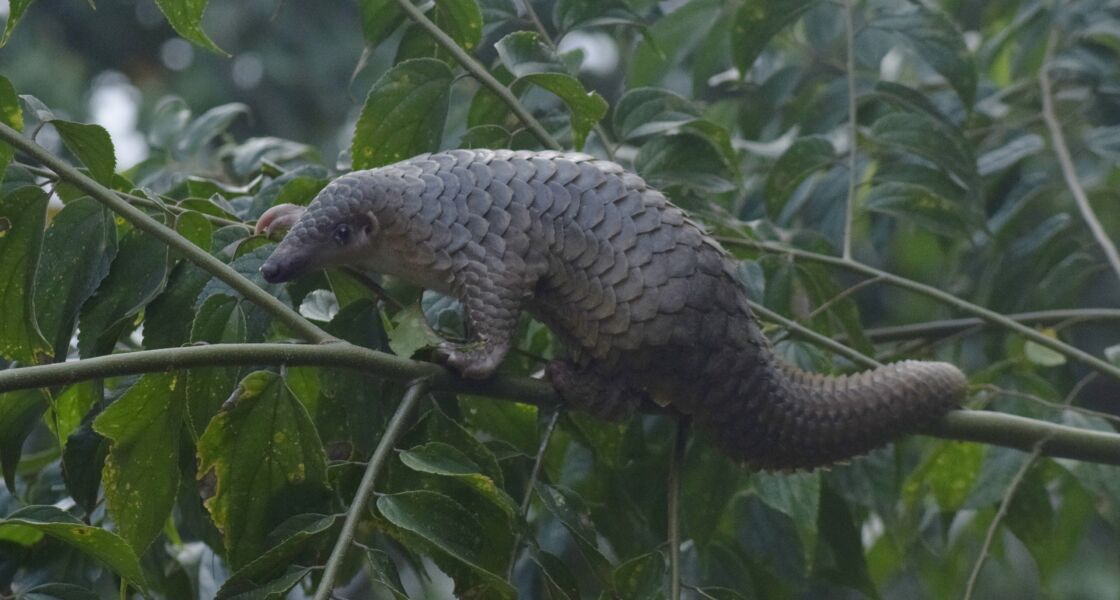
Imagine a pinecone that walks. Add a long nose, a swishing tail, and a set of claws built for digging. That is a pangolin, the only mammal on Earth that is wrapped head to tail in scales.
Most of us picture scales on fish, snakes, or lizards. Pangolins break that rule. They are warm-blooded mammals, yet they wear armor made of the same stuff as our own fingernails.
Scales like living fingernails
A pangolin’s scales are made of keratin, the same material in human fingernails, hair, and horn. The scales grow from the base and wear down at the tip as the animal pushes through dirt and brushes against branches, just like a nail that keeps growing.
On an Indian pangolin, those overlapping plates make up roughly a quarter to a third of its whole body weight. That is a heavy coat to carry, but it works. The scales have sharp edges and sit on thick skin, and they are tough enough that a big cat usually cannot bite through them.
The word pangolin even comes from the idea of rolling. It traces back to the Malay word pengguling, which means something like “one that rolls over.”
Roll into a ball and wait
When a pangolin feels threatened, it does not run far. It tucks its head under its tail and curls into a tight ball, scales facing out on every side. The soft belly and face vanish inside.
A predator is left with what looks like a spiky, armored stone. Lions and leopards can roll it around, but they often give up and walk away. A pangolin can also release a strong-smelling fluid from a gland near its tail, a bit like a skunk, to make the point even clearer.
A tongue that starts near the hips
Here is the part that surprises almost everyone. A pangolin’s tongue is not anchored in its mouth the way ours is. It attaches far back, near the pelvis and the last pair of ribs, and coils up inside the chest when the animal is not eating.
When it is time to feed, that tongue unspools. An Indian pangolin can flick its tongue out about 10 inches (25 centimeters) past the end of its snout. Counting the hidden part, the whole tongue can reach well over a foot long, longer than the animal’s head and body in some species.
The tongue is slim, muscular, and coated in sticky saliva. A pangolin pokes it deep into an ant nest or a termite mound, then reels the insects back in. One adult pangolin can eat up to 70 million ants and termites in a single year.
Because it has no teeth to chew with, the pangolin does its grinding in the stomach. It swallows small stones and grit along with its meal, and a tough, inward-pointing part of the stomach mashes everything together. The result is a mammal that eats like a bird, gravel and all.
Built for a life of digging
Everything about a pangolin points toward insects. Strong front claws tear open the concrete-hard walls of a termite mound. The long snout sniffs out the tunnels. Thick eyelids and closable nostrils keep angry insects out while the pangolin eats.
The Indian pangolin lives across a wide stretch of South Asia, from Pakistan and India to Sri Lanka, Bangladesh, Nepal, and into parts of Myanmar and southern China. It makes a home in dry forests, grasslands, and even scrubby ground near villages, mostly coming out at night to feed alone.
Scientists count eight pangolin species in all. Four live in Asia and four in Africa. They range from tree-climbers no bigger than a house cat to ground-dwellers several feet long.
The Indian pangolin sits toward the larger end. Its body and head together stretch roughly 18 to 26 inches (45 to 65 cm), with a thick tail that can be nearly as long again. A grown one can weigh 18 to 37 pounds (8 to 17 kg), about as much as a medium dog. A newborn, by contrast, weighs only about half a pound and rides along on its mother’s tail.
The most trafficked mammal
There is one fact about pangolins that is hard to shake. They are the most trafficked mammals in the world, hunted for their meat and for their scales.
That pressure has pushed several species to the edge. On the IUCN Red List, the Sunda pangolin and the Chinese pangolin are both listed as Critically Endangered. The gentle habit that protects a pangolin from a lion, curling into a quiet ball, is exactly what makes it easy for a person to pick up.
So the next walking pinecone you read about is stranger than it first looks: a scaled mammal with no teeth, a tongue rooted near its hips, and a coat it grows the way you grow a fingernail.