
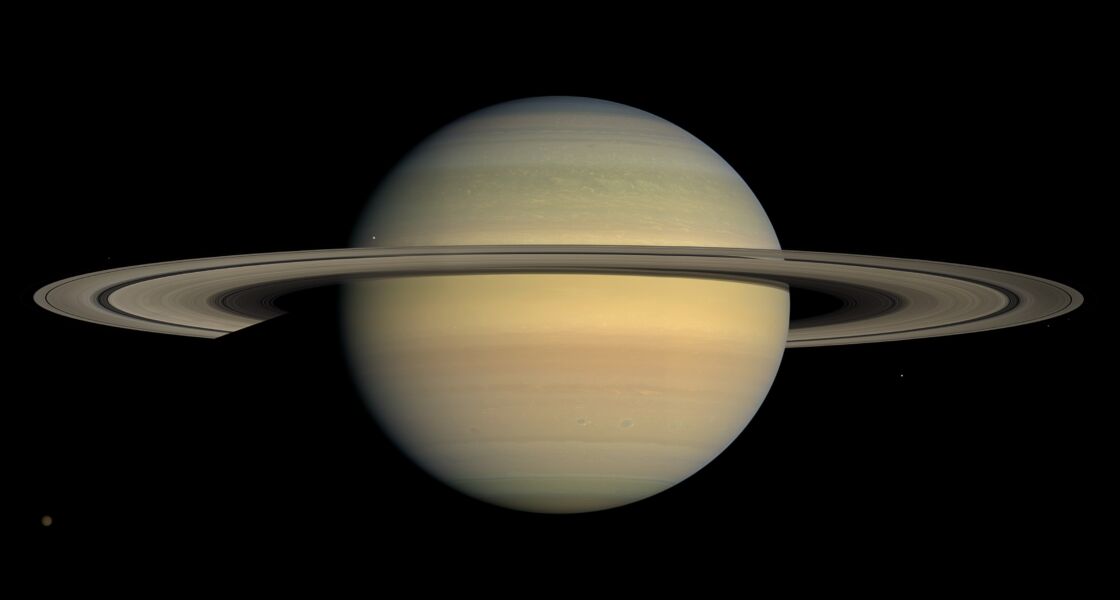
Saturn is lighter than water. Not lighter in total weight, since it holds about 95 times the mass of Earth. Lighter for its size. Spread out, Saturn is less dense than the water in your sink.
So would Saturn float in water? On paper, yes. All you would need is a bathtub big enough, and nobody has one of those.
The Planet Lighter Than Water
NASA says it plainly: Saturn is the only planet in our solar system with an average density that is less than water.
Density tells you how much stuff is packed into a space. A rock is dense. A sponge is not. Saturn’s average density, according to NASA’s planetary fact sheet, is 687 kilograms per cubic meter. That is about 0.69 grams per cubic centimeter.
Water comes in at about 1 gram per cubic centimeter, or 1,000 kilograms per cubic meter. Saturn falls short of that by about a third.
Now compare Saturn with Earth. Earth’s average density is 5,513 kilograms per cubic meter. NASA’s table lists Saturn at 0.125 times that. In other words, a scoop of Saturn weighs about one-eighth as much as a scoop of Earth.
Notice the word “average.” Saturn is not one smooth ball of the same material. It is a mix, and the mix averages out light.
A Thought Experiment, Not a Plan
Here is where the bathtub comes in. NASA’s Saturn page says the giant gas planet could float in a bathtub “if such a colossal thing existed.”
Read that last part again. Such a thing does not exist. No tub, ocean or tank anywhere comes close to holding a planet, and nobody has ever tested this.
So treat the floating planet as a way of picturing a number. It is a thought experiment. If you could find a bathtub big enough, the density comparison says Saturn would bob on top instead of sinking. That is all the comparison says.
What Saturn Is Made Of
Why is Saturn so light for its size? Mostly because of what it is made from.
NASA describes Saturn as a massive ball made mostly of hydrogen and helium. Those are the two lightest elements there are. They are also the same two main ingredients that make up the Sun.
Earth’s average density is about eight times higher. Saturn’s recipe of very light gases, spread over an enormous volume, gives a very different result.
Saturn does have a heavy heart. NASA says there is a dense core of metals like iron and nickel at its center, surrounded by rocky material and other compounds. But a heavy core in the middle does not change the big picture: Saturn’s average still comes out below water.
The Planetary Society adds that Saturn’s atmosphere is 96 percent hydrogen, 3 percent helium and 1 percent other gases. It also notes a strong magnetic field made by metallic hydrogen churning deep inside.
How Big Is Saturn Next to Earth?
Big. NASA gives Saturn an equatorial diameter of about 74,897 miles (120,500 kilometers), which is 9 times wider than Earth.
NASA also offers a picture to hold in your head. If Earth were the size of a nickel, Saturn would be about as big as a volleyball.
The volume is even more startling. NASA’s fact sheet lists Saturn’s volume at about 764 times Earth’s. That means you could fit hundreds of Earths inside it. The Planetary Society counts 827, a bit higher than the fact sheet, so the safe answer is somewhere above 700.
Now put the two numbers side by side. Saturn has about 95 times Earth’s mass but about 764 times Earth’s volume. Much more room, only somewhat more stuff. That is how you end up with a low density.
Rings of Ice and Rock
You cannot talk about Saturn without the rings. Space Place, NASA’s kid-friendly site, describes a set of seven main rings with spaces between them.
Up close, they are not solid sheets. NASA says the rings are made of billions of small chunks of ice and rock, coated with other materials such as dust. Their origin is still debated: NASA says they are thought to be pieces of comets, asteroids or shattered moons, while the Planetary Society says they may be a large moon torn apart by Saturn’s gravity, or leftover material from when Saturn formed.
The ring system is huge, too. NASA says it extends up to 175,000 miles (282,000 kilometers) from the planet. The Planetary Society describes the main rings as about 27 Earths wide.
And they are light. The Planetary Society says the rings weigh less than even the small moon Mimas. All that sparkle, with surprisingly little mass.
Add in a few more numbers from NASA. A day on Saturn lasts only about 10.7 hours. A year takes about 29.4 Earth years. And as of March 2025, Saturn had 274 confirmed moons, more than any other planet in our solar system.
Floating Is Just the Fun Part
Next time someone tells you Saturn would float, you can add the details. It is true that its average density is lower than water’s. It is true that it is mostly hydrogen and helium. It is not true that anyone could ever try it.
Saturn is a planet about nine times wider than Earth, with a ring system that spans a huge distance, and it is less dense than water. We will happily keep the bathtub joke.