
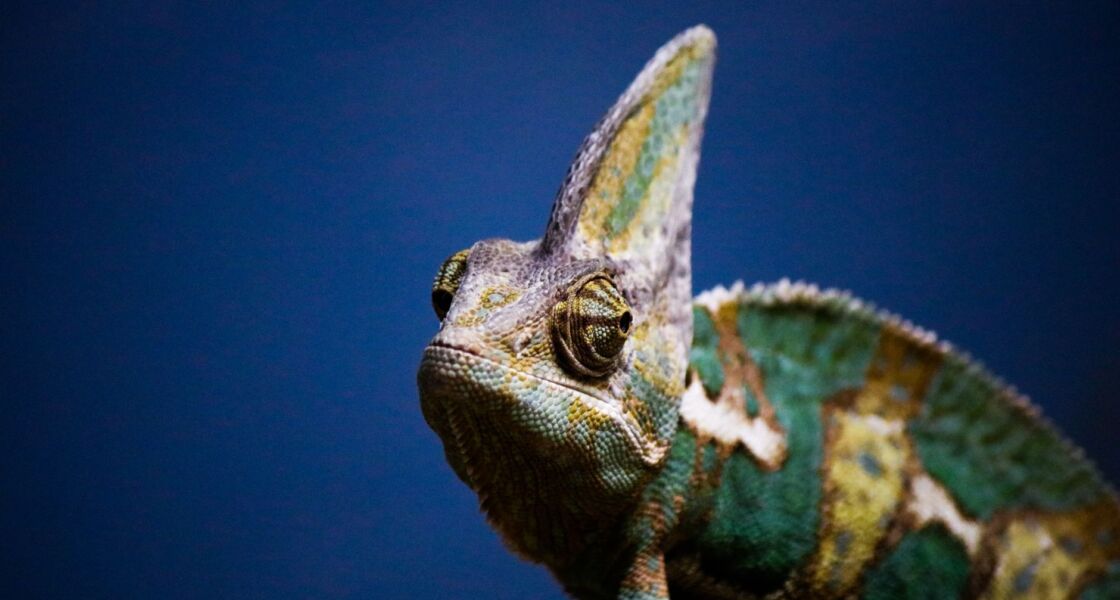
Here is a surprise about the chameleon: the famous color change is not mainly about hiding. It is mostly about talking. A chameleon’s skin works like a tiny signal flag that other chameleons can read.
Not Quite the Camouflage Trick You Heard About
Most of us grew up thinking a chameleon turns into whatever it is sitting on. Put one on a red couch, and it goes red. National Geographic calls that a common misconception. Chameleons cannot change to match any color they like.
They do blend in, and many species are green or brown to match leaves and branches. But their dramatic color shifts have a different job. National Geographic says the color change of the veiled chameleon is mostly for communication, not camouflage.
Scientists tested the idea in southern Africa. They compared 21 lineages of dwarf chameleons in field trials. The species with the biggest color-changing ability were the ones with the most eye-catching signals, as seen by other chameleons. The ability to change color did not line up with how many different backgrounds a species had to match. The researchers concluded that dramatic color change evolved largely as a way to signal to others.
What Colors Say
So what is the message? It depends on the moment. A male veiled chameleon shows red, orange and white when he fights over territory. When he turns his colors off, that signals he has given up.
Females talk with color too. A pregnant female veiled chameleon turns dark with orange and turquoise spots. A female that is ready to mate stays a calmer, more neutral color.
Mood shows up on the skin as well. According to National Geographic, chameleons turn dark when they are stressed, scared or angry. In the 2015 study, adult males changed color within a couple of minutes during a contest or when they met a possible mate. Then the change reversed.
The Crystal Trick Under the Skin
Color in animals often comes from pigment, like paint. In 2015, a team studying the panther chameleon, a species from Madagascar, found that chameleon color works differently. It is not only about moving pigment.
The color comes from structure. In a top layer of skin cells, the team found tiny crystals made of a substance called guanine. Each crystal is only about 127 nanometers across. A nanometer is a billionth of a meter, so these crystals are far too small to see without strong microscopes.
The crystals sit in a neat, repeating pattern. Light bounces off them in a way that makes certain colors stand out. When the pattern changes, the color changes.
Spacing Is Everything
Here is the clever part. The crystals do not change size. What changes is the space between them.
When the skin is at rest, the crystals are packed closer together, and it reflects more blue. When the chameleon gets excited, the crystals spread apart. The researchers found the spacing was about 30 percent smaller in resting skin than in excited skin. That moves the reflected color from blue toward yellow, orange or red.
To check the idea, the scientists changed the salt concentration around pieces of skin removed from the animal. The blue shift appeared in the lab, and their model matched the colors they saw.
What flips the switch? Nobody knows yet. The authors say the exact trigger has not been identified. They suggest nerves or hormones could be involved, the way other color cells in animals are controlled.
A Second Layer That Handles Sunlight
Chameleons have another layer of crystal cells deeper down. These crystals are bigger and arranged in a messier way, so they do not make bright colors. Instead, they reflect a lot of sunlight, especially near-infrared light, which is the invisible kind that carries heat.
The team measured that about 45 percent of the sun’s energy in that range is reflected from the deeper skin layer. They say this may give a chameleon some passive protection from heat. They also point out that they are not claiming this was the layer’s original purpose.
The researchers describe the two-layer setup as something new for chameleons. They say it may let some species combine good camouflage with spectacular displays.
Warm Skin, Dark Skin
Temperature plays a part as well. National Geographic says chameleons get darker when they are cold, because dark colors absorb more heat. They get lighter when they bask. The researchers who studied dwarf chameleons suggest that small color changes may first have evolved for temperature control or camouflage, and that the big, bold shifts came later for signaling.
Built to Watch and Grab
Color is not the only strange trick. A chameleon’s tongue can reach twice its body length. Some species fire it out about as fast as a car going from zero to 60 miles per hour in a hundredth of a second. The tip works like a suction cup, covered in mucus 400 times thicker than human saliva.
The eyes are odd too. Each one can look in a different direction, giving a field of view of about 180 degrees across. The feet grip like a finger and thumb, with two toes pointing one way and three the other. That is why a chameleon can hold a branch so firmly.
Chameleons come in more than 200 species. The tiniest known, Brookesia nana, is about 0.85 inches long, about the size of a sunflower seed.