

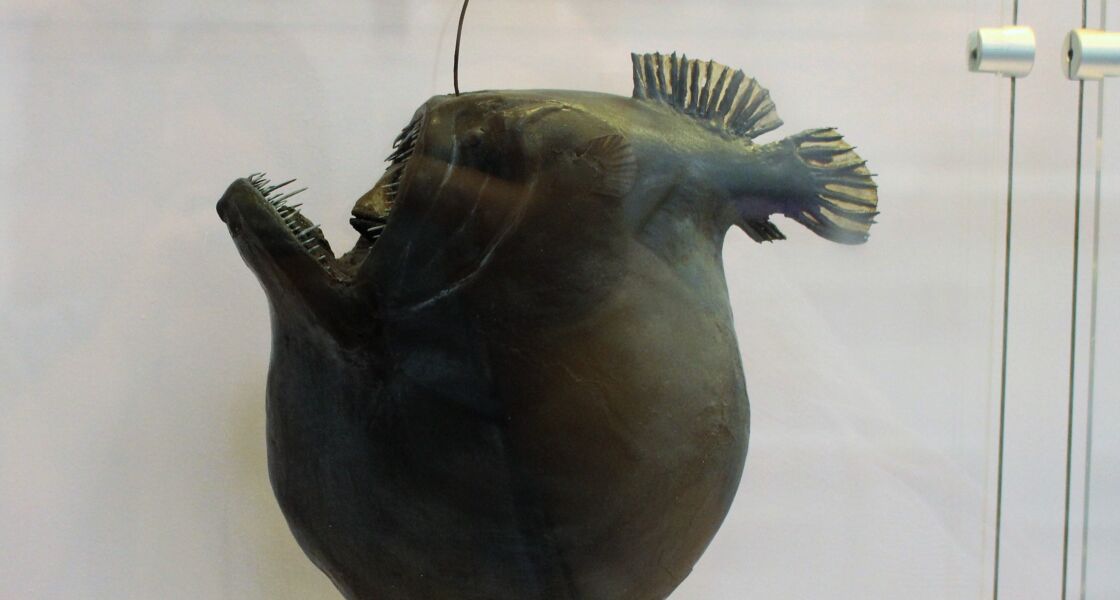
Far below the waves, in water so deep that sunlight never reaches it, a tiny blue light clicks on. It glows, wiggles, and waits. Any small fish that swims over for a closer look is about to meet the deep-sea anglerfish, and its enormous, tooth-filled mouth.
Scientists have named more than 200 species of anglerfish in the order Lophiiformes. Not all of them live in the deep. Some are flat, warty fish that sit on shallow reefs. But the ones with the famous glowing lure are deep-sea hunters, and they are some of the strangest animals on Earth.
A fishing rod built into its head
The anglerfish is named for the way it fishes. The first ray of its dorsal fin, the fin along its back, is stretched out into a long filament that stands up over its mouth like a fishing pole. At the very tip sits a small bulb called the esca.
Here is the clever part. The esca glows. It holds a pocket of living bacteria that make their own light, a trick called bioluminescence, the ability of a living thing to produce light. In the pitch-black deep sea, that little blue glow is the only thing a passing fish can see.
The anglerfish waves the lure back and forth. Small fish and shrimp drift closer, curious about the light. When one gets close enough, the anglerfish’s huge mouth and sharp teeth snap shut.
A mouth bigger than its stomach
Food is hard to find in the deep ocean, so an anglerfish cannot be picky. It is built to eat whatever wanders past, even if that meal is almost as big as the hunter itself.
Its mouth is a wide crescent lined with long, see-through teeth that curve inward. Prey that swims in has a hard time swimming back out. With bendy bones and a stretchy stomach, an anglerfish can swallow prey up to twice its own size.
Most deep-sea anglerfish are small. Many females are only a few inches long, roughly the size of a softball when they puff up, though the largest kinds can reach about 3 feet. Their dark skin soaks up light so well that it works as a kind of camouflage, hiding everything but the glowing lure.
The males live as hitchhikers
The anglerfish with the glowing lure is almost always a female. The males look completely different. They are tiny, sometimes just a few centimeters long, with no lure and no giant mouth. Their one job is to find a female in the dark.
In many deep-sea species the male does something remarkable. When he finds a female, he bites onto her body and holds on. Over time his skin fuses with hers, and the two fish share a single blood supply. He loses his eyes and most of his organs, keeping little more than what is needed to help her make eggs.
Scientists call this sexual parasitism. In the most extreme cases, a female can be more than 60 times longer than her mate. A single female may carry several fused males at once.
Life in the midnight zone
Deep-sea anglerfish live in what scientists call the midnight zone, the layer of ocean where no sunlight reaches. Depending on the species, they are found from a few hundred feet down to more than 13,000 feet below the surface.
That is a hard place to live. It is cold, dark, and nearly empty. A fish can swim a long time without meeting another living thing. Meals are mostly small fishes and crustaceans, the little shrimp-like animals that drift through the deep. The glowing lure solves two problems at once: it brings dinner close, and in some species it helps a lonely male find a mate in all that darkness.
The anglerfish does not chase its food. It saves energy by hanging almost still, letting the light do the work. In a world where the next meal might be days away, patience is its best tool.
Because they live so deep, anglerfish are rarely seen alive. For a long time scientists knew them mostly from dead specimens hauled up in nets. Only in recent years have deep-diving robots filmed living ones glowing quietly in the dark, lures swaying, waiting for the next curious fish to swim a little too close.