
Scoop up a handful of sand at the beach. Now try to picture every grain on every beach on Earth. It sounds like the biggest number anyone could imagine. Astronomers think the night sky beats it.
The comparison goes like this: there are more stars in the universe than there are grains of sand on all of Earth’s beaches. Nobody has counted either one exactly. But when scientists do the math, the stars seem to win.
Start with our own galaxy
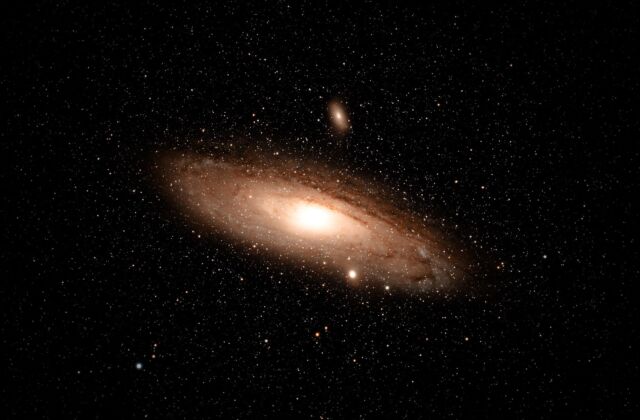
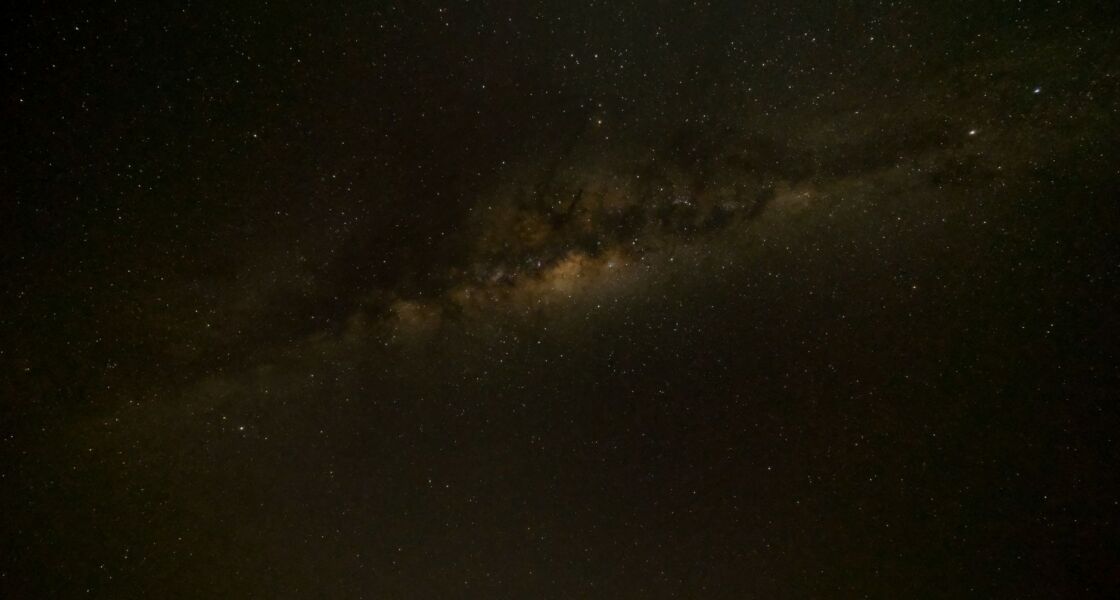
Our home is the Milky Way, a spinning disk of stars, gas and dust. How many stars live in it? Even that number is an estimate. NASA says our galaxy “probably contains 100 to 400 billion stars.” The European Space Agency puts it at “about 100 thousand million,” which is another way of saying 100 billion.
Why such a wide range? Many stars are small, dim red dwarfs that hide in the glare of brighter neighbors. Astronomers can’t line them all up and count them one by one. Instead they measure how much the galaxy weighs and how bright it shines, then work out a careful guess.
So already, in just one galaxy, we are talking about a few hundred billion suns. And the Milky Way is only the beginning.
Now count the galaxies
For a long time, people thought our galaxy was the whole universe. Then telescopes showed that those faint smudges in the sky were other galaxies, each one packed with its own billions of stars.
So how many galaxies are out there? Using its deepest images, NASA estimates the Milky Way is “one of about 2 trillion galaxies in the observable universe.” That number comes from counting the galaxies in tiny patches of sky, then scaling up to cover the whole thing, and adding in the faint ones too small to see.
Here is the key word: observable. We can only see the part of the universe whose light has had time to reach us. The real universe may stretch much farther, with even more galaxies we will never glimpse.
Multiply it all together
Here is where the numbers get dizzying. Take a few hundred billion stars per galaxy. Multiply by a huge number of galaxies. The answer is a total so large it barely fits on the page.
The European Space Agency walks through this exact calculation and lands on “something like 10 to the power of 22 to 10 to the power of 24 stars in the universe.” That is a 1 followed by 22 to 24 zeros. NASA offers a similar ceiling, saying the universe “could contain up to one septillion stars,” which is a one followed by 24 zeros.
Written out, a septillion looks like this: 1,000,000,000,000,000,000,000,000. Our brains are not built to feel a number that big. We can picture ten things, or a hundred. A trillion already slips away from us. A septillion is far beyond imagining.
Every one of these figures is an estimate, not a headcount. Scientists are careful to say “about,” “roughly” and “up to.” Nobody has a tally of every star, and the honest answer to “exactly how many?” is that we do not know.
So where does the sand come in?
This is where the beach returns. The European Space Agency says that “counting the stars in the universe is like trying to count the number of sand grains on a beach on Earth.” Both are far too many to count one at a time, so scientists estimate them the same clever way: measure a small scoop, then scale up.
Pick up a cupful of sand and you might hold tens of thousands of grains. Spread that across every beach on the planet and you reach a number in the quintillions, a 7 followed by 18 zeros in one common estimate. That is enormous. Yet a septillion stars is still larger, by a wide margin.
That is why astronomers are fond of saying there are more stars in the universe than grains of sand on all of Earth’s beaches. It is not a precise contest with a referee. It is a way to shrink an impossible number down to something you can almost hold in your hand.
Why the number keeps changing
You may read one number this year and a different one next year. That is not a mistake. It is science working the way it should.
Each new telescope sees fainter, farther and smaller objects than the last. The Hubble Space Telescope helped push the galaxy count toward 2 trillion by spotting galaxies no one knew were there. Newer telescopes will likely nudge the numbers again. The universe is not changing its mind; we are simply getting better glasses.
There is also honest disagreement. Some older estimates counted “only” 100 to 200 billion galaxies before the fainter ones were added in. When sources differ, the careful move is to give a range and say so, which is exactly what the scientists do.
A number you can take outside
You do not need a telescope to feel this. On a clear, dark night, far from city lights, you can see a few thousand stars with your eyes alone. That is already more than you could count before you got sleepy.
Every one of those points of light is a sun, many of them bigger than ours. And for each one you can see, there are billions upon billions you cannot. The next time you are at the beach, let a little sand run through your fingers and remember: somewhere out there, the stars still outnumber it.