
The part of the universe we can see is about 92 billion light-years wide. That is a number with a lot of zeros, and the strange thing is that the universe is only about 13.8 billion years old. How can something be wider than its own age?
The answer is that the universe is not standing still. It is stretching. And the part we can see may be only a small piece of the whole thing.
First, what is a light-year?
A light-year sounds like a measure of time. It is actually a measure of distance: how far light travels in one year.
Light moves at about 186,000 miles (299,000 km) per second. Keep that up for a whole year and you cover almost 6 trillion miles (9.5 trillion km). That is one light-year.
Space is so spread out that miles stop being useful. NASA points out that the closest star to our Sun is about four light-years away. That is roughly 24 trillion miles, and it is the next-door neighbor.
Our own Milky Way galaxy is about 100,000 light-years across. A beam of light would need 100,000 years just to get from one side to the other.
The universe we can see
Here is the catch. Light takes time to travel. So when we look at a faraway galaxy, we see it as it was when its light set out, not as it is today. NASA describes the Hubble Space Telescope as a time machine for this reason.
The universe has been around for about 13.8 billion years. That means light has had a limited amount of time to reach us. Anything whose light has not arrived yet is out of sight. The region we can see, the part whose light has had time to reach us, is called the observable universe.
Reasoning from the age alone, you might guess its radius is 13.8 billion light-years. But the real number is much bigger. A NASA expert estimates that the observable universe is about 92 billion light-years across. An older NASA education page, from 2006, gave about 94 billion. Estimates shift a little as measurements improve, so expect numbers close to these.
Why it is bigger than its age
The reason is stretching. Imagine a dot drawn on a rubber band. Pull the band, and the dot moves away from you even though it never walked anywhere. Space works a bit like that. Over the whole history of the universe, the space between galaxies has been growing.
NASA gives an example from the James Webb Space Telescope. NASA says some of its deepest images show galaxies whose light left about 13.5 billion years ago. But because the universe has been expanding the whole time, NASA says those galaxies are now much farther away than 13.5 billion light-years.
So the light made its trip in 13.5 billion years. But the starting point kept moving away while the light traveled. That is how a young universe can have a wide observable edge.
Is that everything?
Not necessarily. This is the part that surprises people most. The observable universe is simply the part that has had time to send light to us. It is not an edge of the universe. It is more like the edge of what we can see from where we stand, the way the horizon marks the limit of your view at sea.
NASA says scientists are pretty sure the universe is even bigger than what we can see. And how big is the whole thing? NASA’s answer is honest: “we don’t actually know if the universe is finite or infinite.” Science has no reliable estimate of the size of the entire universe.
Another NASA page says much the same thing: the total volume of the universe may be infinite, but we do not know.
So there are two numbers worth keeping apart. The size of the observable universe is an estimate, around 92 billion light-years. The size of the whole universe is an open question. It may go on forever, or it may not.
Counting the galaxies
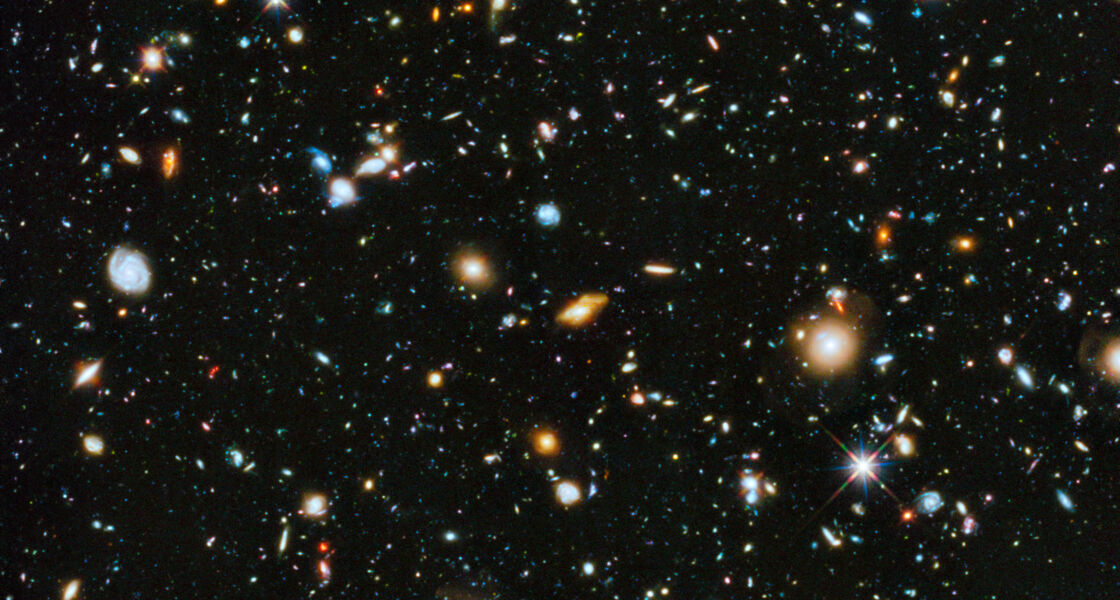
What fills all that space? Galaxies, huge islands of stars. NASA says deep-field images of the universe show there are hundreds of billions, perhaps a trillion, other galaxies. Counts differ by source, and they keep changing.
Those images are made by pointing a telescope at one tiny, dark-looking patch of sky for a very long time. Faint smudges slowly appear, and each smudge turns out to be a whole galaxy.
And the count may still be low. Earlier estimates, built on the Hubble deep fields of the 1990s, were around 100 billion galaxies. In 2016, a team using Hubble data concluded that this figure was at least ten times too low. They reported that about 90 percent of them are too faint and too far away for today’s telescopes to see. These are estimates built from models, not a head count, so the numbers can change as telescopes get better.
A big place to be small in
Put it all together and the picture is a little dizzying. The nearest star is four light-years away. Our galaxy is 100,000 light-years wide. And the observable universe holds hundreds of billions of galaxies, in a region about 92 billion light-years across, with an unknown amount beyond that.
Yet a person can understand it, one comparison at a time. The next time you look up at night, remember that the deep images from the Webb telescope show galaxies whose light set out about 13.5 billion years ago.