

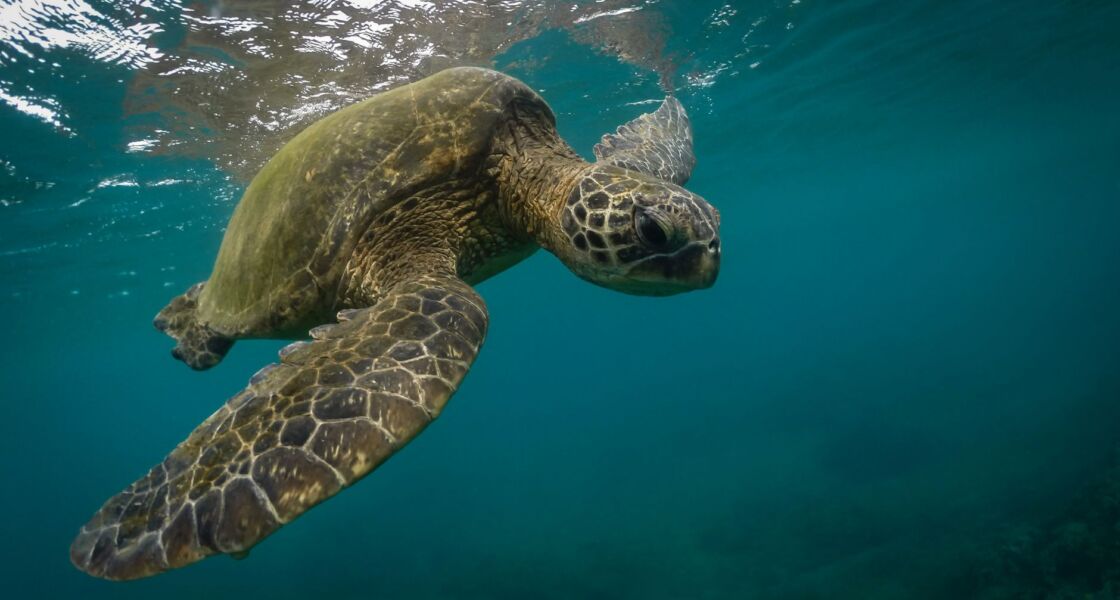
A green sea turtle is not very green. Its shell is usually brown, olive or gray. The name comes from something you would never see on a living turtle: the color of its fat.
That is only the first surprise. This animal can swim more than a thousand miles to lay eggs, and the mothers usually head for a beach near the one where they hatched. How do they find it? Scientists studying sea turtles have a clue, and it has to do with the Earth itself.
Why “green” has nothing to do with the shell
The green sea turtle gets its name from the greenish fat under its shell. Experts once credited the turtle’s diet for that color. But other sea turtles have greenish fat too, so the full story is a little murkier.
On the outside, the shell can be dark brown, gray or olive, with a pale yellow-to-white belly. Look at the head and you can spot a handy clue: a green turtle has a single pair of scales on the front of its head, which sets it apart from other sea turtles.
A sea turtle that eats salad
Most sea turtles eat animals. The adult green turtle mostly eats plants. It is the only sea turtle that is strictly an herbivore, a plant eater. It grazes on seagrass and algae in shallow, sandy waters, tearing them off with finely serrated jaws.
It was not always a vegetarian. A young turtle shorter than about 8 to 10 inches (20 to 25 cm) also eats worms, young crustaceans and aquatic insects. After that, the menu turns green.
Born on a beach, headed for the light
A green turtle hatchling is only about 1.6 to 2.4 inches (4 to 6 cm) long, dark on top and pale underneath. A mother lays about 110 eggs in a nest, and the eggs take around two months to hatch.
When the hatchlings climb out, they have one job: find the water. They crawl away from the dark shapes of dunes and plants and toward the brightest part of the horizon. After they reach the sea, they swim out to open water, where they live for several years.
The long trip home
Here is the big one. Adult green turtles migrate hundreds to thousands of miles each way between feeding grounds and nesting beaches. Females usually return to beaches near where they hatched, and they make the trip every 2 to 5 years.
Take the green turtles that feed along the coast of Brazil. They swim to Ascension Island in the middle of the Atlantic Ocean, more than 1,360 miles (2,200 km) away. An island is a hard target to hit in a very big ocean.
Researchers tested how they manage it. They moved turtles that had finished nesting about 30 miles (50 km) away from the island, some downwind and some upwind, and watched them return. The downwind turtles got home in 1 to 4 days. Two upwind turtles took 10 and 27 days, and one headed back toward Brazil. The researchers concluded that the turtles use wind-borne cues to find the island. It was a small test of just six turtles.
A magnetic address
The Earth acts like a giant magnet, and its magnetic field is a little different from place to place along a coast. Scientists studying loggerhead sea turtles, another species, have a bold idea. They propose that hatchlings imprint on the unique magnetic field of their birth beach. Imprint means they learn it, like memorizing a smell.
Years later, an adult would then look for that same magnetic signature to find her way home. Researchers found a matching pattern in a 19-year record of loggerhead nests in Florida. When the magnetic signatures of neighboring beaches moved closer together, nests bunched into a shorter stretch of coast. When they drifted apart, nests spread out.
The scientists say their results provide evidence, and nobody knows for sure how a turtle would sense the field. The best guess is tiny magnetic particles in its brain. Whether green turtles use a magnetic address too is still an open question.
Slow to grow up, built for the long haul
A green turtle takes its time. Females reach adulthood at around 25 to 35 years old. Nobody knows exactly how long the species lives, but estimates run to 70 years or more.
Nesting is a big event. Tortuguero, in Costa Rica, sees about 30,000 females in an average season. At Raine Island on Australia’s Great Barrier Reef, up to 60,000 females may come ashore in a peak season.
Where do they live? Mostly in warm, shallow coastal waters in the Atlantic, Pacific and Indian Oceans. In the United States you can find them from Texas up the Atlantic coast, in Puerto Rico and the U.S. Virgin Islands, and in Hawaii.
Where things stand
The U.S. government lists green sea turtles under the Endangered Species Act in 11 distinct population segments, which are groups treated separately. Three are listed as endangered and eight as threatened. NOAA lists accidental catch in fishing gear (called bycatch) among the threats.
Curious about more ocean life? Meet the blue whale or find out what causes ocean tides.
So the next time you see a turtle gliding over a seagrass meadow, remember: it may be a long way from the beach where it was born, and it may be planning to go back.