
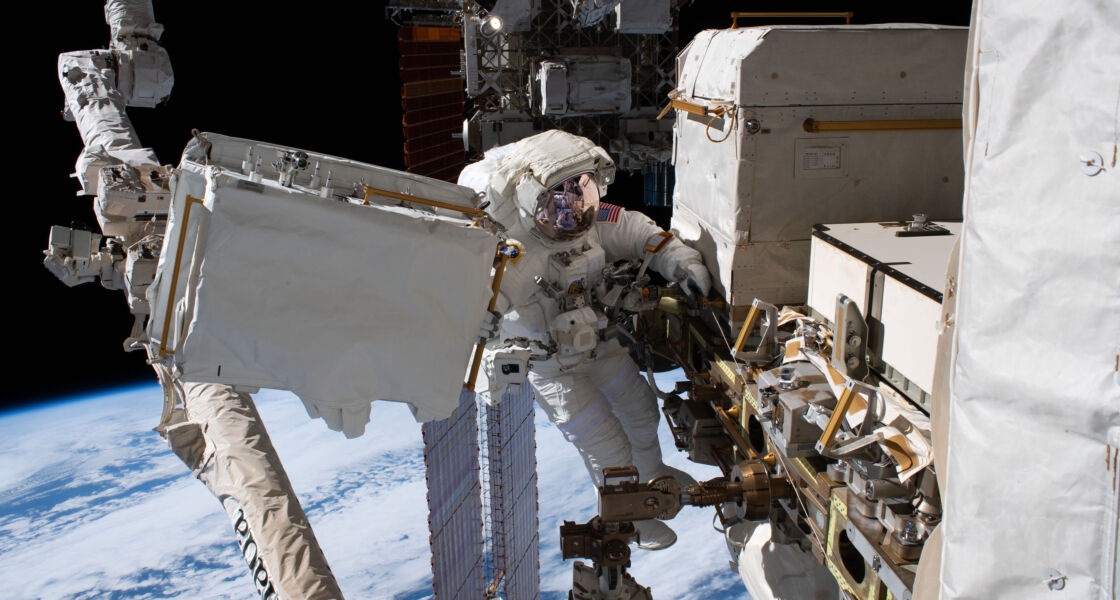
Astronauts on the space station float around like balloons. So there must be no gravity up there, right?
Wrong. Gravity is still pulling on them, and it is pulling hard. The real reason they float is stranger and much more fun: they are falling, all day and all night, and they never land.
Gravity Is Still There
Many people think gravity switches off once you leave the ground far enough behind. NASA’s Glenn Research Center says this is a common mistake: gravity does not stop in space.
The International Space Station orbits Earth at an altitude of roughly 230 to 285 miles (about 370 to 460 kilometers). That sounds very high, but compared with the size of Earth, it is a short hop. NASA says that at the station’s altitude, Earth’s gravity is about 90 percent of what it is on the planet’s surface.
Think about what that means. If you weigh 100 pounds on the ground, gravity at the station’s height would still tug on you with a force of about 90 pounds. An astronaut up there is not escaping Earth’s pull. The pull is what keeps the whole station circling our planet.
NASA’s Glenn Research Center gives a close number for a spot about 250 miles up: Earth’s gravitational field there is 88.8 percent of its strength at the surface. Two NASA pages, two slightly different figures, and the same message. Up where the station flies, gravity has barely let go.
The Secret Is Falling
So why do astronauts float? Because the station, the astronauts and everything inside are all falling together.
NASA describes it this way: the spacecraft, its crew and any objects on board are all falling toward Earth, but also around it. The Glenn Research Center puts it in a line worth remembering: they are not falling toward Earth, they are falling around it.
Picture an apple, an astronaut and the space station dropping at the same moment. NASA says they are all falling together: the apple, the astronaut and the station. Since nothing is falling faster than anything else, nothing presses against anything else. The floor does not push on your feet. Your body feels no weight, so you drift.
It may help to think of the station as a very large, very fast elevator ride that never reaches the bottom floor. Everyone aboard is on the same ride, so nobody feels squashed against the floor.
That feeling is called microgravity. The name is a little misleading, because the gravity is not tiny. What is tiny is the feeling of being pulled against something.
Falling Sideways, Very Fast
Here is the clever part. If the station is always falling, why does it not crash?
The answer is speed. According to NASA, the station is also moving at a very fast speed: about 17,500 miles per hour (about 28,000 kilometers per hour). That speed is sideways, not downward, so the station keeps moving forward while gravity bends its path.
NASA’s Space Place explains the idea with an old rule from Isaac Newton. An object in motion stays in motion unless something pushes or pulls on it. Gravity keeps pulling the station toward Earth, but the station’s sideways speed keeps carrying it forward. Gravity pulls, speed carries, and the result is a loop around the planet.
NASA sums it up neatly. The spacecraft keeps falling toward the ground but never hits it. That is exactly what an orbit is: a fall that keeps missing.
Going Around and Around
A fall that never ends makes for a busy trip. NASA’s Space Place says one complete orbit in low Earth orbit takes about 90 minutes. That is about as long as a movie.
The European Space Agency says there are 16 sunsets and sunrises every 24 hours on the space station. If you were riding along, you could watch the sun come up before breakfast and again before you finished it.
Speed is also what sets how long a trip takes. At about 17,500 miles per hour, the station covers almost 300 miles every minute. Blink slowly, and it has already moved on.
The station has been home to people for a long time. NASA says people have lived aboard continuously since the Expedition 1 crew arrived on November 2, 2000. All that time, the crew has been falling around Earth.
A Fall You Can Practice on the Ground
You cannot launch yourself to 17,500 miles per hour, but you can feel a tiny taste of the idea. Next time you hop off a low step, notice the moment in the air. For a split second, your body feels light, because nothing is pushing back against you while you fall.
Astronauts feel that lightness for months at a time. The difference is that they never land. The station’s sideways speed keeps the fall going, so the ride has no bottom.
It also explains something about the word “weightless.” Astronauts still have mass, and gravity still pulls on them. What they have lost is the feeling of weight, because the floor, the chair and the bed are all falling right along with them.
That is also why NASA’s Glenn Research Center takes the time to say that gravity does not stop in space. The idea is easy to believe and easy to get wrong, and the real picture is more interesting.
So the next time you see a video of an astronaut somersaulting through a hallway, remember what you are really watching. Gravity is working harder than ever, and the astronaut is simply falling very, very well.