
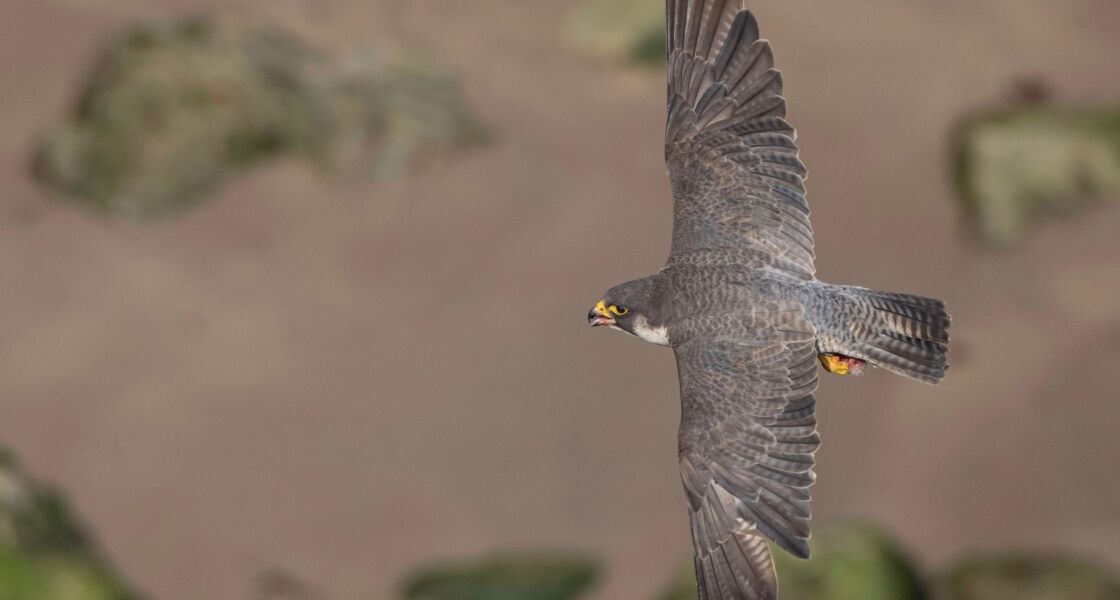
A peregrine falcon folds its wings, tips forward, and drops out of the sky like a thrown stone. In that dive it can top 200 miles per hour, faster than a race car on a straightaway. No other bird moves like it.
That dive has a name. Falconers call it a stoop: a steep, headfirst plunge aimed at another bird flying far below. The peregrine lines up the target, tucks in tight, and falls.
How fast is a peregrine falcon, really?
Biologists have clocked peregrines diving at speeds of over 200 miles per hour. That is the speed of the stoop, the nose-dive, not of ordinary flapping flight. When it levels off and flies straight, the peregrine is still quick, fast enough to rival a running cheetah, but the record-setting numbers come from the plunge.
Here is the part that is easy to miss. The falcon is not just falling. It steers the whole way down, adjusting its wings and tail by tiny amounts to stay locked on a bird that is also trying to escape. It is one of the world’s fastest birds, and it hits its target while both of them are moving.
Built for the dive
A peregrine is not a huge bird. It runs about 13 to 20 inches long from beak to tail, with a wingspan of roughly two and a half to four feet, close to the reach of a grown adult’s arms. Most weigh between one and three and a half pounds, less than a bag of sugar.
The females are the larger ones. In peregrines, the female is noticeably bigger and heavier than the male. Both wear the same sharp uniform: bluish-gray above, pale and finely barred below, and a dark “mustache” stripe running down from each eye like a smudge of war paint.
It hunts other birds in midair
Most of what a peregrine eats, it catches in the air. It is mainly a bird hunter. Starlings, pigeons, blackbirds, jays, shorebirds, and ducks are all fair game, along with the occasional bat.
The usual move is to fly high, spot a bird below, and stoop. At the bottom of the dive the falcon strikes with its feet, knocking the other bird clean out of the sky. It is a hunter built around a single, spectacular trick, and the trick works.
A bird that lives almost everywhere
The peregrine is one of the most widespread birds on Earth. It lives and breeds on every continent except Antarctica, from Greenland to Greece, from Australia to Argentina.
Traditionally it nests on high cliffs, which gives it a long drop to build up speed. But peregrines have figured out that a city is basically a canyon made of concrete. In towns, they nest on the ledges of tall buildings and bridges, and they hunt the pigeons that cities have in such supply.
So a bird that holds a speed record most people only read about may be living a few blocks away, perched on a skyscraper, watching the street below. Cities give the peregrine two things it loves: high ledges that work just like cliffs, and crowds of pigeons to hunt.
That mix of habitats is part of why the peregrine turns up almost anywhere. From tundra to deserts to downtown rooftops, it finds a tall perch, a wide-open view, and birds to chase, and it settles in.
The crash, and the comeback
Not long ago, the peregrine almost vanished from much of the United States. A pesticide called DDT spread through the food chain and into the falcons. It did not kill the adults outright; it made their eggshells too thin, so the eggs broke before they could hatch. Across the middle of the 20th century, peregrines failed to raise young, and their numbers collapsed.
Then the tide turned. In 1972, the U.S. Environmental Protection Agency banned DDT, which made recovery possible. Captive breeding programs raised young falcons and released them into the wild. The birds came back. In 1999, the peregrine falcon was removed from the U.S. Endangered Species List.
Today the peregrine is doing well, including in the very cities where people can watch it. A wild falcon can live up to about 17 years, and young birds are ready to start raising families of their own by the time they are one to three years old.
One of the fastest fliers many of us will ever see shares the air right over our heads.