
Scientists can tell you which storms might make a tornado. They still cannot fully explain how the spin tightens into one.
That is not a joke or a gap in the textbook. The National Severe Storms Laboratory says science does not yet fully explain how a storm’s energy gets focused into a narrow area, perhaps only a hundred yards across. A tornado is one of the most studied things in weather, and it still keeps a secret.
What a Tornado Actually Is
A tornado is a narrow, violently rotating column of air that reaches from a thunderstorm to the ground. Wind is invisible, so you usually see a tornado only when water droplets, dust and debris fill the spinning column and draw its outline. That outline is the funnel.
The thunderstorm overhead is the engine. Forecasters look for four ingredients in the air: moisture, instability (air that wants to rise), lift, and wind shear. The last one is the strangest, and it is where the spin comes from.
Where the Spin Begins
Wind shear means the wind changes speed or direction as you go up. Picture a day when the air near the ground is moving gently from the southwest at 5 mph. Higher up, at 5,000 feet, a faster wind of 25 mph is blowing from the southeast. NSSL uses this very example.
The two layers slide past each other. That makes a long, invisible, sideways-rolling tube of air, a bit like a pencil rolling between your palms.
Then the storm does something clever. Its updraft, the rising column of warm, moist air that feeds a thunderstorm, scoops up the rolling tube and tips it on its end. Now the spin is vertical, and it runs through much of the storm.
The Supercell: A Storm That Spins
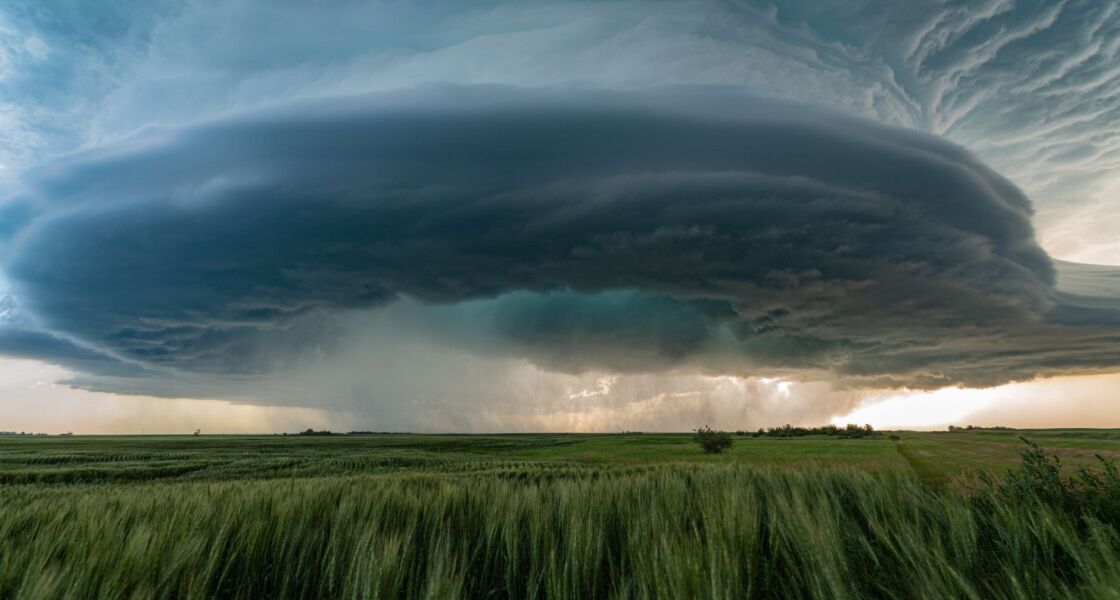
A supercell is a thunderstorm built around that rotating updraft. Inside, the whole updraft is turning.
Most of the time, that is as far as it goes. The storm rumbles, rains and moves on. Why most supercells never make a tornado is an open question that researchers are still chasing.
When a tornado does form, the rotating updraft is fed by warm, moist air at ground level, and somehow the spin reaches the surface and squeezes into a tight, fast column. NSSL notes that there are many ideas about exactly how that last step happens. Nobody has one final answer yet.
Not every tornado needs a supercell. Some come from lines of strong thunderstorms, and nearly 20 percent of all tornadoes are linked to those lines. Others, called landspouts, form under a growing cloud with no rotating updraft at all. Their spin starts near the ground.
How Fast Is Fast?
Tornado winds are hard to measure, because nobody wants to put an instrument in the way. Radar has caught a few astonishing numbers, though. On May 3, 1999, a mobile Doppler radar measured winds of about 300 mph, roughly 100 feet above the ground, in a tornado near Bridge Creek and Moore, Oklahoma. NSSL lists the peak reading as 318 mph.
The tornado itself usually travels much more slowly than the wind inside it. A typical one moves along the ground at about 10 to 20 mph. Some are almost stationary, and some move faster than 60 mph.
Most do not last long. The Storm Prediction Center says most tornadoes last less than 10 minutes, and NSSL puts the average at about five minutes. They are usually a few hundred yards across, although some are more than a quarter mile wide.
Rating a Tornado After the Fact
Here is another twist. Meteorologists mostly do not measure a tornado’s wind. They look at what it did, then work backward.
The Enhanced Fujita Scale, which the National Weather Service began using in 2007, rates tornadoes from EF0 to EF5. Experts study the damage using 28 damage indicators, such as different kinds of buildings and trees. Each indicator has 8 degrees of damage, and each degree points to an estimated wind speed.
The Storm Prediction Center lists the estimated three-second gust ranges:
- EF0: 65 to 85 mph
- EF1: 86 to 110 mph
- EF2: 111 to 135 mph
- EF3: 136 to 165 mph
- EF4: 166 to 200 mph
- EF5: over 200 mph
The scale stops at EF5. There is no EF6.
Where Tornadoes Happen
About 1,200 tornadoes hit the United States in an average year, according to NSSL. Tornadoes have been reported in all fifty states, but they are most common in the central Plains, east of the Rocky Mountains and west of the Appalachians.
One more small detail from NSSL: in the Northern Hemisphere, more tornadoes spin counterclockwise than clockwise. Even a tornado seems to have a favorite direction.
You may have heard of Tornado Alley. NSSL calls it a media nickname for a broad area of relatively high tornado activity. It is not a sharply drawn zone, and violent tornadoes happen outside it too.
The busy season also travels. The threat starts in the Southeast in the cooler months, moves to the southern and central Plains in May and June, and shifts to the northern Plains and Midwest in early summer. Tornadoes can strike at any hour, but most come between 4 and 9 p.m.
Storms have plenty more surprises. Try Does Lightning Strike the Same Place Twice? for another one.
Even with all that science, the last step still belongs to the storm.