
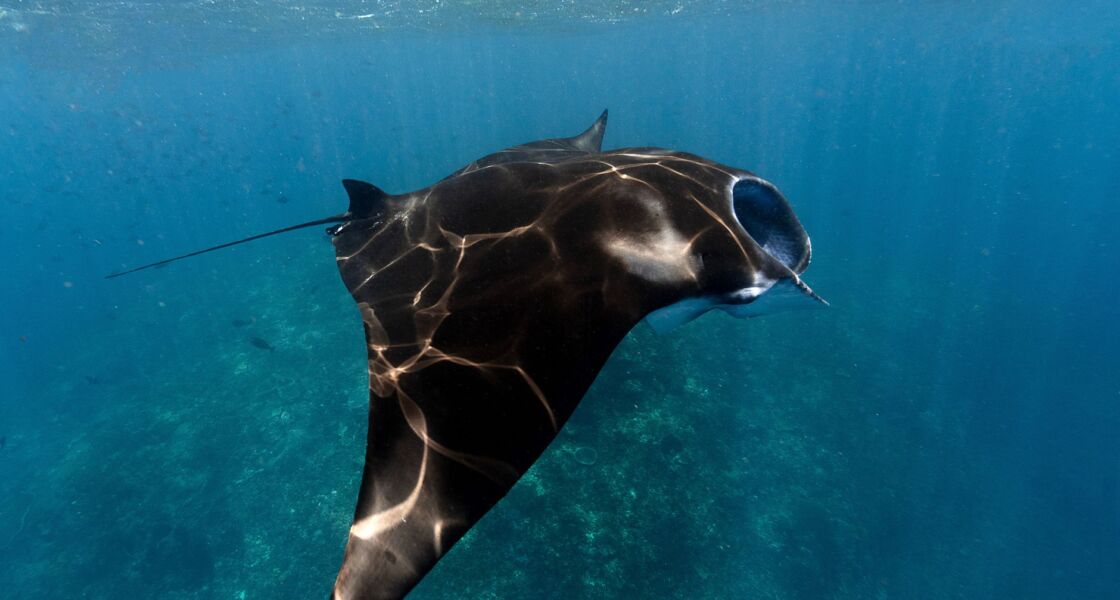
The giant manta ray is the biggest ray in the ocean. Its wings can stretch up to 26 feet from tip to tip, wider than a minivan is long. And yet this gentle glider eats some of the smallest food in the sea.
A Ray Wider Than a Minivan
Picture a flat, diamond-shaped body with two long, pointed “wings.” That is a manta ray. The wings are really its pectoral fins, and the animal flaps them slowly, like a bird flying through water.
There are two species. The giant manta ray, the larger one, can reach a wingspan of up to 26 feet and weigh up to 5,300 pounds, according to NOAA Fisheries. The reef manta ray is smaller, with a wingspan of about 11 feet on average.
For a long time, scientists thought there was only one kind. In 2008, researchers found there were two.
Why It Is Called a Manta
The name comes from Spanish, where “manta” means blanket or cloak. Look at that big, flat body and you can see why.
Mantas have a nickname, too: “devil fish.” It comes from the two horn-shaped fins that stick out in front of the head. Those fins are not scary at all. They have a very useful job, and you are about to meet it.
A Giant That Eats Tiny Food
A manta ray is a filter feeder. It swims with its wide mouth open and lets the ocean flow in. Tiny drifting animals called zooplankton get strained out, a bit like noodles in a colander.
Those two horn-shaped fins are called cephalic lobes. When a manta feeds, it curls them into an “O” shape and uses them like a funnel to channel water toward its mouth. NOAA notes this makes mantas the only vertebrates, animals with backbones, with three paired appendages.
Mantas do have teeth, but Oceana reports they do not use them to eat. The filtering does all the work.
Feeding Chains and Somersaults
When dinner is thick in the water, mantas get creative. NOAA lists barrel rolling, doing somersaults over and over, as one of their feeding strategies. National Geographic adds that it helps a manta stay in a single spot that is packed with krill, a small shrimp-like food. Mantas can also form feeding chains with each other.
National Geographic describes a feeding chain as a line of mantas following each other in a circle with mouths open. The circle makes a cyclone effect that traps food in a spiral.
It is teamwork, with no one planning it. Everyone just follows the one in front.
One of the Bigger Brains for Its Size
Here is a surprise. National Geographic says manta rays have the largest brain-to-size ratio of any cold-blooded fish. In other words, for the size of its body, a manta has an unusually big brain.
The same page says studies suggest mantas may recognize themselves in a mirror. That is a skill also seen in dolphins, primates and elephants. The page also says studies show mantas can create mental maps of their surroundings, using smell and sight cues. That points to a highly developed long-term memory.
Nobody can ask a manta ray what it is thinking, so scientists keep studying how much it understands.
A Spa Day on the Reef
Mantas also visit cleaning stations. These are spots on a coral reef where smaller fish clean larger animals. A manta holds still for several minutes while the cleaners pick off parasites and dead skin.
National Geographic says many individual mantas return to the same station over and over.
A Belly Pattern Like a Fingerprint
Look at a manta from underneath and you will see spots. Each ray has its own pattern, and NOAA says scientists use it to tell individuals apart. Oceana compares the pattern to fingerprints.
Mantas also come in two color types. Some have a mostly black back with a white belly. Others are almost entirely black on both sides.
Slow Growing, Deep Diving
Manta rays grow slowly. NOAA says a female typically gives birth to just one pup every two to three years, after a pregnancy that is thought to last around a year.
Newborns look like smaller versions of adults. National Geographic notes that they can survive without any parental care right away, and that a mother usually has one pup, sometimes two.
Mantas can live a long time, too. They have been reported to live at least 45 years. NOAA says that with so few pups, manta populations are slow to recover from losses.
They are also better divers than you might expect. NOAA says tagged giant mantas have dived 200 to 450 meters (about 650 to 1,500 feet) and can go deeper than 1,000 meters. That is more than half a mile down.
Where They Live
Giant manta rays are found worldwide in tropical, subtropical and temperate waters. NOAA says they are often seen offshore and along productive coasts. In US waters, NOAA lists regions from New England and the Mid-Atlantic to the Southeast, the West Coast and the Pacific Islands. NOAA Fisheries listed the giant manta ray as threatened under the Endangered Species Act in 2018.
A manta can be hard to forget if you ever see one. Imagine a shadow as wide as a boat sliding past, silent and unhurried, on its way to a snack of plankton.